

216
S. Sánchez-Carrillo et al.
15.7 Organic Matter Quality Changes and
Effects on Microbial Responses
Significant changes in wetland plant community composition affect the litter quality and hence the microbial community response (Corstanje and Reddy 2006). Presence or
absence of plants and plant species richness influence nutrient retention and enzyme activities in constructed wetlands
(Zhang et al. 2010). Litter quality has been significantly correlated with the microbial response measures. Factors such
as the lignocellulose composition (DeBusk and Reddy 1998)
and the nutrient content of the plant litter material (KögelKnaber 2002) all determine the response of the microbial
communities in concert with a direct response to enhanced
levels of nutrients. However, there are still no studies jointly
evaluating effects of eutrophication, changes in litter quality
and effects on microbial transformations. Although the above
mentioned lignocelluse index (LCI) can be used as an qualitative indicator of the organic matter quality, the proportion
of aerobic basal respiration (CO 2 production) to MBC, i.e.,
metabolic coefficient qCO 2 (Anderson and Domsch 1990)
can be considered as a better sensitive response variable to
soil organic matter quality (Kaiser and Heinemeyer 1993;
Corstanje and Reddy 2006). The suggestion is that large
qCO 2 coefficients are an indication of disturbed ecosystems
(Dilly et al. 1997), in which microbial communities respire
more per unit biomass than in stable systems. The loss in the
nutrient cycling efficiency (i.e., perturbation) then appears
when increased concentrations of microbial biomass result
in a decrease of the microbial metabolic activity to microbial biomass ratio (Wardle 1993). Similarly, PMP and PMN,
which are assumed to be primarily microbially mediated
(Bridgham et al. 1998), reflects potential P and N-turnover
rates at a given site and is a function of the biodegradability
of the litter organic P and N (see Sect. 4.2).
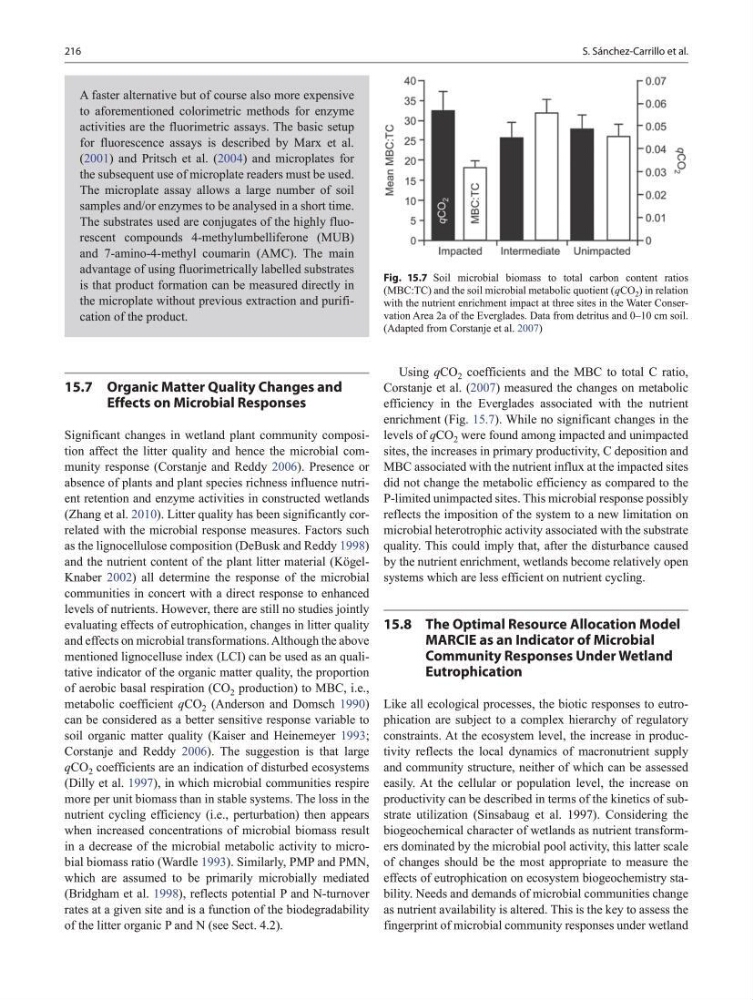
Using qCO 2 coefficients and the MBC to total C ratio,
Corstanje et al. (2007) measured the changes on metabolic
efficiency in the Everglades associated with the nutrient
enrichment (Fig. 15.7). While no significant changes in the
levels of qCO 2 were found among impacted and unimpacted
sites, the increases in primary productivity, C deposition and
MBC associated with the nutrient influx at the impacted sites
did not change the metabolic efficiency as compared to the
P-limited unimpacted sites. This microbial response possibly
reflects the imposition of the system to a new limitation on
microbial heterotrophic activity associated with the substrate
quality. This could imply that, after the disturbance caused
by the nutrient enrichment, wetlands become relatively open
systems which are less efficient on nutrient cycling.
15.8 The Optimal Resource Allocation Model
MARCIE as an Indicator of Microbial
Community Responses Under Wetland
Eutrophication
Like all ecological processes, the biotic responses to eutrophication are subject to a complex hierarchy of regulatory
constraints. At the ecosystem level, the increase in productivity reflects the local dynamics of macronutrient supply
and community structure, neither of which can be assessed
easily. At the cellular or population level, the increase on
productivity can be described in terms of the kinetics of substrate utilization (Sinsabaug et al. 1997). Considering the
biogeochemical character of wetlands as nutrient transformers dominated by the microbial pool activity, this latter scale
of changes should be the most appropriate to measure the
effects of eutrophication on ecosystem biogeochemistry stability. Needs and demands of microbial communities change
as nutrient availability is altered. This is the key to assess the
fingerprint of microbial community responses under wetland
Fig. 15.7 Soil microbial biomass to total carbon content ratios
(MBC:TC) and the soil microbial metabolic quotient ( qCO 2 ) in relation
with the nutrient enrichment impact at three sites in the Water Conservation Area 2a of the Everglades. Data from detritus and 0–10 cm soil.
(Adapted from Corstanje et al. 2007)
A faster alternative but of course also more expensive
to aforementioned colorimetric methods for enzyme
activities are the fluorimetric assays. The basic setup
for fluorescence assays is described by Marx et al.
(2001) and Pritsch et al. (2004) and microplates for
the subsequent use of microplate readers must be used.
The microplate assay allows a large number of soil
samples and/or enzymes to be analysed in a short time.
The substrates used are conjugates of the highly fluorescent compounds 4-methylumbelliferone (MUB)
and 7-amino-4-methyl coumarin (AMC). The main
advantage of using fluorimetrically labelled substrates
is that product formation can be measured directly in
the microplate without previous extraction and purification of the product.
S. Sánchez-Carrillo et al.
15.7 Organic Matter Quality Changes and
Effects on Microbial Responses
Significant changes in wetland plant community composition affect the litter quality and hence the microbial community response (Corstanje and Reddy 2006). Presence or
absence of plants and plant species richness influence nutrient retention and enzyme activities in constructed wetlands
(Zhang et al. 2010). Litter quality has been significantly correlated with the microbial response measures. Factors such
as the lignocellulose composition (DeBusk and Reddy 1998)
and the nutrient content of the plant litter material (KögelKnaber 2002) all determine the response of the microbial
communities in concert with a direct response to enhanced
levels of nutrients. However, there are still no studies jointly
evaluating effects of eutrophication, changes in litter quality
and effects on microbial transformations. Although the above
mentioned lignocelluse index (LCI) can be used as an qualitative indicator of the organic matter quality, the proportion
of aerobic basal respiration (CO 2 production) to MBC, i.e.,
metabolic coefficient qCO 2 (Anderson and Domsch 1990)
can be considered as a better sensitive response variable to
soil organic matter quality (Kaiser and Heinemeyer 1993;
Corstanje and Reddy 2006). The suggestion is that large
qCO 2 coefficients are an indication of disturbed ecosystems
(Dilly et al. 1997), in which microbial communities respire
more per unit biomass than in stable systems. The loss in the
nutrient cycling efficiency (i.e., perturbation) then appears
when increased concentrations of microbial biomass result
in a decrease of the microbial metabolic activity to microbial biomass ratio (Wardle 1993). Similarly, PMP and PMN,
which are assumed to be primarily microbially mediated
(Bridgham et al. 1998), reflects potential P and N-turnover
rates at a given site and is a function of the biodegradability
of the litter organic P and N (see Sect. 4.2).
Using qCO 2 coefficients and the MBC to total C ratio,
Corstanje et al. (2007) measured the changes on metabolic
efficiency in the Everglades associated with the nutrient
enrichment (Fig. 15.7). While no significant changes in the
levels of qCO 2 were found among impacted and unimpacted
sites, the increases in primary productivity, C deposition and
MBC associated with the nutrient influx at the impacted sites
did not change the metabolic efficiency as compared to the
P-limited unimpacted sites. This microbial response possibly
reflects the imposition of the system to a new limitation on
microbial heterotrophic activity associated with the substrate
quality. This could imply that, after the disturbance caused
by the nutrient enrichment, wetlands become relatively open
systems which are less efficient on nutrient cycling.
15.8 The Optimal Resource Allocation Model
MARCIE as an Indicator of Microbial
Community Responses Under Wetland
Eutrophication
Like all ecological processes, the biotic responses to eutrophication are subject to a complex hierarchy of regulatory
constraints. At the ecosystem level, the increase in productivity reflects the local dynamics of macronutrient supply
and community structure, neither of which can be assessed
easily. At the cellular or population level, the increase on
productivity can be described in terms of the kinetics of substrate utilization (Sinsabaug et al. 1997). Considering the
biogeochemical character of wetlands as nutrient transformers dominated by the microbial pool activity, this latter scale
of changes should be the most appropriate to measure the
effects of eutrophication on ecosystem biogeochemistry stability. Needs and demands of microbial communities change
as nutrient availability is altered. This is the key to assess the
fingerprint of microbial community responses under wetland
Fig. 15.7 Soil microbial biomass to total carbon content ratios
(MBC:TC) and the soil microbial metabolic quotient ( qCO 2 ) in relation
with the nutrient enrichment impact at three sites in the Water Conservation Area 2a of the Everglades. Data from detritus and 0–10 cm soil.
(Adapted from Corstanje et al. 2007)
A faster alternative but of course also more expensive
to aforementioned colorimetric methods for enzyme
activities are the fluorimetric assays. The basic setup
for fluorescence assays is described by Marx et al.
(2001) and Pritsch et al. (2004) and microplates for
the subsequent use of microplate readers must be used.
The microplate assay allows a large number of soil
samples and/or enzymes to be analysed in a short time.
The substrates used are conjugates of the highly fluorescent compounds 4-methylumbelliferone (MUB)
and 7-amino-4-methyl coumarin (AMC). The main
advantage of using fluorimetrically labelled substrates
is that product formation can be measured directly in
the microplate without previous extraction and purification of the product.