

192
D. Liu et al.
has been carried out on the phytoplankton assemblages in
ICOLLs. Phytoplankton biomass in ICOLLs can be decreased by the dilution of seawater when the lake entrance
is open to the sea, high grazing pressure and even nutrient
competition with seagrass, macroalgae, or saltmarsh. Consequently, these factors may also reduce the usefulness of
phytoplankton as an indicator of the “environmental health”
of these systems (Perissinotto et al. 2002; Cummins et al.
2004; Gobler et al. 2005). A comparative study is therefore
required to assess the usefulness of phytoplankton as an indicator of environmental change. In this study, seven ICOLLs
in southern NSW were chosen to explore the relationship between a suite of environmental factors and the phytoplankton
assemblages. Phytoplankton species diversity, biomass, and
seasonal patterns were studied and the possible role of phytoplankton as an indicator of water quality was evaluated in
a range of ICOLLs characterized by different physical and
chemical conditions.
14.2 Materials and Methods
14.2.1 Studied Estuaries and Sampling
Methods
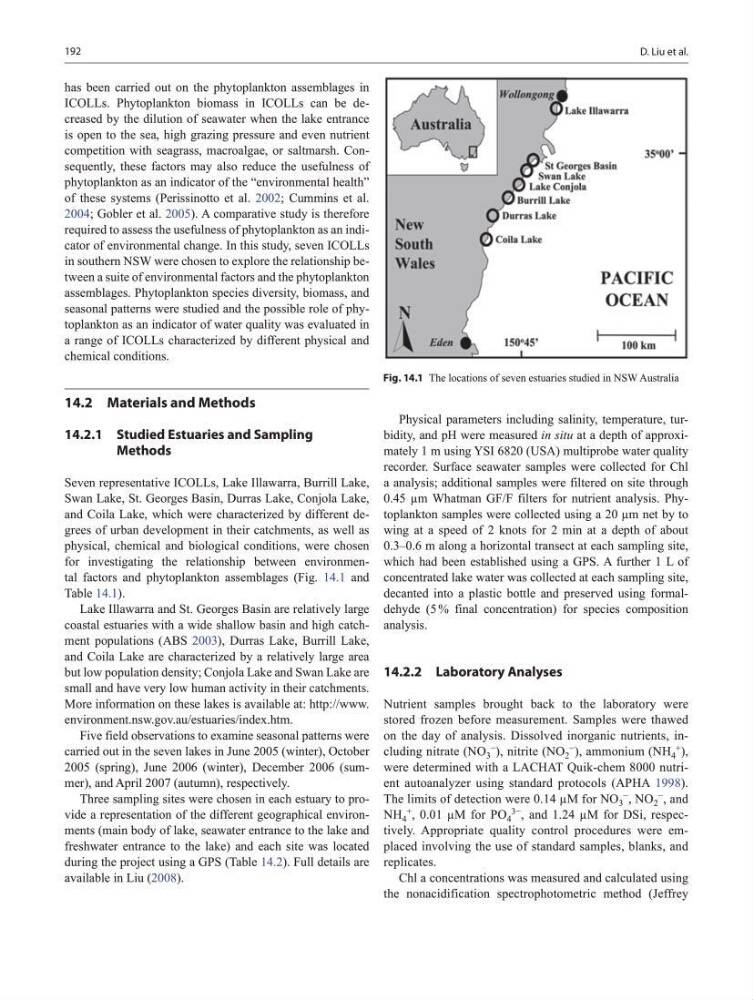
Seven representative ICOLLs, Lake Illawarra, Burrill Lake,
Swan Lake, St. Georges Basin, Durras Lake, Conjola Lake,
and Coila Lake, which were characterized by different degrees of urban development in their catchments, as well as
physical, chemical and biological conditions, were chosen
for investigating the relationship between environmental factors and phytoplankton assemblages (Fig. 14.1 and
Table 14.1).
Lake Illawarra and St. Georges Basin are relatively large
coastal estuaries with a wide shallow basin and high catchment populations (ABS 2003), Durras Lake, Burrill Lake,
and Coila Lake are characterized by a relatively large area
but low population density; Conjola Lake and Swan Lake are
small and have very low human activity in their catchments.
More information on these lakes is available at: http://www.
environment.nsw.gov.au/estuaries/index.htm.
Five field observations to examine seasonal patterns were
carried out in the seven lakes in June 2005 (winter), October
2005 (spring), June 2006 (winter), December 2006 (summer), and April 2007 (autumn), respectively.
Three sampling sites were chosen in each estuary to provide a representation of the different geographical environments (main body of lake, seawater entrance to the lake and
freshwater entrance to the lake) and each site was located
during the project using a GPS (Table 14.2). Full details are
available in Liu (2008).
Physical parameters including salinity, temperature, turbidity, and pH were measured in situ at a depth of approximately 1 m using YSI 6820 (USA) multiprobe water quality
recorder. Surface seawater samples were collected for Chl
a analysis; additional samples were filtered on site through
0.45 µm Whatman GF/F filters for nutrient analysis. Phytoplankton samples were collected using a 20 µm net by to
wing at a speed of 2 knots for 2 min at a depth of about
0.3–0.6 m along a horizontal transect at each sampling site,
which had been established using a GPS. A further 1 L of
concentrated lake water was collected at each sampling site,
decanted into a plastic bottle and preserved using formaldehyde (5 % final concentration) for species composition
analysis.
14.2.2 Laboratory Analyses
Nutrient samples brought back to the laboratory were
stored frozen before measurement. Samples were thawed
on the day of analysis. Dissolved inorganic nutrients, including nitrate (NO 3
− ), nitrite (NO 2
− ), ammonium (NH 4
+ ),
were determined with a LACHAT Quik-chem 8000 nutrient autoanalyzer using standard protocols (APHA 1998).
The limits of detection were 0.14 µM for NO 3
− , NO 2
− , and
NH 4
+ , 0.01 µM for PO 4
3− , and 1.24 µM for DSi, respectively. Appropriate quality control procedures were emplaced involving the use of standard samples, blanks, and
replicates.
Chl a concentrations was measured and calculated using
the nonacidification spectrophotometric method (Jeffrey
Fig. 14.1 The locations of seven estuaries studied in NSW Australia
D. Liu et al.
has been carried out on the phytoplankton assemblages in
ICOLLs. Phytoplankton biomass in ICOLLs can be decreased by the dilution of seawater when the lake entrance
is open to the sea, high grazing pressure and even nutrient
competition with seagrass, macroalgae, or saltmarsh. Consequently, these factors may also reduce the usefulness of
phytoplankton as an indicator of the “environmental health”
of these systems (Perissinotto et al. 2002; Cummins et al.
2004; Gobler et al. 2005). A comparative study is therefore
required to assess the usefulness of phytoplankton as an indicator of environmental change. In this study, seven ICOLLs
in southern NSW were chosen to explore the relationship between a suite of environmental factors and the phytoplankton
assemblages. Phytoplankton species diversity, biomass, and
seasonal patterns were studied and the possible role of phytoplankton as an indicator of water quality was evaluated in
a range of ICOLLs characterized by different physical and
chemical conditions.
14.2 Materials and Methods
14.2.1 Studied Estuaries and Sampling
Methods
Seven representative ICOLLs, Lake Illawarra, Burrill Lake,
Swan Lake, St. Georges Basin, Durras Lake, Conjola Lake,
and Coila Lake, which were characterized by different degrees of urban development in their catchments, as well as
physical, chemical and biological conditions, were chosen
for investigating the relationship between environmental factors and phytoplankton assemblages (Fig. 14.1 and
Table 14.1).
Lake Illawarra and St. Georges Basin are relatively large
coastal estuaries with a wide shallow basin and high catchment populations (ABS 2003), Durras Lake, Burrill Lake,
and Coila Lake are characterized by a relatively large area
but low population density; Conjola Lake and Swan Lake are
small and have very low human activity in their catchments.
More information on these lakes is available at: http://www.
environment.nsw.gov.au/estuaries/index.htm.
Five field observations to examine seasonal patterns were
carried out in the seven lakes in June 2005 (winter), October
2005 (spring), June 2006 (winter), December 2006 (summer), and April 2007 (autumn), respectively.
Three sampling sites were chosen in each estuary to provide a representation of the different geographical environments (main body of lake, seawater entrance to the lake and
freshwater entrance to the lake) and each site was located
during the project using a GPS (Table 14.2). Full details are
available in Liu (2008).
Physical parameters including salinity, temperature, turbidity, and pH were measured in situ at a depth of approximately 1 m using YSI 6820 (USA) multiprobe water quality
recorder. Surface seawater samples were collected for Chl
a analysis; additional samples were filtered on site through
0.45 µm Whatman GF/F filters for nutrient analysis. Phytoplankton samples were collected using a 20 µm net by to
wing at a speed of 2 knots for 2 min at a depth of about
0.3–0.6 m along a horizontal transect at each sampling site,
which had been established using a GPS. A further 1 L of
concentrated lake water was collected at each sampling site,
decanted into a plastic bottle and preserved using formaldehyde (5 % final concentration) for species composition
analysis.
14.2.2 Laboratory Analyses
Nutrient samples brought back to the laboratory were
stored frozen before measurement. Samples were thawed
on the day of analysis. Dissolved inorganic nutrients, including nitrate (NO 3
− ), nitrite (NO 2
− ), ammonium (NH 4
+ ),
were determined with a LACHAT Quik-chem 8000 nutrient autoanalyzer using standard protocols (APHA 1998).
The limits of detection were 0.14 µM for NO 3
− , NO 2
− , and
NH 4
+ , 0.01 µM for PO 4
3− , and 1.24 µM for DSi, respectively. Appropriate quality control procedures were emplaced involving the use of standard samples, blanks, and
replicates.
Chl a concentrations was measured and calculated using
the nonacidification spectrophotometric method (Jeffrey
Fig. 14.1 The locations of seven estuaries studied in NSW Australia