

185
13 Estimating Fish Production in the Itaipu Reservoir (Brazil): The Relationship Between Fish Trophic Guilds, Limnology …
toplankton, suggesting that the nutrient may constitute an
important source for algae.
Fishes release phosphorus in the water directly through
metabolic processes (excretion) and, indirectly owing to
their habit of turning the sediment in search of food, making nutrients available in the water column (Persson 1997;
Pereira and Ribeiro Filho 2004). Starling (1998) stresses that
the importance of fish in maintaining the concentration of
phosphorus of the water can be greater than that of allochthonous sources, primarily as a source of nutrients in the pelagic region. Brabrand et al. (1990) point out that the soluble
phosphorus is the main form of phosphorus excreted by fish,
and Starling (1998) demonstrated that tilapia are the fish that
have the highest rate of excretion of soluble phosphorus in
Lake Paranoá.
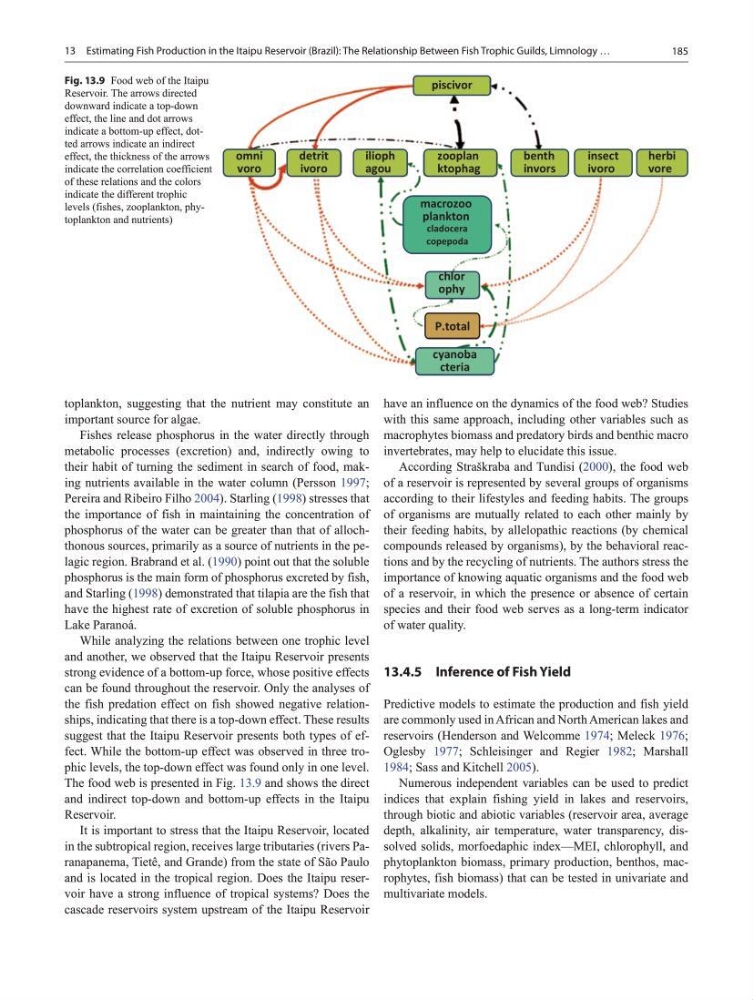
While analyzing the relations between one trophic level
and another, we observed that the Itaipu Reservoir presents
strong evidence of a bottom-up force, whose positive effects
can be found throughout the reservoir. Only the analyses of
the fish predation effect on fish showed negative relationships, indicating that there is a top-down effect. These results
suggest that the Itaipu Reservoir presents both types of effect. While the bottom-up effect was observed in three trophic levels, the top-down effect was found only in one level.
The food web is presented in Fig. 13.9 and shows the direct
and indirect top-down and bottom-up effects in the Itaipu
Reservoir.
It is important to stress that the Itaipu Reservoir, located
in the subtropical region, receives large tributaries (rivers Paranapanema, Tietê, and Grande) from the state of São Paulo
and is located in the tropical region. Does the Itaipu reservoir have a strong influence of tropical systems? Does the
cascade reservoirs system upstream of the Itaipu Reservoir
have an influence on the dynamics of the food web? Studies
with this same approach, including other variables such as
macrophytes biomass and predatory birds and benthic macro
invertebrates, may help to elucidate this issue.
According Straškraba and Tundisi (2000), the food web
of a reservoir is represented by several groups of organisms
according to their lifestyles and feeding habits. The groups
of organisms are mutually related to each other mainly by
their feeding habits, by allelopathic reactions (by chemical
compounds released by organisms), by the behavioral reactions and by the recycling of nutrients. The authors stress the
importance of knowing aquatic organisms and the food web
of a reservoir, in which the presence or absence of certain
species and their food web serves as a long-term indicator
of water quality.
13.4.5 Inference of Fish Yield
Predictive models to estimate the production and fish yield
are commonly used in African and North American lakes and
reservoirs (Henderson and Welcomme 1974; Meleck 1976;
Oglesby 1977; Schleisinger and Regier 1982; Marshall
1984; Sass and Kitchell 2005).
Numerous independent variables can be used to predict
indices that explain fishing yield in lakes and reservoirs,
through biotic and abiotic variables (reservoir area, average
depth, alkalinity, air temperature, water transparency, dissolved solids, morfoedaphic index—MEI, chlorophyll, and
phytoplankton biomass, primary production, benthos, macrophytes, fish biomass) that can be tested in univariate and
multivariate models.
Fig. 13.9 Food web of the Itaipu
Reservoir. The arrows directed
downward indicate a top-down
effect, the line and dot arrows
indicate a bottom-up effect, dotted arrows indicate an indirect
effect, the thickness of the arrows
indicate the correlation coefficient
of these relations and the colors
indicate the different trophic
levels (fishes, zooplankton, phytoplankton and nutrients)
macrozoo
plankton
cladocera
copepoda
chlor
ophy
P.total
cyanoba
cteria
omni
voro
detrit
ivoro
ilioph
agou
zooplan
ktophag
piscivor
benth
invors
insect
ivoro
herbi
vore
13 Estimating Fish Production in the Itaipu Reservoir (Brazil): The Relationship Between Fish Trophic Guilds, Limnology …
toplankton, suggesting that the nutrient may constitute an
important source for algae.
Fishes release phosphorus in the water directly through
metabolic processes (excretion) and, indirectly owing to
their habit of turning the sediment in search of food, making nutrients available in the water column (Persson 1997;
Pereira and Ribeiro Filho 2004). Starling (1998) stresses that
the importance of fish in maintaining the concentration of
phosphorus of the water can be greater than that of allochthonous sources, primarily as a source of nutrients in the pelagic region. Brabrand et al. (1990) point out that the soluble
phosphorus is the main form of phosphorus excreted by fish,
and Starling (1998) demonstrated that tilapia are the fish that
have the highest rate of excretion of soluble phosphorus in
Lake Paranoá.
While analyzing the relations between one trophic level
and another, we observed that the Itaipu Reservoir presents
strong evidence of a bottom-up force, whose positive effects
can be found throughout the reservoir. Only the analyses of
the fish predation effect on fish showed negative relationships, indicating that there is a top-down effect. These results
suggest that the Itaipu Reservoir presents both types of effect. While the bottom-up effect was observed in three trophic levels, the top-down effect was found only in one level.
The food web is presented in Fig. 13.9 and shows the direct
and indirect top-down and bottom-up effects in the Itaipu
Reservoir.
It is important to stress that the Itaipu Reservoir, located
in the subtropical region, receives large tributaries (rivers Paranapanema, Tietê, and Grande) from the state of São Paulo
and is located in the tropical region. Does the Itaipu reservoir have a strong influence of tropical systems? Does the
cascade reservoirs system upstream of the Itaipu Reservoir
have an influence on the dynamics of the food web? Studies
with this same approach, including other variables such as
macrophytes biomass and predatory birds and benthic macro
invertebrates, may help to elucidate this issue.
According Straškraba and Tundisi (2000), the food web
of a reservoir is represented by several groups of organisms
according to their lifestyles and feeding habits. The groups
of organisms are mutually related to each other mainly by
their feeding habits, by allelopathic reactions (by chemical
compounds released by organisms), by the behavioral reactions and by the recycling of nutrients. The authors stress the
importance of knowing aquatic organisms and the food web
of a reservoir, in which the presence or absence of certain
species and their food web serves as a long-term indicator
of water quality.
13.4.5 Inference of Fish Yield
Predictive models to estimate the production and fish yield
are commonly used in African and North American lakes and
reservoirs (Henderson and Welcomme 1974; Meleck 1976;
Oglesby 1977; Schleisinger and Regier 1982; Marshall
1984; Sass and Kitchell 2005).
Numerous independent variables can be used to predict
indices that explain fishing yield in lakes and reservoirs,
through biotic and abiotic variables (reservoir area, average
depth, alkalinity, air temperature, water transparency, dissolved solids, morfoedaphic index—MEI, chlorophyll, and
phytoplankton biomass, primary production, benthos, macrophytes, fish biomass) that can be tested in univariate and
multivariate models.
Fig. 13.9 Food web of the Itaipu
Reservoir. The arrows directed
downward indicate a top-down
effect, the line and dot arrows
indicate a bottom-up effect, dotted arrows indicate an indirect
effect, the thickness of the arrows
indicate the correlation coefficient
of these relations and the colors
indicate the different trophic
levels (fishes, zooplankton, phytoplankton and nutrients)
macrozoo
plankton
cladocera
copepoda
chlor
ophy
P.total
cyanoba
cteria
omni
voro
detrit
ivoro
ilioph
agou
zooplan
ktophag
piscivor
benth
invors
insect
ivoro
herbi
vore