

2
M. N. Khan and F. Mohammad
Eutrophication of water bodies is occurs due to overenrichment by nutrients, principally phosphorus (Schindler
1977), followed by uncontrolled growth of primary producers and episodes of oxygen depletion owing to decomposition of algal organic matter. Excess phosphorus inputs to
water bodies usually come from two types of nutrient sources, point sources such as sewage, industrial discharges, and
nonpoint sources such as runoff from agriculture, construction sites, and urban areas. Nonpoint sources of nutrients
have replaced point sources as the driver of eutrophication in
many regions (Carpenter et al. 1998). An important driver of
nonpoint nutrient input is excessive application of fertilizer
or manure, which causes phosphorus to accumulate in soils
(Bennett et al. 2001). Phosphorus-rich soils are washed into
lakes, where some of the phosphorus dissolves and stimulates growth of phytoplankton and aquatic plants.
Prevailing eutrophication by anthropogenic nutrient inputs is a relatively recent environmental problem. Intensive fertilization of agricultural soils and associated nonpoint inputs of phosphorus increased through the middle of
the twentieth century (Carpenter et al. 1998; Bennett et al.
2001). It could take 1,000 years or more to recover from eutrophication caused by agricultural overenrichment of soils
(Carpenter 2005).
1.2 Causes of Eutrophication
There are a number of sources of nutrients causing eutrophication of water bodies. All activities in the entire drainage
area of a lake or reservoir are reflected directly or indirectly in the water quality of water bodies. A lake or reservoir
may, however, be naturally eutrophied when situated in a
fertile area with naturally nutrient-enriched soils. In many
lakes and reservoirs wastewater is the main source since untreated wastewater or wastewater treated only by a conventional mechanical–biological methods still contains nitrogen
(25–40 mg/l) and phosphorus (6–10 mg/l). In fact, agriculture (including livestock agriculture) is the largest source
of nonpoint water pollution. Drainage water from agricultural land contains phosphorus and nitrogen. It usually has
much more nitrogen because phosphorus is usually bound
to soil components. Extensive use of fertilizers results in
significant concentrations of nutrients, particularly nitrogen,
in agricultural runoff. If eroded soil reaches the water bodies, both phosphorus and the nitrogen in the soil contribute
to eutrophication. Erosion is often caused by deforestation
which also results from unwise planning and management
of the resource.
Nitrates, because of their water-soluble nature, move
readily with surface runoff into rivers or with water percolating through the soil profile into the groundwater below. A
1998 assessment of nonpoint sources of N and P to waters in
the USA (conducted by the Ecological Society of America)
determined that only about 18 % of the nitrogen that is applied to fields as fertilizers leaves the fields in the form of
produce and the remaining 82 % is left behind as residue or
in soils, where it either accumulates, erodes with the soil
(often to surface waters), leaches to groundwater, or volatilizes into the atmosphere.
Unlike nitrate, however, phosphate is not water soluble,
so it moves only with soil movement as it adheres to soil
particles. When it erodes on soils from agricultural fields,
it is essentially nonrecoverable, washing into sediments in
oceans. The global P budget concludes that P is accumulating in the world’s soils (that is, inputs, largely from fertilizers, animal feeds, and animal wastes, are greater than removals in harvested crops and meat). The result of this imbalance
Population growth
Agricultural extension
Increased fertilizer consumption
Land-use transformation
Livestock intensification
Fossil fuel and energy consumption
Hypertrophic
Eutrophic
Mesotrophic
Oligotrophic
Nutrient
enrichment of
water bodies
Atmospheric emissions
Nutrient cycling
Residential runoff
Macrophyte, Algal
and Cyanobacterial
growth
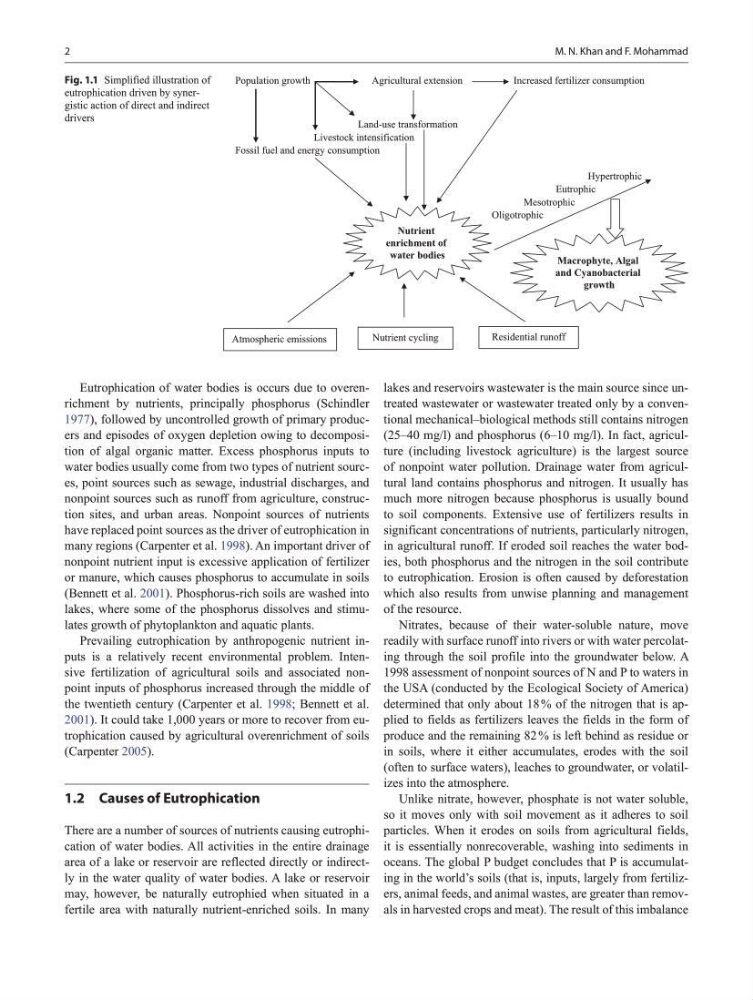
Fig. 1.1 Simplified illustration of
eutrophication driven by synergistic action of direct and indirect
drivers
M. N. Khan and F. Mohammad
Eutrophication of water bodies is occurs due to overenrichment by nutrients, principally phosphorus (Schindler
1977), followed by uncontrolled growth of primary producers and episodes of oxygen depletion owing to decomposition of algal organic matter. Excess phosphorus inputs to
water bodies usually come from two types of nutrient sources, point sources such as sewage, industrial discharges, and
nonpoint sources such as runoff from agriculture, construction sites, and urban areas. Nonpoint sources of nutrients
have replaced point sources as the driver of eutrophication in
many regions (Carpenter et al. 1998). An important driver of
nonpoint nutrient input is excessive application of fertilizer
or manure, which causes phosphorus to accumulate in soils
(Bennett et al. 2001). Phosphorus-rich soils are washed into
lakes, where some of the phosphorus dissolves and stimulates growth of phytoplankton and aquatic plants.
Prevailing eutrophication by anthropogenic nutrient inputs is a relatively recent environmental problem. Intensive fertilization of agricultural soils and associated nonpoint inputs of phosphorus increased through the middle of
the twentieth century (Carpenter et al. 1998; Bennett et al.
2001). It could take 1,000 years or more to recover from eutrophication caused by agricultural overenrichment of soils
(Carpenter 2005).
1.2 Causes of Eutrophication
There are a number of sources of nutrients causing eutrophication of water bodies. All activities in the entire drainage
area of a lake or reservoir are reflected directly or indirectly in the water quality of water bodies. A lake or reservoir
may, however, be naturally eutrophied when situated in a
fertile area with naturally nutrient-enriched soils. In many
lakes and reservoirs wastewater is the main source since untreated wastewater or wastewater treated only by a conventional mechanical–biological methods still contains nitrogen
(25–40 mg/l) and phosphorus (6–10 mg/l). In fact, agriculture (including livestock agriculture) is the largest source
of nonpoint water pollution. Drainage water from agricultural land contains phosphorus and nitrogen. It usually has
much more nitrogen because phosphorus is usually bound
to soil components. Extensive use of fertilizers results in
significant concentrations of nutrients, particularly nitrogen,
in agricultural runoff. If eroded soil reaches the water bodies, both phosphorus and the nitrogen in the soil contribute
to eutrophication. Erosion is often caused by deforestation
which also results from unwise planning and management
of the resource.
Nitrates, because of their water-soluble nature, move
readily with surface runoff into rivers or with water percolating through the soil profile into the groundwater below. A
1998 assessment of nonpoint sources of N and P to waters in
the USA (conducted by the Ecological Society of America)
determined that only about 18 % of the nitrogen that is applied to fields as fertilizers leaves the fields in the form of
produce and the remaining 82 % is left behind as residue or
in soils, where it either accumulates, erodes with the soil
(often to surface waters), leaches to groundwater, or volatilizes into the atmosphere.
Unlike nitrate, however, phosphate is not water soluble,
so it moves only with soil movement as it adheres to soil
particles. When it erodes on soils from agricultural fields,
it is essentially nonrecoverable, washing into sediments in
oceans. The global P budget concludes that P is accumulating in the world’s soils (that is, inputs, largely from fertilizers, animal feeds, and animal wastes, are greater than removals in harvested crops and meat). The result of this imbalance
Population growth
Agricultural extension
Increased fertilizer consumption
Land-use transformation
Livestock intensification
Fossil fuel and energy consumption
Hypertrophic
Eutrophic
Mesotrophic
Oligotrophic
Nutrient
enrichment of
water bodies
Atmospheric emissions
Nutrient cycling
Residential runoff
Macrophyte, Algal
and Cyanobacterial
growth
Fig. 1.1 Simplified illustration of
eutrophication driven by synergistic action of direct and indirect
drivers