

90
absorbed radiation. The photosynthesis-irradiance parameters should preferably be
wavelength-dependent. Therefore, not only chlorophyll a light absorption is of importance,
but also that of all other pigments absorbing in the wavelength range of photosynthetic action
(400-700 nm). An important additional source of variability in underwater light absorption is
360
428
START
o
ChI ~
009
fucaxanthin
049
retention time, min
Chl.g
066
Chl.a
~
STOP
30
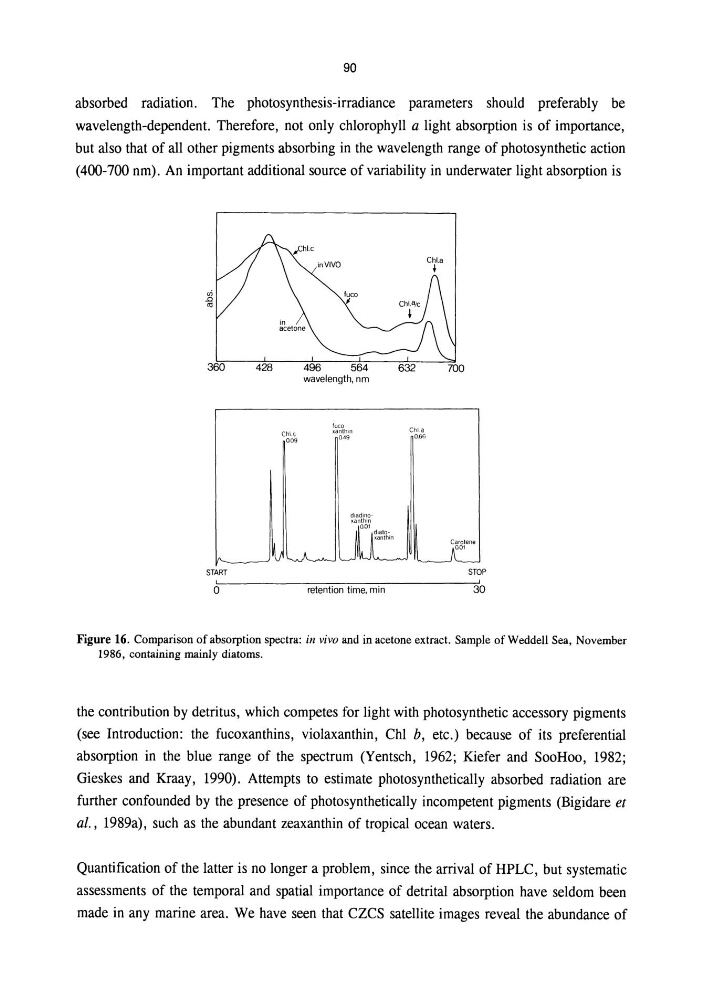
Figure 16. Comparison of absorption spectra: in vivo and in acetone extract. Sample of Weddell Sea, November
1986, containing mainly diatoms.
the contribution by detritus, which competes for light with photosynthetic accessory pigments
(see Introduction: the fucoxanthins, violaxanthin, ChI b, etc.) because of its preferential
absorption in the blue range of the spectrum (Yentsch, 1962; Kiefer and SooHoo, 1982;
Gieskes and Kraay, 1990). Attempts to estimate photosynthetically absorbed radiation are
further confounded by the presence of photosynthetically incompetent pigments (Bigidare et
al., 1989a), such as the abundant zeaxanthin of tropical ocean waters.
Quantification of the latter is no longer a problem, since the arrival of HPLC, but systematic
assessments of the temporal and spatial importance of detrital absorption have seldom been
made in any marine area. We have seen that CZCS satellite images reveal the abundance of
absorbed radiation. The photosynthesis-irradiance parameters should preferably be
wavelength-dependent. Therefore, not only chlorophyll a light absorption is of importance,
but also that of all other pigments absorbing in the wavelength range of photosynthetic action
(400-700 nm). An important additional source of variability in underwater light absorption is
360
428
START
o
ChI ~
009
fucaxanthin
049
retention time, min
Chl.g
066
Chl.a
~
STOP
30
Figure 16. Comparison of absorption spectra: in vivo and in acetone extract. Sample of Weddell Sea, November
1986, containing mainly diatoms.
the contribution by detritus, which competes for light with photosynthetic accessory pigments
(see Introduction: the fucoxanthins, violaxanthin, ChI b, etc.) because of its preferential
absorption in the blue range of the spectrum (Yentsch, 1962; Kiefer and SooHoo, 1982;
Gieskes and Kraay, 1990). Attempts to estimate photosynthetically absorbed radiation are
further confounded by the presence of photosynthetically incompetent pigments (Bigidare et
al., 1989a), such as the abundant zeaxanthin of tropical ocean waters.
Quantification of the latter is no longer a problem, since the arrival of HPLC, but systematic
assessments of the temporal and spatial importance of detrital absorption have seldom been
made in any marine area. We have seen that CZCS satellite images reveal the abundance of