

390
Fuhrman 1987). To analyze a sample of IO-tlm diatoms (containing 10. 5 tlg N cell· I ), then,
roughly 10 6 cells are needed. This number of cells can be sorted under optimum conditions
from a culture in about an hour using a typical commercial instrument; even a preconcentrated
seawater sample would take much longer because the cells of interest are usually only a small
1.0
0
,.-..,
.-<
,:......,
S 0.8
bJ)
0
:::
> 0.8 f-Lm
'--"
0.6
(])
~
0
ro
.......
0.4
~
;:::I
0
U
!::. sort(light)
0.2
0.4-0.8 f-Lm
0
0.0
sort(dark)
0
2
4
6
8
10
12
Time (hours)
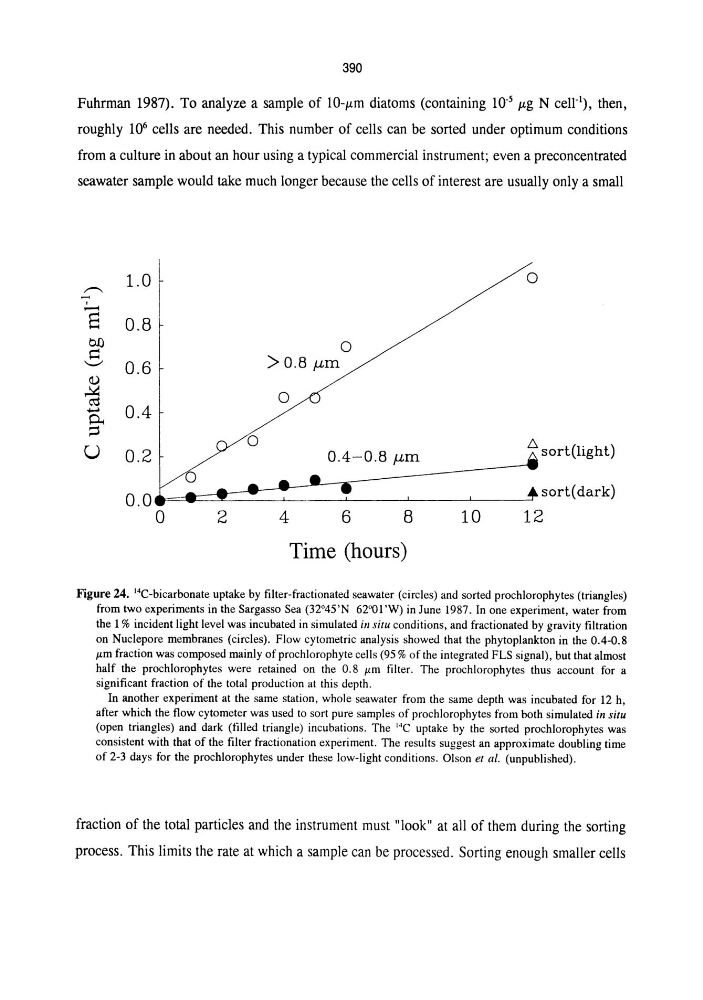
Figure 24. 14C-bicarbonate uptake by filter-fractionated seawater (circles) and sorted prochlorophytes (triangles)
from two experiments in the Sargasso Sea (32°45'N 62"01 'W) in June 1987. In one experiment, water from
the 1 % incident light level was incubated in simulated ill situ conditions, and fractionated by gravity filtration
on Nuclepore membranes (circles). Flow cytometric analysis showed that the phytoplankton in the 0.4-0.8
JLm fraction was composed mainly of prochlorophyte cells (95 % of the integrated FLS signal), but that almost
half the prochlorophytes were retained on the 0.8 JLm filter. The prochlorophytes thus account for a
significant fraction of the total production at this depth.
In another experiment at the same station, whole seawater from the same depth was incubated for 12 h,
after which the flow cytometer was used to sort pure samples of prochlorophytes from both simulated ill situ
(open triangles) and dark (filled triangle) incubations. The 14C uptake by the sorted prochlorophytes was
consistent with that of the filter fractionation experiment. The results suggest an approximate doubling time
of 2-3 days for the prochlorophytes under these low-light conditions. Olson et al. (unpublished).
fraction of the total particles and the instrument must "look" at all of them during the sorting
process. This limits the rate at which a sample can be processed. Sorting enough smaller cells
Fuhrman 1987). To analyze a sample of IO-tlm diatoms (containing 10. 5 tlg N cell· I ), then,
roughly 10 6 cells are needed. This number of cells can be sorted under optimum conditions
from a culture in about an hour using a typical commercial instrument; even a preconcentrated
seawater sample would take much longer because the cells of interest are usually only a small
1.0
0
,.-..,
.-<
,:......,
S 0.8
bJ)
0
:::
> 0.8 f-Lm
'--"
0.6
(])
~
0
ro
.......
0.4
~
;:::I
0
U
!::. sort(light)
0.2
0.4-0.8 f-Lm
0
0.0
sort(dark)
0
2
4
6
8
10
12
Time (hours)
Figure 24. 14C-bicarbonate uptake by filter-fractionated seawater (circles) and sorted prochlorophytes (triangles)
from two experiments in the Sargasso Sea (32°45'N 62"01 'W) in June 1987. In one experiment, water from
the 1 % incident light level was incubated in simulated ill situ conditions, and fractionated by gravity filtration
on Nuclepore membranes (circles). Flow cytometric analysis showed that the phytoplankton in the 0.4-0.8
JLm fraction was composed mainly of prochlorophyte cells (95 % of the integrated FLS signal), but that almost
half the prochlorophytes were retained on the 0.8 JLm filter. The prochlorophytes thus account for a
significant fraction of the total production at this depth.
In another experiment at the same station, whole seawater from the same depth was incubated for 12 h,
after which the flow cytometer was used to sort pure samples of prochlorophytes from both simulated ill situ
(open triangles) and dark (filled triangle) incubations. The 14C uptake by the sorted prochlorophytes was
consistent with that of the filter fractionation experiment. The results suggest an approximate doubling time
of 2-3 days for the prochlorophytes under these low-light conditions. Olson et al. (unpublished).
fraction of the total particles and the instrument must "look" at all of them during the sorting
process. This limits the rate at which a sample can be processed. Sorting enough smaller cells