

388
sites on the rRNA molecule, the signal size could be increased. This is an important point
since bacteria in nature typically grow at much slower rates (and thus have lower rRNA
contents) than in the laboratory cultures tested.
These results are exciting since antibodies and rRNA probes offer researchers a wide range
of specificities. These probes may allow us to study populations of cells that cannot easily be
identified in any other way (e.g. heterotrophic flagellates or particular species of
phytoplankton), and thus allow field studies that could previously only be done with cultures.
However, significant problems remain, including the need to preconcentrate cells for the
hybridization procedure and the reduction of background fluorescence levels. When cells can
D. gigas
E. coli
A
B
Q)
u
c CD
Q)
0:::
U
(/)
(/)
Q)
~
0
~
C
D
4'
l..J....
(J)
CD
0
=>
w
--.J
b"
8
Log FLS
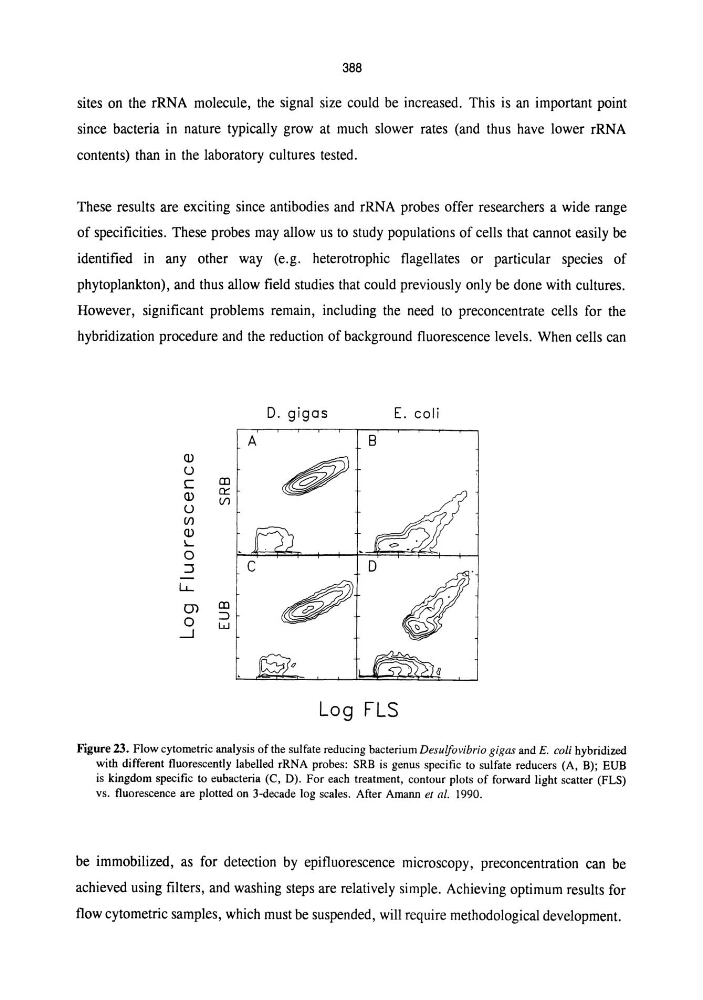
Figure 23. Flow cytometric analysis of the sulfate reducing bacterium Desulfovibrio gigas and E. coli hybridized
with different fluorescently labelled rRNA probes: SRB is genus specific to sulfate reducers (A, B); EUB
is kingdom specific to eubacteria (C, D). For each treatment, contour plots of forward light scatter (FLS)
vs. fluorescence are plotted on 3-decade log scales. After Amann et al. 1990.
be immobilized, as for detection by epifluorescence microscopy, preconcentration can be
achieved using filters, and washing steps are relatively simple. Achieving optimum results for
flow cytometric samples, which must be suspended, will require methodological development.
sites on the rRNA molecule, the signal size could be increased. This is an important point
since bacteria in nature typically grow at much slower rates (and thus have lower rRNA
contents) than in the laboratory cultures tested.
These results are exciting since antibodies and rRNA probes offer researchers a wide range
of specificities. These probes may allow us to study populations of cells that cannot easily be
identified in any other way (e.g. heterotrophic flagellates or particular species of
phytoplankton), and thus allow field studies that could previously only be done with cultures.
However, significant problems remain, including the need to preconcentrate cells for the
hybridization procedure and the reduction of background fluorescence levels. When cells can
D. gigas
E. coli
A
B
Q)
u
c CD
Q)
0:::
U
(/)
(/)
Q)
~
0
~
C
D
4'
l..J....
(J)
CD
0
=>
w
--.J
b"
8
Log FLS
Figure 23. Flow cytometric analysis of the sulfate reducing bacterium Desulfovibrio gigas and E. coli hybridized
with different fluorescently labelled rRNA probes: SRB is genus specific to sulfate reducers (A, B); EUB
is kingdom specific to eubacteria (C, D). For each treatment, contour plots of forward light scatter (FLS)
vs. fluorescence are plotted on 3-decade log scales. After Amann et al. 1990.
be immobilized, as for detection by epifluorescence microscopy, preconcentration can be
achieved using filters, and washing steps are relatively simple. Achieving optimum results for
flow cytometric samples, which must be suspended, will require methodological development.