

Whole 100m SW
.S Q)
s... () Syn
..c: ~
..,.J Q)
>'u
s... f/)
Q) Q)
o s...
u 0
E..:!
p..'M
........ Q)
........ ()
>.~
..c: Q)
o..u o f/)
s... Q)
o s...
........ 0
..c: ::l
U . . . . . . . .
'M
. .
Beads
,1' . " •
larger ~ ' : ";,,,:,", .
phyto .
. .;;.
365
0 .8 /-Lm filtrate
0 .6 /-Lm filtrate
•. !"~
;JF~:rr - "
Ii.
Forward light scatter (size)
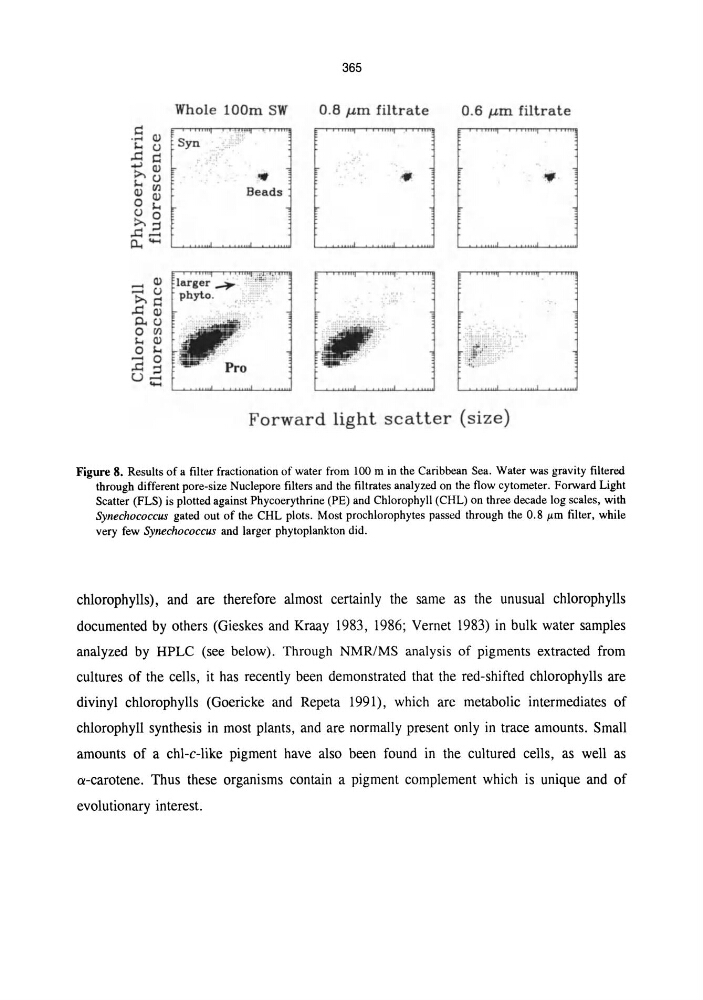
Figure 8. Results of a filter fractionation of water from 100 m in the Caribbean Sea. Water was gravity filtered
through different pore-size Nuc\epore filters and the filtrates analyzed on the flow cytometer. Forward Light
Scatter (FLS) is plotted against Phycoerythrine (PE) and Chlorophyll (CHL) on three decade log scales, with
Synechococcus gated out of the CHL plots. Most prochlorophytes passed through the 0.8 I'm filter, while
very few Synechococcus and larger phytoplankton did.
chlorophylls), and are therefore almost certainly the same as the unusual chlorophylls
documented by others (Gieskes and Kraay 1983, 1986; Vernet 1983) in bulk water samples
analyzed by HPLC (see below). Through NMR/MS analysis of pigments extracted from
cultures of the cells, it has recently been demonstrated that the red-shifted chlorophylls are
divinyl chlorophylls (Goericke and Repeta 1991), which are metabolic intermediates of
chlorophyll synthesis in most plants, and are normally present only in trace amounts. Small
amounts of a chl-c-like pigment have also been found in the cultured cells, as well as
a-carotene. Thus these organisms contain a pigment complement which is unique and of
evolutionary interest.
.S Q)
s... () Syn
..c: ~
..,.J Q)
>'u
s... f/)
Q) Q)
o s...
u 0
E..:!
p..'M
........ Q)
........ ()
>.~
..c: Q)
o..u o f/)
s... Q)
o s...
........ 0
..c: ::l
U . . . . . . . .
'M
. .
Beads
,1' . " •
larger ~ ' : ";,,,:,", .
phyto .
. .;;.
365
0 .8 /-Lm filtrate
0 .6 /-Lm filtrate
•. !"~
;JF~:rr - "
Ii.
Forward light scatter (size)
Figure 8. Results of a filter fractionation of water from 100 m in the Caribbean Sea. Water was gravity filtered
through different pore-size Nuc\epore filters and the filtrates analyzed on the flow cytometer. Forward Light
Scatter (FLS) is plotted against Phycoerythrine (PE) and Chlorophyll (CHL) on three decade log scales, with
Synechococcus gated out of the CHL plots. Most prochlorophytes passed through the 0.8 I'm filter, while
very few Synechococcus and larger phytoplankton did.
chlorophylls), and are therefore almost certainly the same as the unusual chlorophylls
documented by others (Gieskes and Kraay 1983, 1986; Vernet 1983) in bulk water samples
analyzed by HPLC (see below). Through NMR/MS analysis of pigments extracted from
cultures of the cells, it has recently been demonstrated that the red-shifted chlorophylls are
divinyl chlorophylls (Goericke and Repeta 1991), which are metabolic intermediates of
chlorophyll synthesis in most plants, and are normally present only in trace amounts. Small
amounts of a chl-c-like pigment have also been found in the cultured cells, as well as
a-carotene. Thus these organisms contain a pigment complement which is unique and of
evolutionary interest.