

341
been widely applied, there has been little uniformity with respect to correction methodology.
We wish to encourage theoretical studies as well as extensive laboratory work designed
specifically to acquire a better understanding of the 13 effect. Standardization and optimization
of measuring techniques are also desirable for the purpose of reliable intercomparison; the
geometrical configuration of the measuring set-up is to be controlled and relevant information
provided.
There is also evidence that other methodological difficulties related to imperfect retention of
particles and determination of baseline occur when the filter pad technique is applied. This
may introduce errors into the magnitude and spectral shape of the optical density measured
on the filter before any corrections for the 13 effect are made. Based on his experience with
the filter pad technique, Dariusz Stramski suggests a number of recommendations which
should be followed if best quality results are to be obtained.
0.025
0.02
0.015
a [m'-1]
0.01 1 f--.
I
!
,
i
,
"']
-400
450
500
550
600
650
700
750
Wavelength [nm]
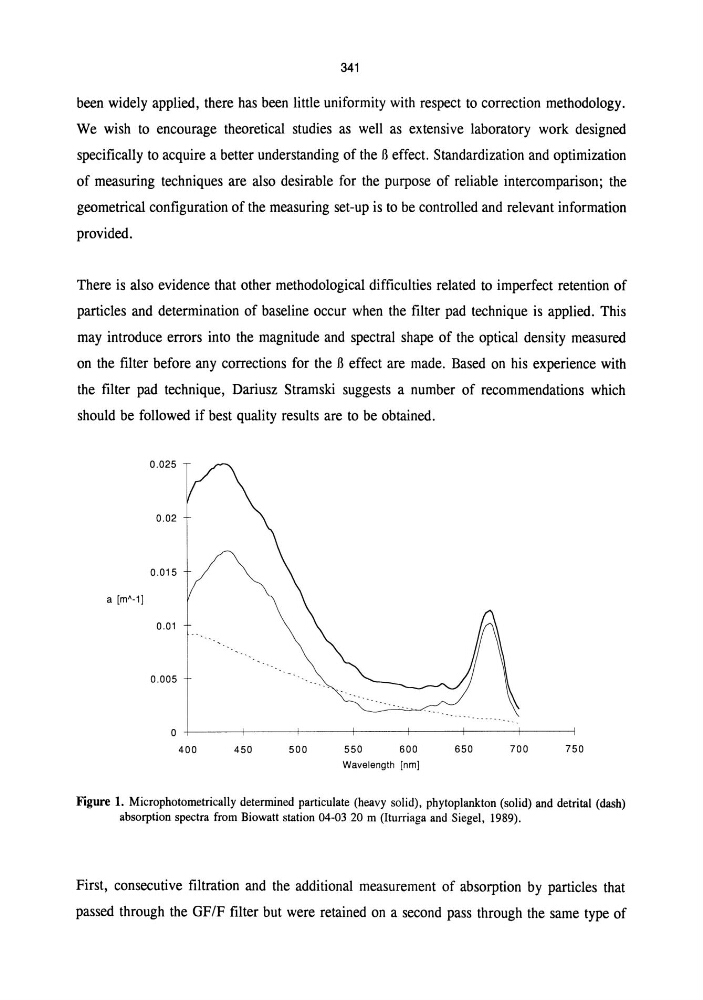
Figure 1. Microphotometrically determined particulate (heavy solid), phytoplankton (solid) and detrital (dash)
absorption spectra from Biowatt station 04-03 20 m (Iturriaga and Siegel, 1989).
First, consecutive filtration and the additional measurement of absorption by particles that
passed through the GF/F filter but were retained on a second pass through the same type of
been widely applied, there has been little uniformity with respect to correction methodology.
We wish to encourage theoretical studies as well as extensive laboratory work designed
specifically to acquire a better understanding of the 13 effect. Standardization and optimization
of measuring techniques are also desirable for the purpose of reliable intercomparison; the
geometrical configuration of the measuring set-up is to be controlled and relevant information
provided.
There is also evidence that other methodological difficulties related to imperfect retention of
particles and determination of baseline occur when the filter pad technique is applied. This
may introduce errors into the magnitude and spectral shape of the optical density measured
on the filter before any corrections for the 13 effect are made. Based on his experience with
the filter pad technique, Dariusz Stramski suggests a number of recommendations which
should be followed if best quality results are to be obtained.
0.025
0.02
0.015
a [m'-1]
0.01 1 f--.
I
!
,
i
,
"']
-400
450
500
550
600
650
700
750
Wavelength [nm]
Figure 1. Microphotometrically determined particulate (heavy solid), phytoplankton (solid) and detrital (dash)
absorption spectra from Biowatt station 04-03 20 m (Iturriaga and Siegel, 1989).
First, consecutive filtration and the additional measurement of absorption by particles that
passed through the GF/F filter but were retained on a second pass through the same type of