

21
B
FLOW
CHANNEL
SO RTiNG ________
ORIFICE
.
- - - - - - - - -
c
SAMPLE INLET
~~~~L--= __ WATER INLETS
:~
dOii~~~=~~~-- COVER GLASS
~IMMERSION OIL
MICROSCOPE OBJECTIVE
N.A.~1.3
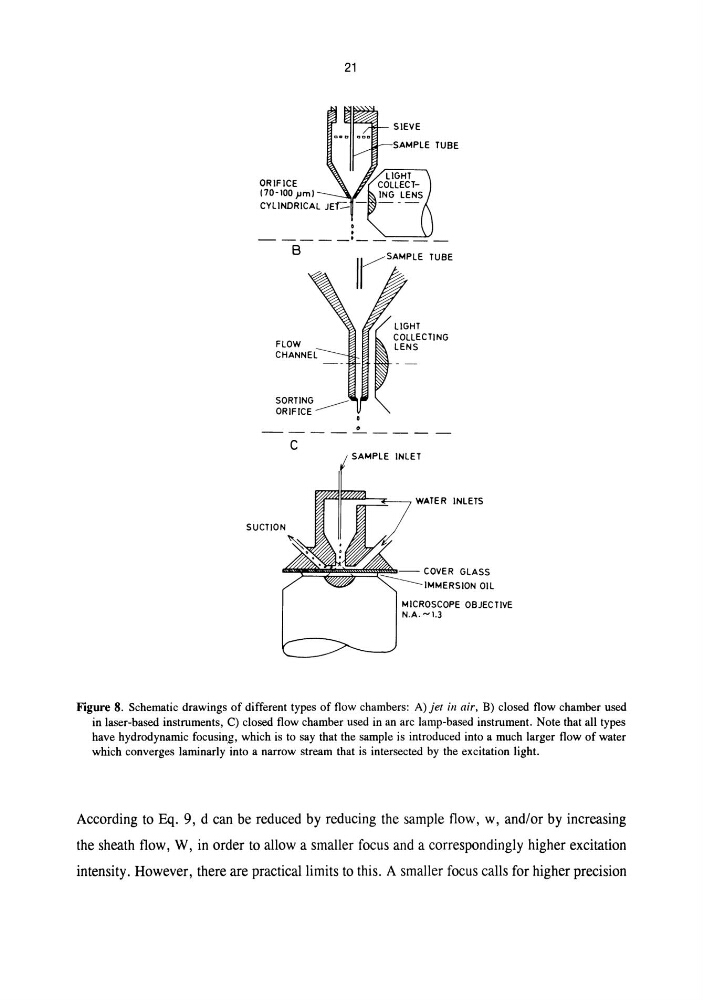
Figure 8. Schematic drawings of different types of flow chambers: A) jet ill air, B) closed flow chamber used
in laser-based instruments, C) closed flow chamber used in an arc lamp-based instrument. Note that all types
have hydrodynamic focusing, which is to say that the sample is introduced into a much larger flow of water
which converges laminarly into a narrow stream that is intersected by the excitation light.
According to Eq. 9, d can be reduced by reducing the sample flow, w, and/or by increasing
the sheath flow, W, in order to allow a smaller focus and a correspondingi y higher excitation
intensity. However, there are practicailimits to this. A smaller focus calls for higher precision
B
FLOW
CHANNEL
SO RTiNG ________
ORIFICE
.
- - - - - - - - -
c
SAMPLE INLET
~~~~L--= __ WATER INLETS
:~
dOii~~~=~~~-- COVER GLASS
~IMMERSION OIL
MICROSCOPE OBJECTIVE
N.A.~1.3
Figure 8. Schematic drawings of different types of flow chambers: A) jet ill air, B) closed flow chamber used
in laser-based instruments, C) closed flow chamber used in an arc lamp-based instrument. Note that all types
have hydrodynamic focusing, which is to say that the sample is introduced into a much larger flow of water
which converges laminarly into a narrow stream that is intersected by the excitation light.
According to Eq. 9, d can be reduced by reducing the sample flow, w, and/or by increasing
the sheath flow, W, in order to allow a smaller focus and a correspondingi y higher excitation
intensity. However, there are practicailimits to this. A smaller focus calls for higher precision