

292
Microbial LOop
New Production
NO- 3
(Episodic)
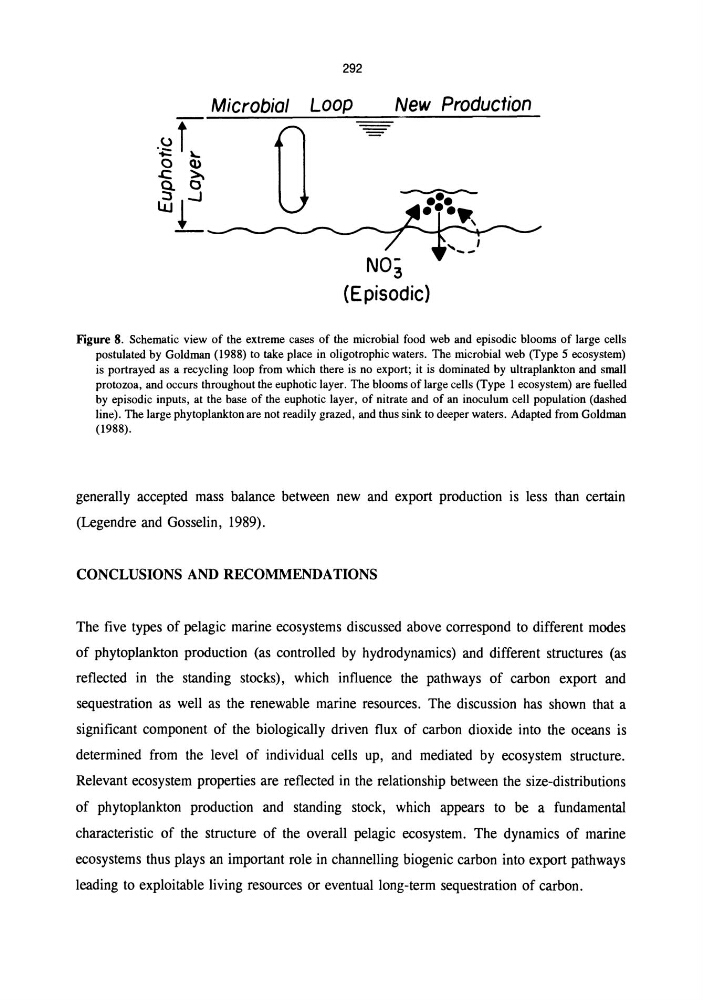
Figure 8. Schematic view of the extreme cases of the microbial food web and episodic blooms of large cells
postulated by Goldman (1988) to take place in oligotrophic waters. The microbial web (Type 5 ecosystem)
is portrayed as a recycling loop from which there is no export; it is dominated by ultraplankton and small
protozoa, and occurs throughout the euphotic layer. The blooms of large cells (Type 1 ecosystem) are fuelled
by episodic inputs, at the base of the euphotic layer, of nitrate and of an inoculum cell population (dashed
line). The large phytoplankton are not readily grazed, and thus sink to deeper waters. Adapted from Goldman
(1988).
generally accepted mass balance between new and export production is less than certain
(Legendre and Gosselin, 1989).
CONCLUSIONS AND RECOMMENDATIONS
The five types of pelagic marine ecosystems discussed above correspond to different modes
of phytoplankton production (as controlled by hydrodynamics) and different structures (as
reflected in the standing stocks), which influence the pathways of carbon export and
sequestration as well as the renewable marine resources. The discussion has shown that a
significant component of the biologically driven flux of carbon dioxide into the oceans is
determined from the level of individual cells up, and mediated by ecosystem structure.
Relevant ecosystem properties are reflected in the relationship between the size-distributions
of phytoplankton production and standing stock, which appears to be a fundamental
characteristic of the structure of the overall pelagic ecosystem. The dynamics of marine
ecosystems thus plays an important role in channelling biogenic carbon into export pathways
leading to exploitable living resources or eventual long-term sequestration of carbon.
Microbial LOop
New Production
NO- 3
(Episodic)
Figure 8. Schematic view of the extreme cases of the microbial food web and episodic blooms of large cells
postulated by Goldman (1988) to take place in oligotrophic waters. The microbial web (Type 5 ecosystem)
is portrayed as a recycling loop from which there is no export; it is dominated by ultraplankton and small
protozoa, and occurs throughout the euphotic layer. The blooms of large cells (Type 1 ecosystem) are fuelled
by episodic inputs, at the base of the euphotic layer, of nitrate and of an inoculum cell population (dashed
line). The large phytoplankton are not readily grazed, and thus sink to deeper waters. Adapted from Goldman
(1988).
generally accepted mass balance between new and export production is less than certain
(Legendre and Gosselin, 1989).
CONCLUSIONS AND RECOMMENDATIONS
The five types of pelagic marine ecosystems discussed above correspond to different modes
of phytoplankton production (as controlled by hydrodynamics) and different structures (as
reflected in the standing stocks), which influence the pathways of carbon export and
sequestration as well as the renewable marine resources. The discussion has shown that a
significant component of the biologically driven flux of carbon dioxide into the oceans is
determined from the level of individual cells up, and mediated by ecosystem structure.
Relevant ecosystem properties are reflected in the relationship between the size-distributions
of phytoplankton production and standing stock, which appears to be a fundamental
characteristic of the structure of the overall pelagic ecosystem. The dynamics of marine
ecosystems thus plays an important role in channelling biogenic carbon into export pathways
leading to exploitable living resources or eventual long-term sequestration of carbon.