

287
Ryther, 1969) in specific locations where primary production dynamics are tuned to the needs
of herbivores (see Le Fevre and Frontier, 1988; Legendre and Le Fevre, 1989). Thus, a
J
o
30
- E
-
£.
60
- a.
Q)
a 90
120~ ____ ~~ ______ ~~~~ __ ~
400
-
~300
c 0
.2 "0
-C\J
U
I
200
.g E
o
'-U
Cl.. Ol 100
E
-SON 0
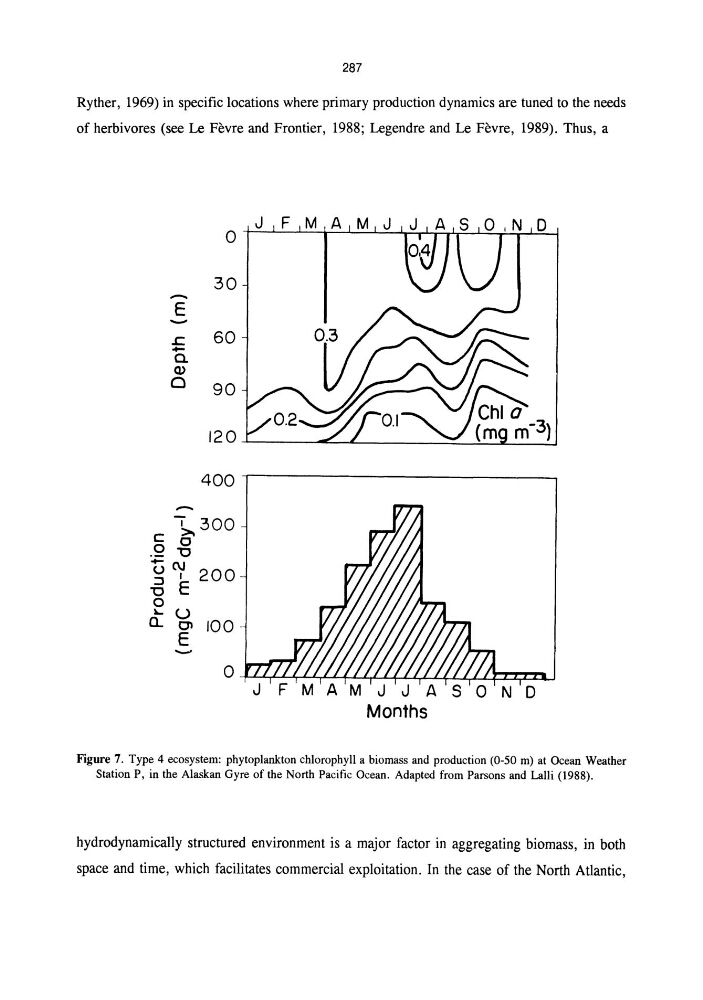
Figure 7. Type 4 ecosystem: phytoplankton chlorophyll a biomass and production (0-50 m) at Ocean Weather
Station P, in the Alaskan Gyre of the North Pacific Ocean. Adapted from Parsons and Lalli (1988).
hydrodynamically structured environment is a major factor in aggregating biomass, in both
space and time, which facilitates commercial exploitation. In the case of the North Atlantic,
Ryther, 1969) in specific locations where primary production dynamics are tuned to the needs
of herbivores (see Le Fevre and Frontier, 1988; Legendre and Le Fevre, 1989). Thus, a
J
o
30
- E
-
£.
60
- a.
Q)
a 90
120~ ____ ~~ ______ ~~~~ __ ~
400
-
~300
c 0
.2 "0
-C\J
U
I
200
.g E
o
'-U
Cl.. Ol 100
E
-SON 0
Figure 7. Type 4 ecosystem: phytoplankton chlorophyll a biomass and production (0-50 m) at Ocean Weather
Station P, in the Alaskan Gyre of the North Pacific Ocean. Adapted from Parsons and Lalli (1988).
hydrodynamically structured environment is a major factor in aggregating biomass, in both
space and time, which facilitates commercial exploitation. In the case of the North Atlantic,