

284
TYPE 3. PRODUCTION AND STANDING STOCK OF SMALL AND LARGE CELLS
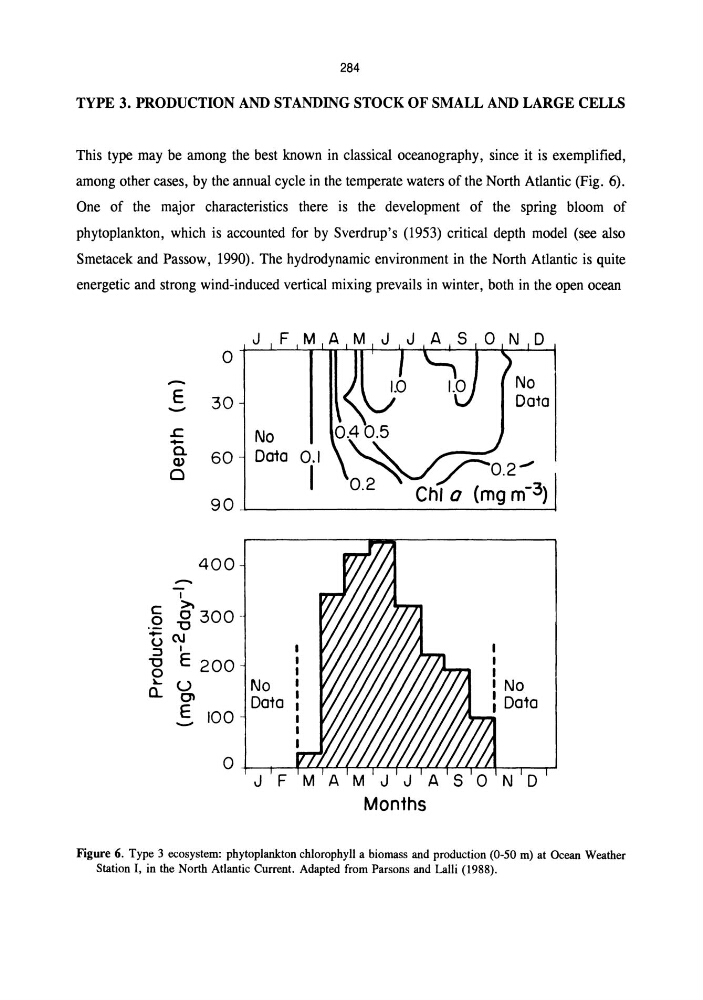
This type may be among the best known in classical oceanography, since it is exemplified,
among other cases, by the annual cycle in the temperate waters of the North Atlantic (Fig. 6).
One of the major characteristics there is the development of the spring bloom of
phytoplankton, which is accounted for by Sverdrup's (1953) critical depth model (see also
Smetacek and Passow, 1990). The hydrodynamic environment in the North Atlantic is quite
energetic and strong wind-induced vertical mixing prevails in winter, both in the open ocean
J
0
- E 30
-
~
No
- a. 60 0010 0.1
Q)
0
I
90
400
- I
C
~
0
o 3001:)
-
C\J
0
:J
I
1:)
E 200
0
~
u
No
a.. 0'
0010
E 100
-
0
J
Figure 6. Type 3 ecosystem: phytoplankton chlorophyll a biomass and production (0-50 m) at Ocean Weather
Station I, in the North Atlantic Current. Adapted from Parsons and Lalli (1988).
TYPE 3. PRODUCTION AND STANDING STOCK OF SMALL AND LARGE CELLS
This type may be among the best known in classical oceanography, since it is exemplified,
among other cases, by the annual cycle in the temperate waters of the North Atlantic (Fig. 6).
One of the major characteristics there is the development of the spring bloom of
phytoplankton, which is accounted for by Sverdrup's (1953) critical depth model (see also
Smetacek and Passow, 1990). The hydrodynamic environment in the North Atlantic is quite
energetic and strong wind-induced vertical mixing prevails in winter, both in the open ocean
J
0
- E 30
-
~
No
- a. 60 0010 0.1
Q)
0
I
90
400
- I
C
~
0
o 3001:)
-
C\J
0
:J
I
1:)
E 200
0
~
u
No
a.. 0'
0010
E 100
-
0
J
Figure 6. Type 3 ecosystem: phytoplankton chlorophyll a biomass and production (0-50 m) at Ocean Weather
Station I, in the North Atlantic Current. Adapted from Parsons and Lalli (1988).