

276
(1983), for instance, report direct fallout of diatoms to the sea floor (at a depth of 145 m) on
the continental shelf in the Peru upwelling area. They found that the diatom cells on the
SINKING
/
LARGE PHYTOPLANKTON
ULTRAPLANKTON
2
NO SINKING
A
GRAZING
/
ACCUMULATION
( MICROPHAGY)
V
AGGREGATION
~
SINKING
~
MICROBIAL
,OOO~
- - - - - - - - RECYCLED/TOTAL PRODUCTION-----------+
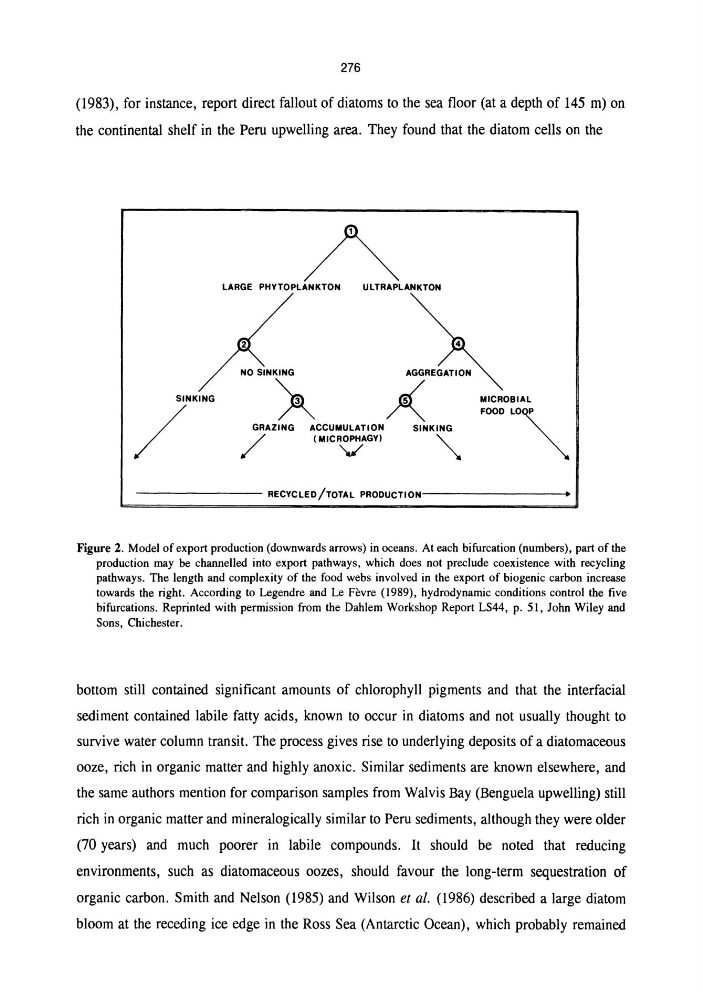
Figure 2. Model of export production (downwards arrows) in oceans. At each bifurcation (numbers), part of the
production may be channelled into export pathways, which does not preclude coexistence with recycling
pathways. The length and complexity of the food webs involved in the export of biogenic carbon increase
towards the right. According to Legendre and Le Fevre (1989), hydrodynamic conditions control the five
bifurcations. Reprinted with permission from the Dahlem Workshop Report LS44, p. 51, John Wiley and
Sons, Chichester.
bottom still contained significant amounts of chlorophyll pigments and that the interfacial
sediment contained labile fatty acids, known to occur in diatoms and not usually thought to
survive water column transit. The process gives rise to underlying deposits of a diatomaceous
ooze, rich in organic matter and highly anoxic. Similar sediments are known elsewhere, and
the same authors mention for comparison samples from Walvis Bay (Benguela upwelling) still
rich in organic matter and mineralogically similar to Peru sediments, although they were older
(70 years) and much poorer in labile compounds. It should be noted that reducing
environments, such as diatomaceous oozes, should favour the long-term sequestration of
organic carbon. Smith and Nelson (1985) and Wilson et al. (1986) described a large diatom
bloom at the receding ice edge in the Ross Sea (Antarctic Ocean), which probably remained
(1983), for instance, report direct fallout of diatoms to the sea floor (at a depth of 145 m) on
the continental shelf in the Peru upwelling area. They found that the diatom cells on the
SINKING
/
LARGE PHYTOPLANKTON
ULTRAPLANKTON
2
NO SINKING
A
GRAZING
/
ACCUMULATION
( MICROPHAGY)
V
AGGREGATION
~
SINKING
~
MICROBIAL
,OOO~
- - - - - - - - RECYCLED/TOTAL PRODUCTION-----------+
Figure 2. Model of export production (downwards arrows) in oceans. At each bifurcation (numbers), part of the
production may be channelled into export pathways, which does not preclude coexistence with recycling
pathways. The length and complexity of the food webs involved in the export of biogenic carbon increase
towards the right. According to Legendre and Le Fevre (1989), hydrodynamic conditions control the five
bifurcations. Reprinted with permission from the Dahlem Workshop Report LS44, p. 51, John Wiley and
Sons, Chichester.
bottom still contained significant amounts of chlorophyll pigments and that the interfacial
sediment contained labile fatty acids, known to occur in diatoms and not usually thought to
survive water column transit. The process gives rise to underlying deposits of a diatomaceous
ooze, rich in organic matter and highly anoxic. Similar sediments are known elsewhere, and
the same authors mention for comparison samples from Walvis Bay (Benguela upwelling) still
rich in organic matter and mineralogically similar to Peru sediments, although they were older
(70 years) and much poorer in labile compounds. It should be noted that reducing
environments, such as diatomaceous oozes, should favour the long-term sequestration of
organic carbon. Smith and Nelson (1985) and Wilson et al. (1986) described a large diatom
bloom at the receding ice edge in the Ross Sea (Antarctic Ocean), which probably remained