

263
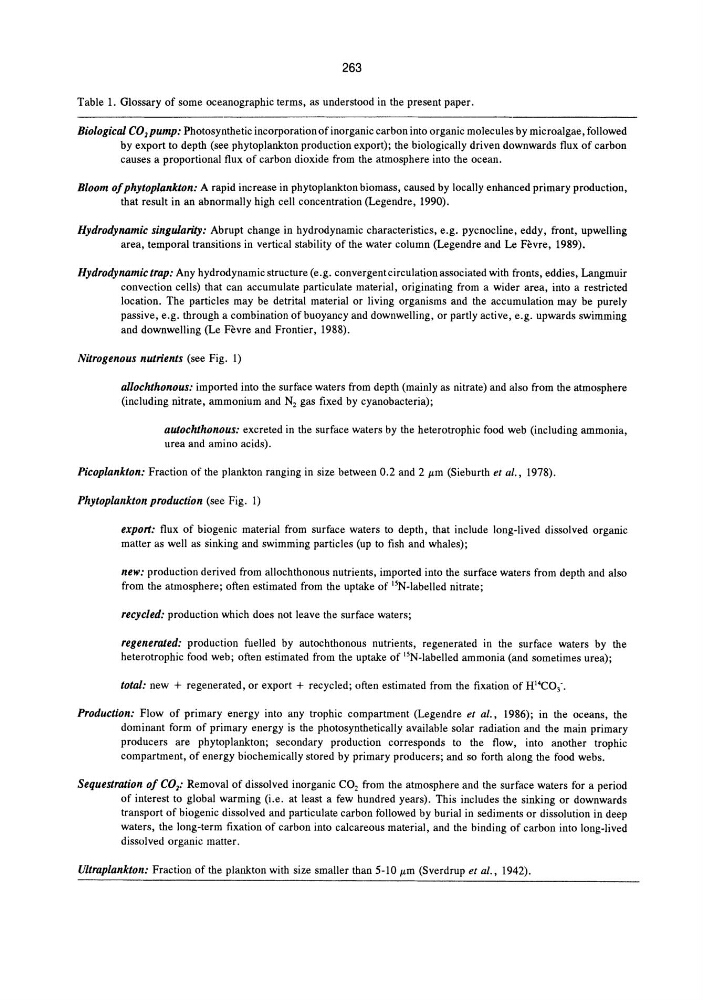
Table 1. Glossary of some oceanographic terms, as understood in the present paper.
Biological COl pump: Photosynthetic incorporation of inorganic carbon into organic molecules by microalgae, followed
by export to depth (see phytoplankton production export); the biologically driven downwards flux of carbon
causes a proportional flux of carbon dioxide from the atmosphere into the ocean.
Bloom ofphytoplan1cton: A rapid increase in phytoplankton biomass, caused by locally enhanced primary production,
that result in an abnormally high cell concentration (Legendre, 1990).
Hydrodynamic singularity: Abrupt change in hydrodynamic characteristics, e.g. pycnocline, eddy, front, upwelling
area, temporal transitions in vertical stability of the water column (Legendre and Le Fevre, 1989).
Hydrodynamic trap: Any hydrodynamic structure (e.g. convergent circulation associated with fronts, eddies, Langmuir
convection cells) that can accumulate particulate material, originating from a wider area, into a restricted
location. The particles may be detrital material or living organisms and the accumulation may be purely
passive, e.g. through a combination of buoyancy and downwelling, or partly active, e.g. upwards swimming
and downwelling (Le Fevre and Frontier, 1988).
Nitrogenous nutrients (see Fig. 1)
allochthonous: imported into the surface waters from depth (mainly as nitrate) and also from the atmosphere
(including nitrate, ammonium and N2 gas fixed by cyanobacteria);
autochthonous: excreted in the surface waters by the heterotrophic food web (including ammonia,
urea and amino acids).
Picoplankton: Fraction of the plankton ranging in size between 0.2 and 2 ILm (Sieburth et al., 1978).
Phytoplankton production (see Fig. 1)
export: flux of biogenic material from surface waters to depth, that include long-lived dissolved organic
matter as well as sinking and swimming particles (up to fish and whales);
new: production derived from allochthonous nutrients, imported into the surface waters from depth and also
from the atmosphere; often estimated from the uptake of ISN-labelled nitrate;
recycled: production which does not leave the surface waters;
regenerated: production fuelled by autochthonous nutrients, regenerated in the surface waters by the
heterotrophic food web; often estimated from the uptake of "N-labelled ammonia (and sometimes urea);
toto1: new + regenerated, or export + recycled; often estimated from the fixation of H 14 C03••
Production: Flow of primary energy into any trophic compartment (Legendre et al., 1986); in the oceans, the
dominant form of primary energy is the photosynthetically available solar radiation and the main primary
producers are phytoplankton; secondary production corresponds to the flow, into another trophic
compartment, of energy biochemically stored by primary producers; and so forth along the food webs.
Sequestration of COl: Removal of dissolved inorganic CO2 from the atmosphere and the surface waters for a period
of interest to global warming (i.e. at least a few hundred years). This includes the sinking or downwards
transport of biogenic dissolved and particulate carbon followed by burial in sediments or dissolution in deep
waters, the long-term fixation of carbon into calcareous material, and the binding of carbon into long-lived
dissolved organic matter.
Ultraplankton: Fraction of the plankton with size smaller than 5-10 ILm (Sverdrup et al., 1942).
Table 1. Glossary of some oceanographic terms, as understood in the present paper.
Biological COl pump: Photosynthetic incorporation of inorganic carbon into organic molecules by microalgae, followed
by export to depth (see phytoplankton production export); the biologically driven downwards flux of carbon
causes a proportional flux of carbon dioxide from the atmosphere into the ocean.
Bloom ofphytoplan1cton: A rapid increase in phytoplankton biomass, caused by locally enhanced primary production,
that result in an abnormally high cell concentration (Legendre, 1990).
Hydrodynamic singularity: Abrupt change in hydrodynamic characteristics, e.g. pycnocline, eddy, front, upwelling
area, temporal transitions in vertical stability of the water column (Legendre and Le Fevre, 1989).
Hydrodynamic trap: Any hydrodynamic structure (e.g. convergent circulation associated with fronts, eddies, Langmuir
convection cells) that can accumulate particulate material, originating from a wider area, into a restricted
location. The particles may be detrital material or living organisms and the accumulation may be purely
passive, e.g. through a combination of buoyancy and downwelling, or partly active, e.g. upwards swimming
and downwelling (Le Fevre and Frontier, 1988).
Nitrogenous nutrients (see Fig. 1)
allochthonous: imported into the surface waters from depth (mainly as nitrate) and also from the atmosphere
(including nitrate, ammonium and N2 gas fixed by cyanobacteria);
autochthonous: excreted in the surface waters by the heterotrophic food web (including ammonia,
urea and amino acids).
Picoplankton: Fraction of the plankton ranging in size between 0.2 and 2 ILm (Sieburth et al., 1978).
Phytoplankton production (see Fig. 1)
export: flux of biogenic material from surface waters to depth, that include long-lived dissolved organic
matter as well as sinking and swimming particles (up to fish and whales);
new: production derived from allochthonous nutrients, imported into the surface waters from depth and also
from the atmosphere; often estimated from the uptake of ISN-labelled nitrate;
recycled: production which does not leave the surface waters;
regenerated: production fuelled by autochthonous nutrients, regenerated in the surface waters by the
heterotrophic food web; often estimated from the uptake of "N-labelled ammonia (and sometimes urea);
toto1: new + regenerated, or export + recycled; often estimated from the fixation of H 14 C03••
Production: Flow of primary energy into any trophic compartment (Legendre et al., 1986); in the oceans, the
dominant form of primary energy is the photosynthetically available solar radiation and the main primary
producers are phytoplankton; secondary production corresponds to the flow, into another trophic
compartment, of energy biochemically stored by primary producers; and so forth along the food webs.
Sequestration of COl: Removal of dissolved inorganic CO2 from the atmosphere and the surface waters for a period
of interest to global warming (i.e. at least a few hundred years). This includes the sinking or downwards
transport of biogenic dissolved and particulate carbon followed by burial in sediments or dissolution in deep
waters, the long-term fixation of carbon into calcareous material, and the binding of carbon into long-lived
dissolved organic matter.
Ultraplankton: Fraction of the plankton with size smaller than 5-10 ILm (Sverdrup et al., 1942).