

250
hybridization probes. The more conserved sequence regions are useful for discriminating
between broad phylogenetic groups, such as eukaryotes and eubacteria (Giovanonni et al.,
1988). The more variable regions of rRNA are useful targets for genus,species and subspecies
.----Sar 6
~ALO 25
. - - - - - l
l~Sar7
~ALO 11
I
L. _ _ _ _ _ _ _ _ _ Synechococcus 6301
L. _ _ _ _ _ _ _ _ _ _ -:-_ _ _ : -_ _ ---:-_ _ _ A9robac~erium tumefaciens
o
0.02
0.04
0.06
0.06
0.10
0.12
Fixed mutations per sequence position
. - - - - - - - - - - - - - - - - Synechococcus PCC 6301
,....-----ALO 29
o
..--------1
'--------Oceanospirillum linum
. - - - - - - - - - ALO 3
'--------Vibrio harveyi
L - - - - - - - - - - A L O 18
....--------ALO 17
'------Agrobacterium tumefaciens
Sar 11
0.05
0.10
0.15
Fixed mutations per sequence position
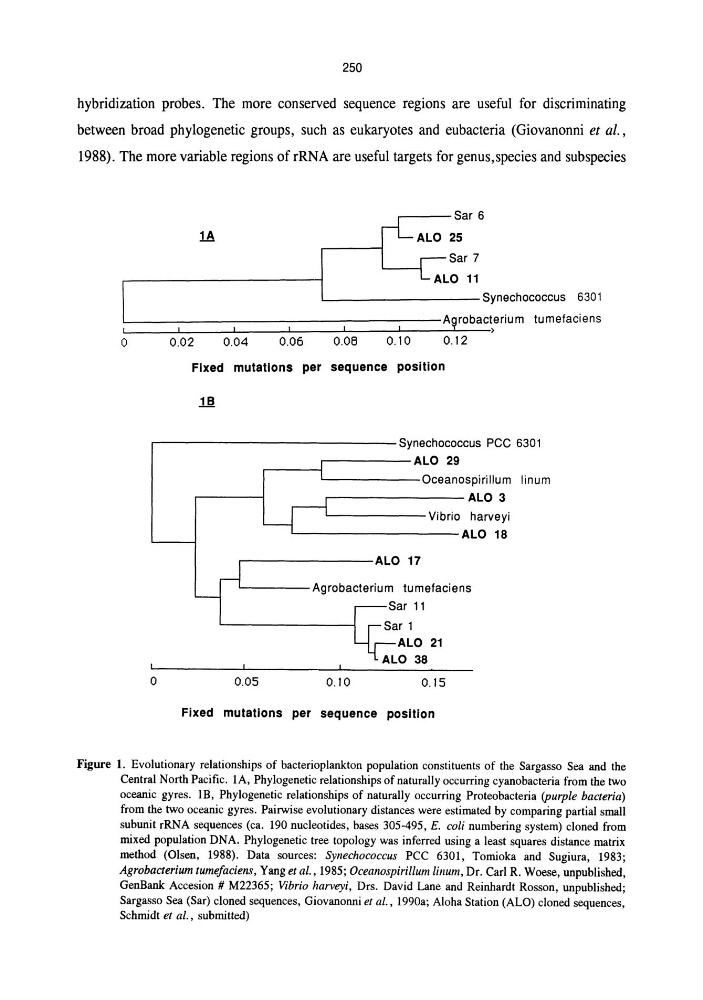
Figure 1. Evolutionary relationships of bacterioplankton population constituents of the Sargasso Sea and the
Central North Pacific. lA, Phylogenetic relationships of naturally occurring cyanobacteria from the two
oceanic gyres. 1B, Phylogenetic relationships of naturally occurring Proteobacteria (purple bacteria)
from the two oceanic gyres. Pairwise evolutionary distances were estimated by comparing partial small
subunit rRNA sequences (ca. 190 nucleotides, bases 305-495, E. coli numbering system) cloned from
mixed population DNA. Phylogenetic tree topology was inferred using a least squares distance matrix
method (Olsen, 1988). Data sources: Synechococcus PCC 6301, Tomioka and Sugiura, 1983;
Agrobacterium tume/aciens, Yang et al., 1985; Oceanospirillum Unum, Dr. Carl R. Woese, unpublished,
GenBank Accesion # M22365; Vibrio harveyi, Drs. David Lane and Reinhardt Rosson, unpublished;
Sargasso Sea (Sar) cloned sequences, Giovanonni et al., 1990a; Aloha Station (ALa) cloned sequences,
Schmidt et al., submitted)
hybridization probes. The more conserved sequence regions are useful for discriminating
between broad phylogenetic groups, such as eukaryotes and eubacteria (Giovanonni et al.,
1988). The more variable regions of rRNA are useful targets for genus,species and subspecies
.----Sar 6
~ALO 25
. - - - - - l
l~Sar7
~ALO 11
I
L. _ _ _ _ _ _ _ _ _ Synechococcus 6301
L. _ _ _ _ _ _ _ _ _ _ -:-_ _ _ : -_ _ ---:-_ _ _ A9robac~erium tumefaciens
o
0.02
0.04
0.06
0.06
0.10
0.12
Fixed mutations per sequence position
. - - - - - - - - - - - - - - - - Synechococcus PCC 6301
,....-----ALO 29
o
..--------1
'--------Oceanospirillum linum
. - - - - - - - - - ALO 3
'--------Vibrio harveyi
L - - - - - - - - - - A L O 18
....--------ALO 17
'------Agrobacterium tumefaciens
Sar 11
0.05
0.10
0.15
Fixed mutations per sequence position
Figure 1. Evolutionary relationships of bacterioplankton population constituents of the Sargasso Sea and the
Central North Pacific. lA, Phylogenetic relationships of naturally occurring cyanobacteria from the two
oceanic gyres. 1B, Phylogenetic relationships of naturally occurring Proteobacteria (purple bacteria)
from the two oceanic gyres. Pairwise evolutionary distances were estimated by comparing partial small
subunit rRNA sequences (ca. 190 nucleotides, bases 305-495, E. coli numbering system) cloned from
mixed population DNA. Phylogenetic tree topology was inferred using a least squares distance matrix
method (Olsen, 1988). Data sources: Synechococcus PCC 6301, Tomioka and Sugiura, 1983;
Agrobacterium tume/aciens, Yang et al., 1985; Oceanospirillum Unum, Dr. Carl R. Woese, unpublished,
GenBank Accesion # M22365; Vibrio harveyi, Drs. David Lane and Reinhardt Rosson, unpublished;
Sargasso Sea (Sar) cloned sequences, Giovanonni et al., 1990a; Aloha Station (ALa) cloned sequences,
Schmidt et al., submitted)