

231
(diffusible) enzymes were enfiohydrolases, producing polymers rather than monomers (e.g.
serine protease); fewer "cuts" would suffice.
Enzyme Pathway
Dllrtllvores
Baclerivores
Sinking Flux
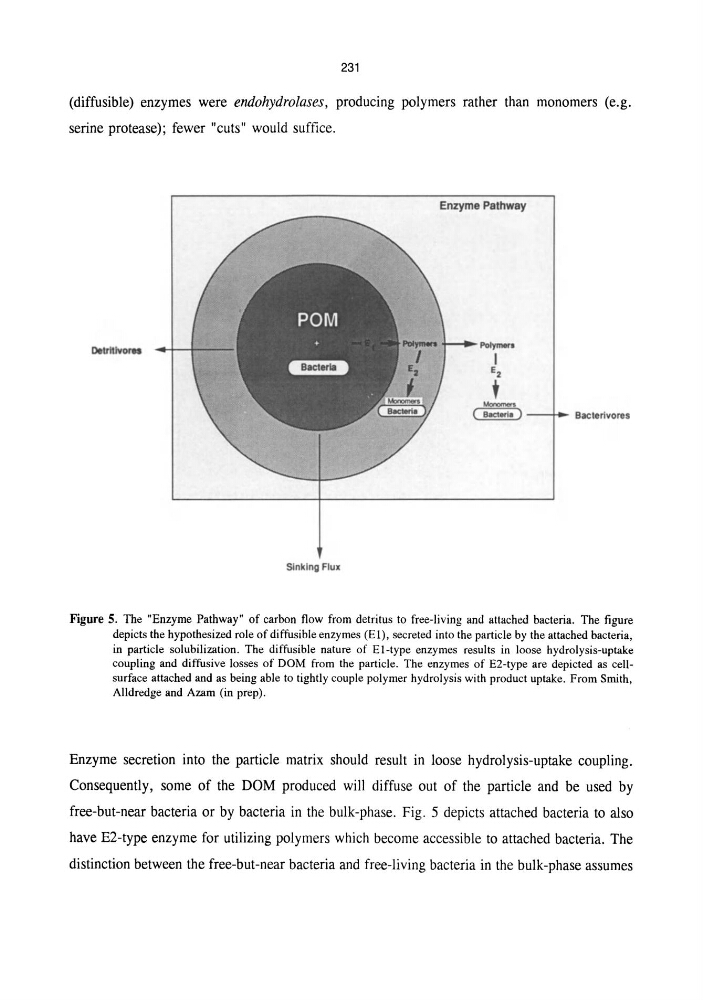
Figure 5. The "Enzyme Pathway" of carbon flow from detritus to free-living and attached bacteria. The figure
depicts the hypothesized role of diffusible enzymes (EI) , secreted into the particle by the attached bacteria,
in particle solubilization. The diffusible nature of EI-type enzymes results in loose hydrolysis-uptake
coupling and diffusive losses of DOM from the particle. The enzymes of E2-type are depicted as cellsurface attached and as being able to tightly couple polymer hydrolysis with product uptake. From Smith,
Alldredge and Azam (in prep).
Enzyme secretion into the particle matrix should result in loose hydrolysis-uptake coupling.
Consequently, some of the DOM produced will diffuse out of the particle and be used by
free-but-near bacteria or by bacteria in the bulk-phase. Fig. 5 depicts attached bacteria to also
have E2-type enzyme for utilizing polymers which become accessible to attached bacteria. The
distinction between the free-but-near bacteria and free-living bacteria in the bulk-phase assumes
(diffusible) enzymes were enfiohydrolases, producing polymers rather than monomers (e.g.
serine protease); fewer "cuts" would suffice.
Enzyme Pathway
Dllrtllvores
Baclerivores
Sinking Flux
Figure 5. The "Enzyme Pathway" of carbon flow from detritus to free-living and attached bacteria. The figure
depicts the hypothesized role of diffusible enzymes (EI) , secreted into the particle by the attached bacteria,
in particle solubilization. The diffusible nature of EI-type enzymes results in loose hydrolysis-uptake
coupling and diffusive losses of DOM from the particle. The enzymes of E2-type are depicted as cellsurface attached and as being able to tightly couple polymer hydrolysis with product uptake. From Smith,
Alldredge and Azam (in prep).
Enzyme secretion into the particle matrix should result in loose hydrolysis-uptake coupling.
Consequently, some of the DOM produced will diffuse out of the particle and be used by
free-but-near bacteria or by bacteria in the bulk-phase. Fig. 5 depicts attached bacteria to also
have E2-type enzyme for utilizing polymers which become accessible to attached bacteria. The
distinction between the free-but-near bacteria and free-living bacteria in the bulk-phase assumes