

204
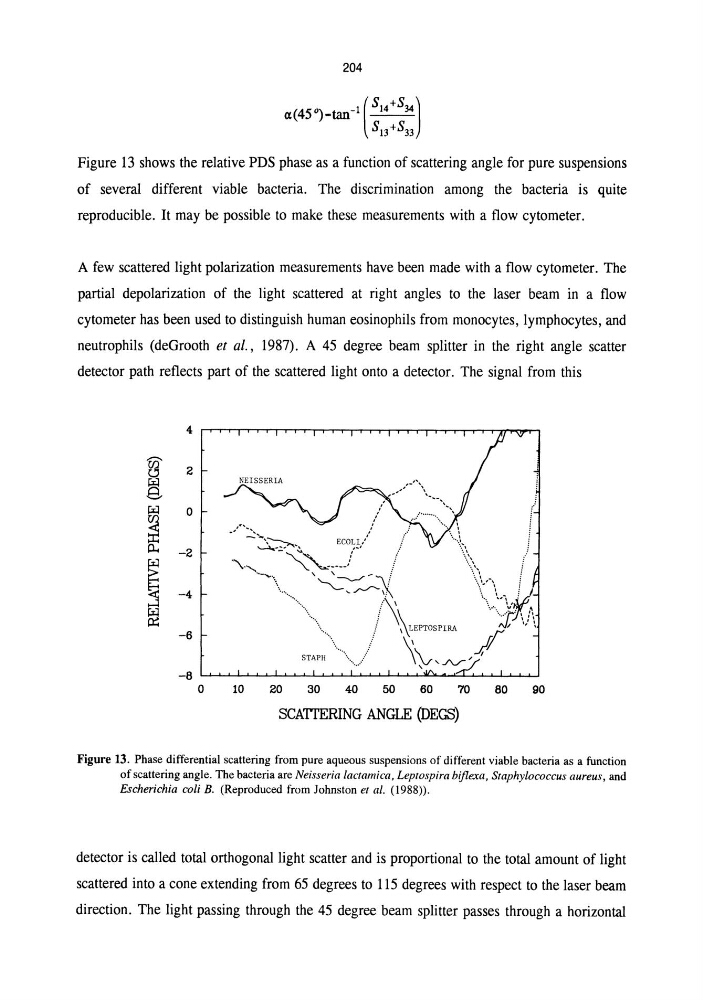
Figure 13 shows the relative PDS phase as a function of scattering angle for pure suspensions
of several different viable bacteria. The discrimination among the bacteria is quite
reproducible. It may be possible to make these measurements with a flow cytometer.
A few scattered light polarization measurements have been made with a flow cytometer. The
partial depolarization of the light scattered at right angles to the laser beam in a flow
cytometer has been used to distinguish human eosinophils from monocytes, lymphocytes, and
neutrophils (deGrooth et al., 1987). A 45 degree beam splitter in the right angle scatter
detector path reflects part of the scattered light onto a detector. The signal from this
4
~ 2
~
.......,
~
0
~ -2
~
-4
~
-6
-8 o 10 20 30 40 50 60 70 80 90
SCATI'ERING ANGLE (DEGS)
Figure 13. Phase differential scattering from pure aqueous suspensions of different viable bacteria as a function
of scattering angle. The bacteria are Neisseria lactamica, Leptospira biflexa, Staphylococcus aureus, and
Escherichia coli B. (Reproduced from Johnston et al. (1988».
detector is called total orthogonal light scatter and is proportional to the total amount of light
scattered into a cone extending from 65 degrees to 115 degrees with respect to the laser beam
direction. The light passing through the 45 degree beam splitter passes through a horizontal
Figure 13 shows the relative PDS phase as a function of scattering angle for pure suspensions
of several different viable bacteria. The discrimination among the bacteria is quite
reproducible. It may be possible to make these measurements with a flow cytometer.
A few scattered light polarization measurements have been made with a flow cytometer. The
partial depolarization of the light scattered at right angles to the laser beam in a flow
cytometer has been used to distinguish human eosinophils from monocytes, lymphocytes, and
neutrophils (deGrooth et al., 1987). A 45 degree beam splitter in the right angle scatter
detector path reflects part of the scattered light onto a detector. The signal from this
4
~ 2
~
.......,
~
0
~ -2
~
-4
~
-6
-8 o 10 20 30 40 50 60 70 80 90
SCATI'ERING ANGLE (DEGS)
Figure 13. Phase differential scattering from pure aqueous suspensions of different viable bacteria as a function
of scattering angle. The bacteria are Neisseria lactamica, Leptospira biflexa, Staphylococcus aureus, and
Escherichia coli B. (Reproduced from Johnston et al. (1988».
detector is called total orthogonal light scatter and is proportional to the total amount of light
scattered into a cone extending from 65 degrees to 115 degrees with respect to the laser beam
direction. The light passing through the 45 degree beam splitter passes through a horizontal