

182
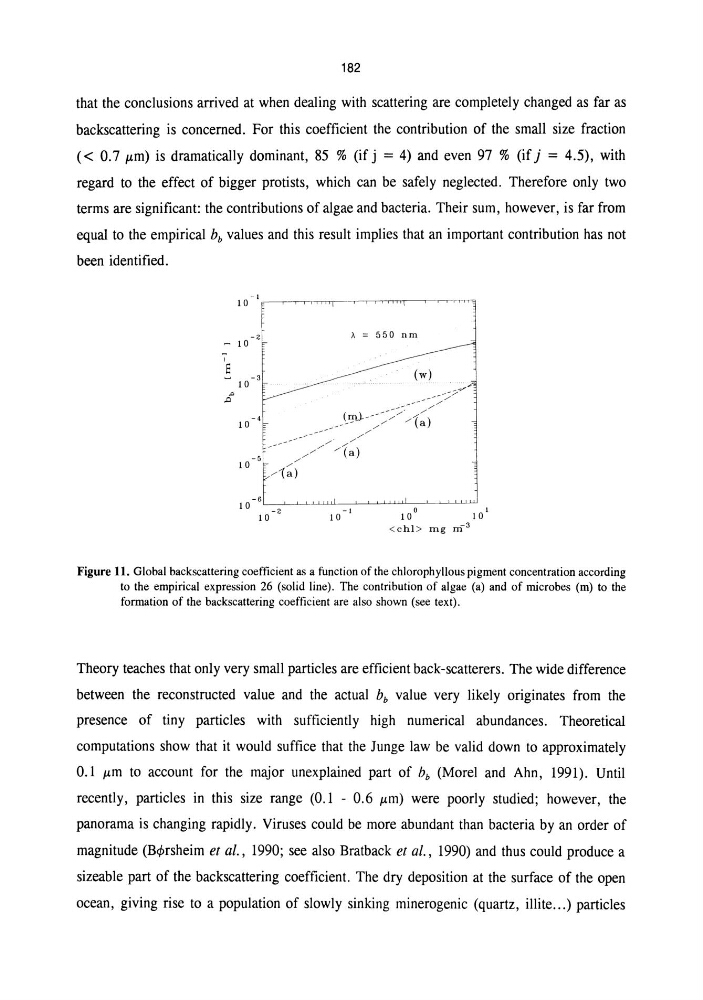
that the conclusions arrived at when dealing with scattering are completely changed as far as
backscattering is concerned. For this coefficient the contribution of the small size fraction
« 0.7 I'm) is dramatically dominant, 85 % (if j = 4) and even 97 % (if j = 4.5), with
regard to the effect of bigger protists, which can be safely neglected. Therefore only two
terms are significant: the contributions of algae and bacteria. Their sum, however, is far from
equal to the empirical bb values and this result implies that an important contribution has not
been identified.
-2
~ 10
A = 550 urn
I
S -3
10
-4
10
-5
10
·(w)
-6L-~~~llL~-L~~~~~~
10
-2
-1
0
1
10
10
10
10
mg rn 3
Figure 11. Global backscattering coefficient as a function of the chlorophyllous pigment concentration according
to the empirical expression 26 (solid line). The contribution of algae (a) and of microbes (m) to the
formation of the backscattering coefficient are also shown (see text).
Theory teaches that only very small particles are efficient back-scatterers. The wide difference
between the reconstructed value and the actual bb value very likely originates from the
presence of tiny particles with sufficiently high numerical abundances. Theoretical
computations show that it would suffice that the Junge law be valid down to approximately
0.1 I'm to account for the major unexplained part of bb (Morel and Ahn, 1991). Until
recently, particles in this size range (0.1 - 0.6 I'm) were poorly studied; however, the
panorama is changing rapidly. Viruses could be more abundant than bacteria by an order of
magnitude (Brsheim et al., 1990; see also Bratback et al., 1990) and thus could produce a
sizeable part of the backscattering coefficient. The dry deposition at the surface of the open
ocean, giving rise to a population of slowly sinking minerogenic (quartz, illite ... ) particles
that the conclusions arrived at when dealing with scattering are completely changed as far as
backscattering is concerned. For this coefficient the contribution of the small size fraction
« 0.7 I'm) is dramatically dominant, 85 % (if j = 4) and even 97 % (if j = 4.5), with
regard to the effect of bigger protists, which can be safely neglected. Therefore only two
terms are significant: the contributions of algae and bacteria. Their sum, however, is far from
equal to the empirical bb values and this result implies that an important contribution has not
been identified.
-2
~ 10
A = 550 urn
I
S -3
10
-4
10
-5
10
·(w)
-6L-~~~llL~-L~~~~~~
10
-2
-1
0
1
10
10
10
10
Figure 11. Global backscattering coefficient as a function of the chlorophyllous pigment concentration according
to the empirical expression 26 (solid line). The contribution of algae (a) and of microbes (m) to the
formation of the backscattering coefficient are also shown (see text).
Theory teaches that only very small particles are efficient back-scatterers. The wide difference
between the reconstructed value and the actual bb value very likely originates from the
presence of tiny particles with sufficiently high numerical abundances. Theoretical
computations show that it would suffice that the Junge law be valid down to approximately
0.1 I'm to account for the major unexplained part of bb (Morel and Ahn, 1991). Until
recently, particles in this size range (0.1 - 0.6 I'm) were poorly studied; however, the
panorama is changing rapidly. Viruses could be more abundant than bacteria by an order of
magnitude (Brsheim et al., 1990; see also Bratback et al., 1990) and thus could produce a
sizeable part of the backscattering coefficient. The dry deposition at the surface of the open
ocean, giving rise to a population of slowly sinking minerogenic (quartz, illite ... ) particles