

167
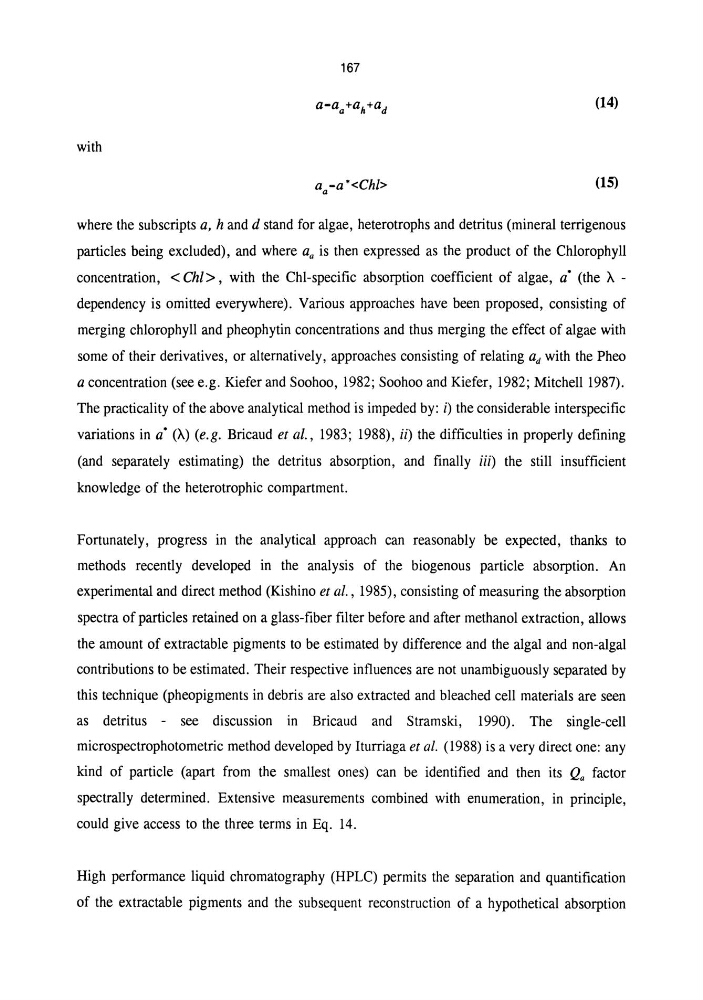
(14)
with
a -a*
a
(15)
where the subscripts a, hand d stand for algae, heterotrophs and detritus (mineral terrigenous
particles being excluded), and where aa is then expressed as the product of the Chlorophyll
concentration, < Chi>, with the ChI-specific absorption coefficient of algae, a* (the "A -
dependency is omitted everywhere). Various approaches have been proposed, consisting of
merging chlorophyll and pheophytin concentrations and thus merging the effect of algae with
some of their derivatives, or alternati vel y, approaches consisting of relating ad with the Pheo
a concentration (see e.g. Kiefer and Soohoo, 1982; Soohoo and Kiefer, 1982; Mitchell 1987).
The practicality of the above analytical method is impeded by: i) the considerable interspecific
variations in a* ("A) (e.g. Bricaud et al., 1983; 1988), ii) the difficulties in properly defining
(and separately estimating) the detritus absorption, and finally iii) the still insufficient
knowledge of the heterotrophic compartment.
Fortunately, progress in the analytical approach can reasonably be expected, thanks to
methods recently developed in the analysis of the biogenous particle absorption. An
experimental and direct method (Kishino et al., 1985), consisting of measuring the absorption
spectra of particles retained on a glass-fiber filter before and after methanol extraction, allows
the amount of extractable pigments to be estimated by difference and the algal and non-algal
contributions to be estimated. Their respective influences are not unambiguously separated by
this technique (pheopigments in debris are also extracted and bleached cell materials are seen
as detritus - see discussion in Bricaud and Stramski, 1990). The single-cell
microspectrophotometric method developed by Iturriaga et al. (1988) is a very direct one: any
kind of particle (apart from the smallest ones) can be identified and then its Qa factor
spectrally determined. Extensive measurements combined with enumeration, in principle,
could give access to the three terms in Eq. 14.
High performance liquid chromatography (HPLC) permits the separation and quantification
of the extractable pigments and the subsequent reconstruction of a hypothetical absorption
(14)
with
a -a*
a
(15)
where the subscripts a, hand d stand for algae, heterotrophs and detritus (mineral terrigenous
particles being excluded), and where aa is then expressed as the product of the Chlorophyll
concentration, < Chi>, with the ChI-specific absorption coefficient of algae, a* (the "A -
dependency is omitted everywhere). Various approaches have been proposed, consisting of
merging chlorophyll and pheophytin concentrations and thus merging the effect of algae with
some of their derivatives, or alternati vel y, approaches consisting of relating ad with the Pheo
a concentration (see e.g. Kiefer and Soohoo, 1982; Soohoo and Kiefer, 1982; Mitchell 1987).
The practicality of the above analytical method is impeded by: i) the considerable interspecific
variations in a* ("A) (e.g. Bricaud et al., 1983; 1988), ii) the difficulties in properly defining
(and separately estimating) the detritus absorption, and finally iii) the still insufficient
knowledge of the heterotrophic compartment.
Fortunately, progress in the analytical approach can reasonably be expected, thanks to
methods recently developed in the analysis of the biogenous particle absorption. An
experimental and direct method (Kishino et al., 1985), consisting of measuring the absorption
spectra of particles retained on a glass-fiber filter before and after methanol extraction, allows
the amount of extractable pigments to be estimated by difference and the algal and non-algal
contributions to be estimated. Their respective influences are not unambiguously separated by
this technique (pheopigments in debris are also extracted and bleached cell materials are seen
as detritus - see discussion in Bricaud and Stramski, 1990). The single-cell
microspectrophotometric method developed by Iturriaga et al. (1988) is a very direct one: any
kind of particle (apart from the smallest ones) can be identified and then its Qa factor
spectrally determined. Extensive measurements combined with enumeration, in principle,
could give access to the three terms in Eq. 14.
High performance liquid chromatography (HPLC) permits the separation and quantification
of the extractable pigments and the subsequent reconstruction of a hypothetical absorption