

161
-6
1 0
"---rrTTTTl,------,,,,Tml, " ' I I , " "I ,I I ,
m 2
-9
10
-[2
10
-[5
10
-[8
10
-2[
10
,
I
/
-24L--.LLLW,d I "i!,lJ------L-lLLLwl __ , II11I111 IIIIIII!
10
-2
_[
0
[
2
3
10
10
10
10
10
10
p ( = d )
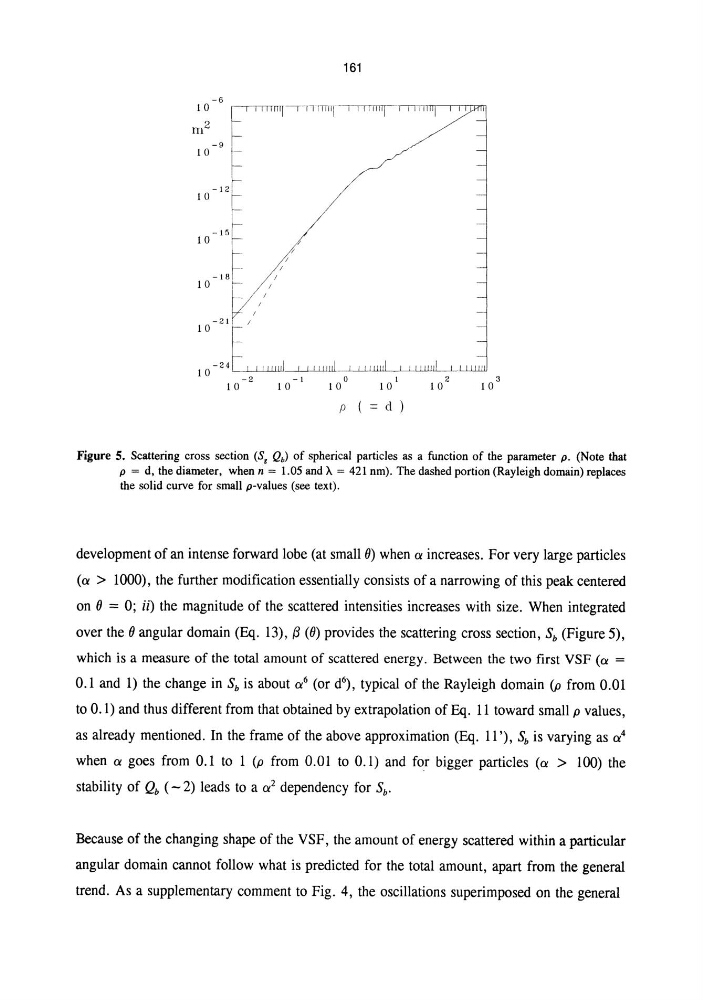
Figure 5. Scattering cross section (Sg Qb) of spherical particles as a function of the parameter p. (Note that
p = d, the diameter, when n = 1.05 and A = 421 nm). The dashed portion (Rayleigh domain) replaces
the solid curve for small p-values (see text).
development of an intense forward lobe (at small 6) when ex increases. For very large particles
(ex > 1000), the further modification essentially consists of a narrowing of this peak centered
on 6 = 0; ii) the magnitude of the scattered intensities increases with size. When integrated
over the 6 angular domain (Eq. 13), {3 (6) provides the scattering cross section, Sb (Figure 5),
which is a measure of the total amount of scattered energy. Between the two first VSF (ex =
0.1 and 1) the change in Sb is about ex 6 (or d 6 ), typical of the Rayleigh domain (p from 0.01
to 0.1) and thus different from that obtained by extrapolation of Eq. 11 toward small p values,
as already mentioned. In the frame of the above approximation (Eq. 11 '), Sb is varying as ex 4
when ex goes from 0.1 to 1 (p from 0.01 to 0.1) and for bigger particles (ex > 100) the
stability of Q b ( - 2) leads to a ex 2 dependency for Sb.
Because of the changing shape of the VSF, the amount of energy scattered within a particular
angular domain cannot follow what is predicted for the total amount, apart from the general
trend. As a supplementary comment to Fig. 4, the oscillations superimposed on the general
-6
1 0
"---rrTTTTl,------,,,,Tml, " ' I I , " "I ,I I ,
m 2
-9
10
-[2
10
-[5
10
-[8
10
-2[
10
,
I
/
-24L--.LLLW,d I "i!,lJ------L-lLLLwl __ , II11I111 IIIIIII!
10
-2
_[
0
[
2
3
10
10
10
10
10
10
p ( = d )
Figure 5. Scattering cross section (Sg Qb) of spherical particles as a function of the parameter p. (Note that
p = d, the diameter, when n = 1.05 and A = 421 nm). The dashed portion (Rayleigh domain) replaces
the solid curve for small p-values (see text).
development of an intense forward lobe (at small 6) when ex increases. For very large particles
(ex > 1000), the further modification essentially consists of a narrowing of this peak centered
on 6 = 0; ii) the magnitude of the scattered intensities increases with size. When integrated
over the 6 angular domain (Eq. 13), {3 (6) provides the scattering cross section, Sb (Figure 5),
which is a measure of the total amount of scattered energy. Between the two first VSF (ex =
0.1 and 1) the change in Sb is about ex 6 (or d 6 ), typical of the Rayleigh domain (p from 0.01
to 0.1) and thus different from that obtained by extrapolation of Eq. 11 toward small p values,
as already mentioned. In the frame of the above approximation (Eq. 11 '), Sb is varying as ex 4
when ex goes from 0.1 to 1 (p from 0.01 to 0.1) and for bigger particles (ex > 100) the
stability of Q b ( - 2) leads to a ex 2 dependency for Sb.
Because of the changing shape of the VSF, the amount of energy scattered within a particular
angular domain cannot follow what is predicted for the total amount, apart from the general
trend. As a supplementary comment to Fig. 4, the oscillations superimposed on the general