

159
characterized by a p2 dependency. Smaller particles, viruses, colloidal particles, and big
molecules, with their nature and abundance largely unknown, are definitely relevant to the
Rayleigh scattering and characterized by a p4 dependency.
Angular scattering pattern
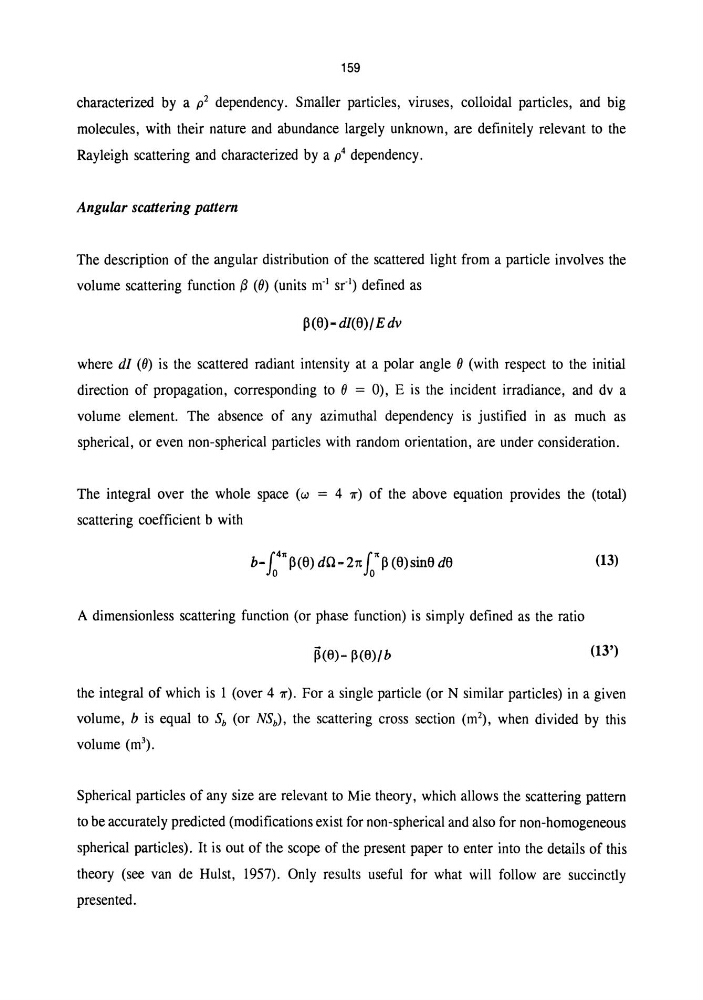
The description of the angular distribution of the scattered light from a particle involves the
volume scattering function {3 (0) (units m· 1 sr- I ) defined as
p(e)- dI(e)/ E dv
where dI (0) is the scattered radiant intensity at a polar angle 0 (with respect to the initial
direction of propagation, corresponding to 0 = 0), E is the incident irradiance, and dv a
volume element. The absence of any azimuthal dependency is justified in as much as
spherical, or even non-spherical particles with random orientation, are under consideration.
The integral over the whole space (w
scattering coefficient b with
4 11") of the above equation provides the (total)
(13)
A dimensionless scattering function (or phase function) is simply defined as the ratio
~(e)- ~(e)/ b
(13')
the integral of which is 1 (over 4 11"). For a single particle (or N similar particles) in a given
volume, b is equal to Sb (or NS b ) , the scattering cross section (m 2 ), when divided by this
volume (m 3 ).
Spherical particles of any size are relevant to Mie theory, which allows the scattering pattern
to be accurately predicted (modifications exist for non-spherical and also for non-homogeneous
spherical particles). It is out of the scope of the present paper to enter into the details of this
theory (see van de Hulst, 1957). Only results useful for what will follow are succinctly
presented.
characterized by a p2 dependency. Smaller particles, viruses, colloidal particles, and big
molecules, with their nature and abundance largely unknown, are definitely relevant to the
Rayleigh scattering and characterized by a p4 dependency.
Angular scattering pattern
The description of the angular distribution of the scattered light from a particle involves the
volume scattering function {3 (0) (units m· 1 sr- I ) defined as
p(e)- dI(e)/ E dv
where dI (0) is the scattered radiant intensity at a polar angle 0 (with respect to the initial
direction of propagation, corresponding to 0 = 0), E is the incident irradiance, and dv a
volume element. The absence of any azimuthal dependency is justified in as much as
spherical, or even non-spherical particles with random orientation, are under consideration.
The integral over the whole space (w
scattering coefficient b with
4 11") of the above equation provides the (total)
(13)
A dimensionless scattering function (or phase function) is simply defined as the ratio
~(e)- ~(e)/ b
(13')
the integral of which is 1 (over 4 11"). For a single particle (or N similar particles) in a given
volume, b is equal to Sb (or NS b ) , the scattering cross section (m 2 ), when divided by this
volume (m 3 ).
Spherical particles of any size are relevant to Mie theory, which allows the scattering pattern
to be accurately predicted (modifications exist for non-spherical and also for non-homogeneous
spherical particles). It is out of the scope of the present paper to enter into the details of this
theory (see van de Hulst, 1957). Only results useful for what will follow are succinctly
presented.