

150
According to the direction of the incident light, an irregularly shaped particle has various
geometrical sections Sg; if this particle is convex and randomly oriented in the light field, its
geometrical cross section is on average one-fourth of its total surface area ("this theorem,
apparently, is one of those which gets discovered and rediscovered many times", van de
Hulst, 1957, pIll). The efficiency factors Qa and Qb of irregularly shaped particles and thus
Sa and Sb also change with the orientation of the particle in the light field. In a diffuse light
field, or even in a directional field if particles are randomly oriented (e.g. algae in a cuvette
during classical spectrophotometric measurements), "average" cross sections are determined.
In cytometry (very short duration) or in microspectrophotometric techniques (organisms fixed
in position), orientation - dependent cross sections are obtained (Iturriaga et al., 1988). In
these cases, even a perfectly monodisperse population of particles (same size and even same
shape within the entire population) will give rise to variable signals in scattering, in
absorption, and even in fluorescence (primarily dependent on absorption capabilities) as a
consequence of this shape-effect.
This effect obviously vanishes for spherical particles, as it also vanishes for irregular particles,
as far as macroscopic techniques allow many particles with various orientations to be
simultaneously examined. The first step in a theoretical approach consists of considering
spherical particles.
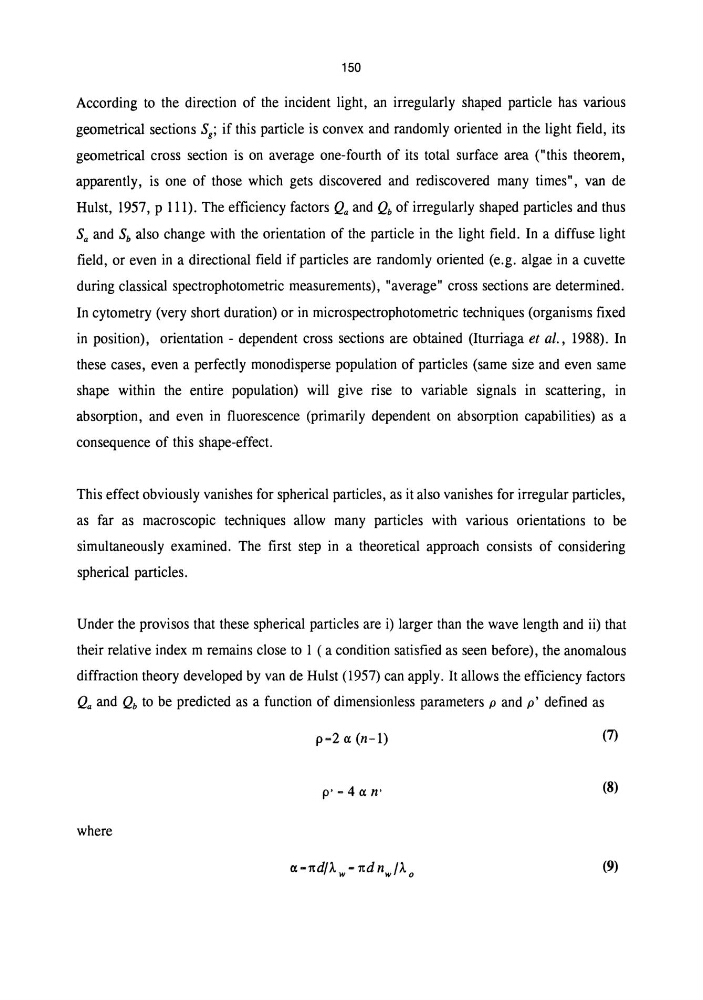
Under the provisos that these spherical particles are i) larger than the wave length and ii) that
their relative index m remains close to 1 ( a condition satisfied as seen before), the anomalous
diffraction theory developed by van de Hulst (1957) can apply. It allows the efficiency factors
Qa and Qb to be predicted as a function of dimensionless parameters p and p' defined as
p-2 a (n-1)
(7)
p' - 4 a n'
(8)
where
a-rtd/Aw-rtdnw/A o
(9)
According to the direction of the incident light, an irregularly shaped particle has various
geometrical sections Sg; if this particle is convex and randomly oriented in the light field, its
geometrical cross section is on average one-fourth of its total surface area ("this theorem,
apparently, is one of those which gets discovered and rediscovered many times", van de
Hulst, 1957, pIll). The efficiency factors Qa and Qb of irregularly shaped particles and thus
Sa and Sb also change with the orientation of the particle in the light field. In a diffuse light
field, or even in a directional field if particles are randomly oriented (e.g. algae in a cuvette
during classical spectrophotometric measurements), "average" cross sections are determined.
In cytometry (very short duration) or in microspectrophotometric techniques (organisms fixed
in position), orientation - dependent cross sections are obtained (Iturriaga et al., 1988). In
these cases, even a perfectly monodisperse population of particles (same size and even same
shape within the entire population) will give rise to variable signals in scattering, in
absorption, and even in fluorescence (primarily dependent on absorption capabilities) as a
consequence of this shape-effect.
This effect obviously vanishes for spherical particles, as it also vanishes for irregular particles,
as far as macroscopic techniques allow many particles with various orientations to be
simultaneously examined. The first step in a theoretical approach consists of considering
spherical particles.
Under the provisos that these spherical particles are i) larger than the wave length and ii) that
their relative index m remains close to 1 ( a condition satisfied as seen before), the anomalous
diffraction theory developed by van de Hulst (1957) can apply. It allows the efficiency factors
Qa and Qb to be predicted as a function of dimensionless parameters p and p' defined as
p-2 a (n-1)
(7)
p' - 4 a n'
(8)
where
a-rtd/Aw-rtdnw/A o
(9)