

w
~
w
~ w
a:
o
3 LL
C
W
~ ::J C
o
::i
127
Fmax --------------------------------------------:
qp-o. qN-o
:
______________________ -1-_______ : . . . . __________ .:
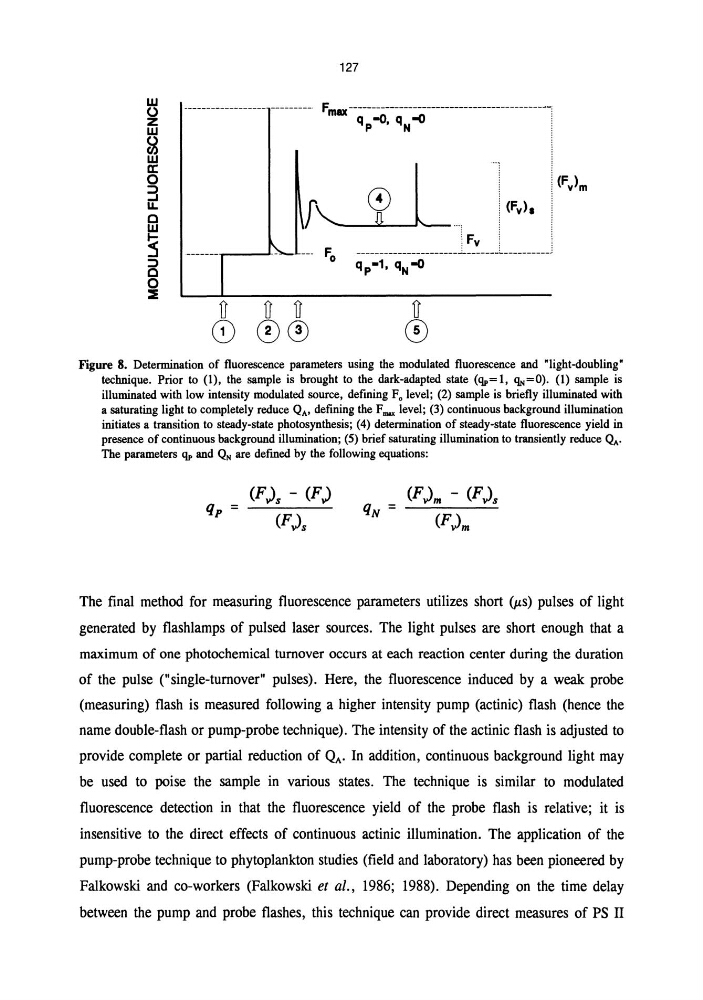
Figure 8. Determination of fluorescence parameters using the modulated fluorescence and "light-doubling"
technique. Prior to (1), the sample is brought to the dark-adapted state (<)p= 1, 'IN=O). (1) sample is
illuminated with low intensity modulated source, defining Fo level; (2) sample is briefly illuminated with
a saturating light to completely reduce QA> defining the F max level; (3) continuous background illumination
initiates a transition to steady-state photosynthesis; (4) determination of steady-state fluorescence yield in
presence of continuous background illumination; (5) brief saturating illumination to transiently reduce ~.
The parameters <)p and Q N are defmed by the following equations:
The final method for measuring fluorescence parameters utilizes short (p.s) pulses of light
generated by flashlamps of pulsed laser sources. The light pulses are short enough that a
maximum of one photochemical turnover occurs at each reaction center during the duration
of the pulse ("single-turnover" pulses). Here, the fluorescence induced by a weak probe
(measuring) flash is measured following a higher intensity pump (actinic) flash (hence the
name double-flash or pump-probe technique). The intensity of the actinic flash is adjusted to
provide complete or partial reduction of ~. In addition, continuous background light may
be used to poise the sample in various states. The technique is similar to modulated
fluorescence detection in that the fluorescence yield of the probe flash is relative; it is
insensitive to the direct effects of continuous actinic illumination. The application of the
pump-probe technique to phytoplankton studies (field and laboratory) has been pioneered by
Falkowski and co-workers (Falkowski et at., 1986; 1988). Depending on the time delay
between the pump and probe flashes, this technique can provide direct measures of PS II
~
w
~ w
a:
o
3 LL
C
W
~ ::J C
o
::i
127
Fmax --------------------------------------------:
qp-o. qN-o
:
______________________ -1-_______ : . . . . __________ .:
Figure 8. Determination of fluorescence parameters using the modulated fluorescence and "light-doubling"
technique. Prior to (1), the sample is brought to the dark-adapted state (<)p= 1, 'IN=O). (1) sample is
illuminated with low intensity modulated source, defining Fo level; (2) sample is briefly illuminated with
a saturating light to completely reduce QA> defining the F max level; (3) continuous background illumination
initiates a transition to steady-state photosynthesis; (4) determination of steady-state fluorescence yield in
presence of continuous background illumination; (5) brief saturating illumination to transiently reduce ~.
The parameters <)p and Q N are defmed by the following equations:
The final method for measuring fluorescence parameters utilizes short (p.s) pulses of light
generated by flashlamps of pulsed laser sources. The light pulses are short enough that a
maximum of one photochemical turnover occurs at each reaction center during the duration
of the pulse ("single-turnover" pulses). Here, the fluorescence induced by a weak probe
(measuring) flash is measured following a higher intensity pump (actinic) flash (hence the
name double-flash or pump-probe technique). The intensity of the actinic flash is adjusted to
provide complete or partial reduction of ~. In addition, continuous background light may
be used to poise the sample in various states. The technique is similar to modulated
fluorescence detection in that the fluorescence yield of the probe flash is relative; it is
insensitive to the direct effects of continuous actinic illumination. The application of the
pump-probe technique to phytoplankton studies (field and laboratory) has been pioneered by
Falkowski and co-workers (Falkowski et at., 1986; 1988). Depending on the time delay
between the pump and probe flashes, this technique can provide direct measures of PS II