

110
Unlike the reaction center pigments which are always chi a, photosynthetic antenna pigments
may be chi a, b or c, phycobilins, or a variety of carotenoids. These pigments are bound in
several classes of pigment-protein complexes (Anderson and Barrett, 1986). The diversity of
light-harvesting pigments is especially pronounced in the algae, where pigment composition
is often a major characteristic separating algal classes. In all cases, chI a is thought to be the
central component of the antenna, with all excitation energy ultimately being transferred to
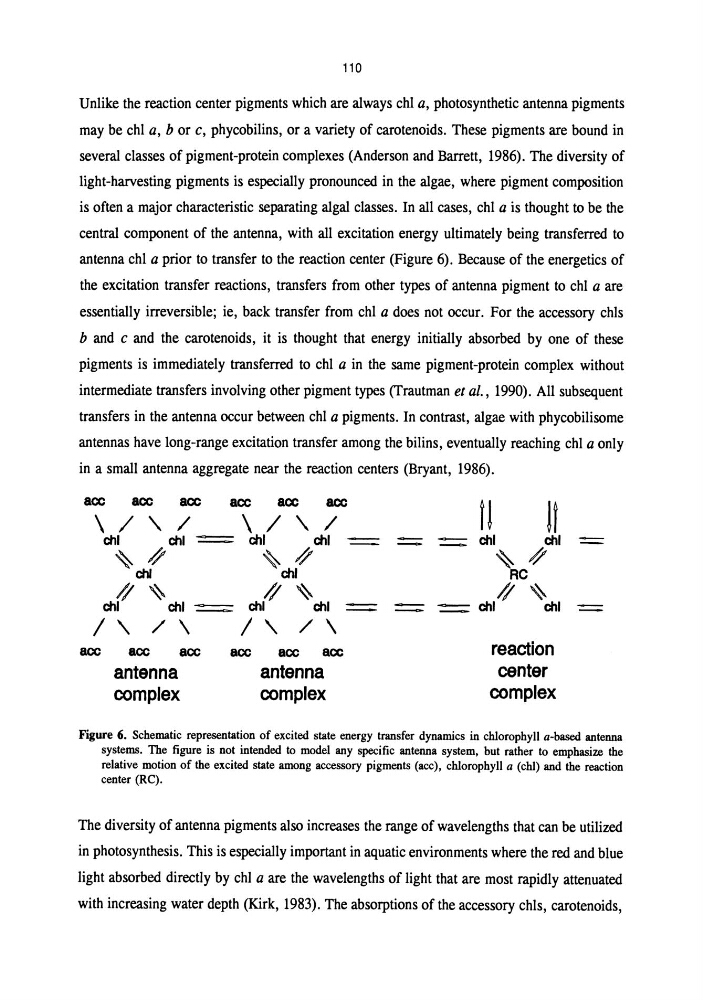
antenna chi a prior to transfer to the reaction center (Figure 6). Because of the energetics of
the excitation transfer reactions, transfers from other types of antenna pigment to chi a are
essentially irreversible; ie, back transfer from chi a does not occur. For the accessory chis
b and c and the carotenoids, it is thought that energy initially absorbed by one of these
pigments is immediately transferred to chi a in the same pigment-protein complex without
intermediate transfers involving other pigment types (Trautman et al., 1990). All subsequent
transfers in the antenna occur between chi a pigments. In contrast, algae with phycobilisome
antennas have long-range excitation transfer among the bilins, eventually reaching chi a only
in a small antenna aggregate near the reaction centers (Bryant, 1986).
ace
ace
ace
ace
ace
ace
t! H
\ / " / \ / " /
chi
chi
~
chi
chi
- - chi chi
-
- -
~~
~~
~~
chi
chi
RC
//~
//~
//~
chi
chi - chi chi
- -= chi chi -
-
-
/ "
/ \
/" / \
ace
ace
ace
ace
ace ace
reaction
antenna
antenna
center
complex
complex
complex
Figure 6. Schematic representation of excited state energy transfer dynamics in chlorophyll a-based antenna
systems. The figure is not intended to model any specific antenna system, but rather to emphasize the
relative motion of the excited state among accessory pigments (ace), chlorophyll a (chl) and the reaction
center (RC).
The diversity of antenna pigments also increases the range of wavelengths that can be utilized
in photosynthesis. This is especially important in aquatic environments where the red and blue
light absorbed directly by chi a are the wavelengths of light that are most rapidly attenuated
with increasing water depth (Kirk, 1983). The absorptions of the accessory chis, carotenoids,
Unlike the reaction center pigments which are always chi a, photosynthetic antenna pigments
may be chi a, b or c, phycobilins, or a variety of carotenoids. These pigments are bound in
several classes of pigment-protein complexes (Anderson and Barrett, 1986). The diversity of
light-harvesting pigments is especially pronounced in the algae, where pigment composition
is often a major characteristic separating algal classes. In all cases, chI a is thought to be the
central component of the antenna, with all excitation energy ultimately being transferred to
antenna chi a prior to transfer to the reaction center (Figure 6). Because of the energetics of
the excitation transfer reactions, transfers from other types of antenna pigment to chi a are
essentially irreversible; ie, back transfer from chi a does not occur. For the accessory chis
b and c and the carotenoids, it is thought that energy initially absorbed by one of these
pigments is immediately transferred to chi a in the same pigment-protein complex without
intermediate transfers involving other pigment types (Trautman et al., 1990). All subsequent
transfers in the antenna occur between chi a pigments. In contrast, algae with phycobilisome
antennas have long-range excitation transfer among the bilins, eventually reaching chi a only
in a small antenna aggregate near the reaction centers (Bryant, 1986).
ace
ace
ace
ace
ace
ace
t! H
\ / " / \ / " /
chi
chi
~
chi
chi
- - chi chi
-
- -
~~
~~
~~
chi
chi
RC
//~
//~
//~
chi
chi - chi chi
- -= chi chi -
-
-
/ "
/ \
/" / \
ace
ace
ace
ace
ace ace
reaction
antenna
antenna
center
complex
complex
complex
Figure 6. Schematic representation of excited state energy transfer dynamics in chlorophyll a-based antenna
systems. The figure is not intended to model any specific antenna system, but rather to emphasize the
relative motion of the excited state among accessory pigments (ace), chlorophyll a (chl) and the reaction
center (RC).
The diversity of antenna pigments also increases the range of wavelengths that can be utilized
in photosynthesis. This is especially important in aquatic environments where the red and blue
light absorbed directly by chi a are the wavelengths of light that are most rapidly attenuated
with increasing water depth (Kirk, 1983). The absorptions of the accessory chis, carotenoids,