

108
starting state D P A. Photochemistry is only possible from the state DPA; this is the open
state of the reaction center. If either P is oxidized or A is reduced, photochemistry is blocked
and the reaction center is said to be closed.
'open'
D P
A
~ .......
1
~ at.orptIon or
. exdtaIion tranaIM
Figure 4. Schematic representation of photochemical
D p
A
and electron transport reactions in a generalized
J - +Primary p/IoIocIlemi&Iy
photosynthetic reaction center. P: reaction center
D p
A
pigment (primary electron donor), D: secondary
'~
J
IeOOIICWy donaIIon
..edIon cenIer
electron donor, A: primary electron acceptor.
D-+- p
APhotochemistry is possible only in an "open"
IIIcWn nnaport \
I ~ eIecCron hnIpOrt
reaction center where P is reduced and A is
OlddIzeaAreduoM 0 +
oxidized.
D P
A
In photosynthetic organisms which evolve oxygen, there are two types of reaction center
pigments: P680 and P700 (these are chI a in special environments, the numbers refer to the
wavelength corresponding to the lowest energy absorption of each pigment). The function of
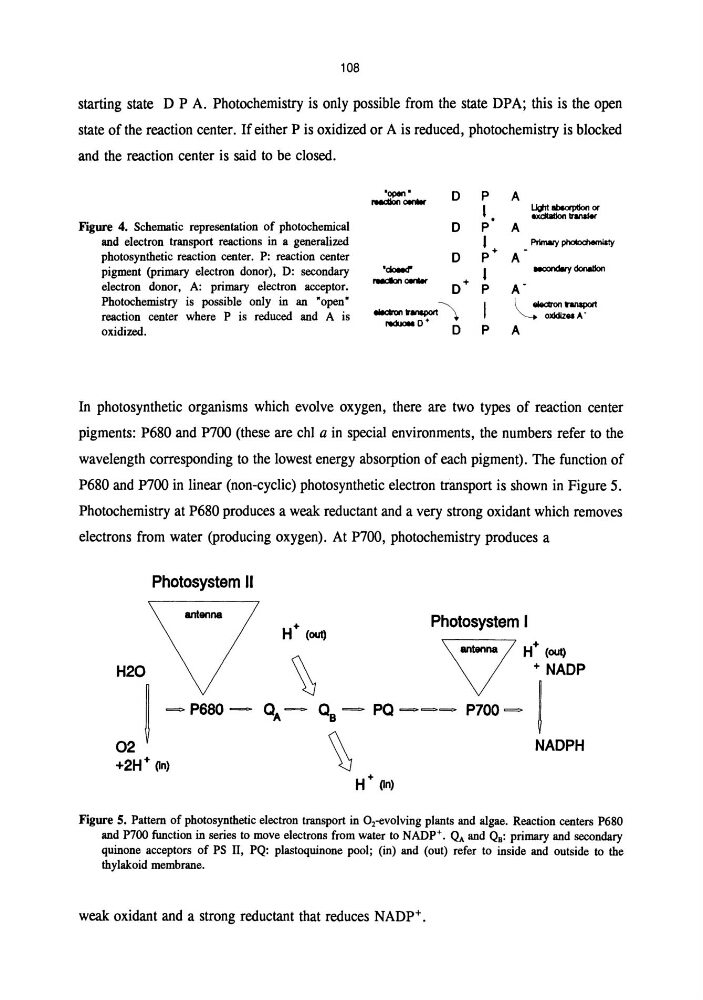
P680 and P700 in linear (non-cyclic) photosynthetic electron transport is shown in Figure 5.
Photochemistry at P680 produces a weak reductant and a very strong oxidant which removes
electrons from water (producing oxygen). At P700, photochemistry produces a
Photosystem II
antenna
H20
02~
+2H+ On)
+
H (out)
Photosystem I
~H+(out)
V +NADP
PO ~~~ P700~ I
NADPH
Figure S. Pattern of photosynthetic electron transport in 02-evolving plants and algae. Reaction centers P680
and P700 function in series to move electrons from water to NADP+. QA and QB: primary and secondary
quinone acceptors of PS II, PQ: plastoquinone pool; (in) and (out) refer to inside and outside to the
thylakoid membrane.
weak oxidant and a strong reductant that reduces NADP+.
starting state D P A. Photochemistry is only possible from the state DPA; this is the open
state of the reaction center. If either P is oxidized or A is reduced, photochemistry is blocked
and the reaction center is said to be closed.
'open'
D P
A
~ .......
1
~ at.orptIon or
. exdtaIion tranaIM
Figure 4. Schematic representation of photochemical
D p
A
and electron transport reactions in a generalized
J - +Primary p/IoIocIlemi&Iy
photosynthetic reaction center. P: reaction center
D p
A
pigment (primary electron donor), D: secondary
'~
J
IeOOIICWy donaIIon
..edIon cenIer
electron donor, A: primary electron acceptor.
D-+- p
APhotochemistry is possible only in an "open"
IIIcWn nnaport \
I ~ eIecCron hnIpOrt
reaction center where P is reduced and A is
OlddIzeaAreduoM 0 +
oxidized.
D P
A
In photosynthetic organisms which evolve oxygen, there are two types of reaction center
pigments: P680 and P700 (these are chI a in special environments, the numbers refer to the
wavelength corresponding to the lowest energy absorption of each pigment). The function of
P680 and P700 in linear (non-cyclic) photosynthetic electron transport is shown in Figure 5.
Photochemistry at P680 produces a weak reductant and a very strong oxidant which removes
electrons from water (producing oxygen). At P700, photochemistry produces a
Photosystem II
antenna
H20
02~
+2H+ On)
+
H (out)
Photosystem I
~H+(out)
V +NADP
PO ~~~ P700~ I
NADPH
Figure S. Pattern of photosynthetic electron transport in 02-evolving plants and algae. Reaction centers P680
and P700 function in series to move electrons from water to NADP+. QA and QB: primary and secondary
quinone acceptors of PS II, PQ: plastoquinone pool; (in) and (out) refer to inside and outside to the
thylakoid membrane.
weak oxidant and a strong reductant that reduces NADP+.