

106
... u
I I
~
II! ...
~
CD®®0
::;)
~
'" 0
z
0
i
600
WAVElENGTH (nm)
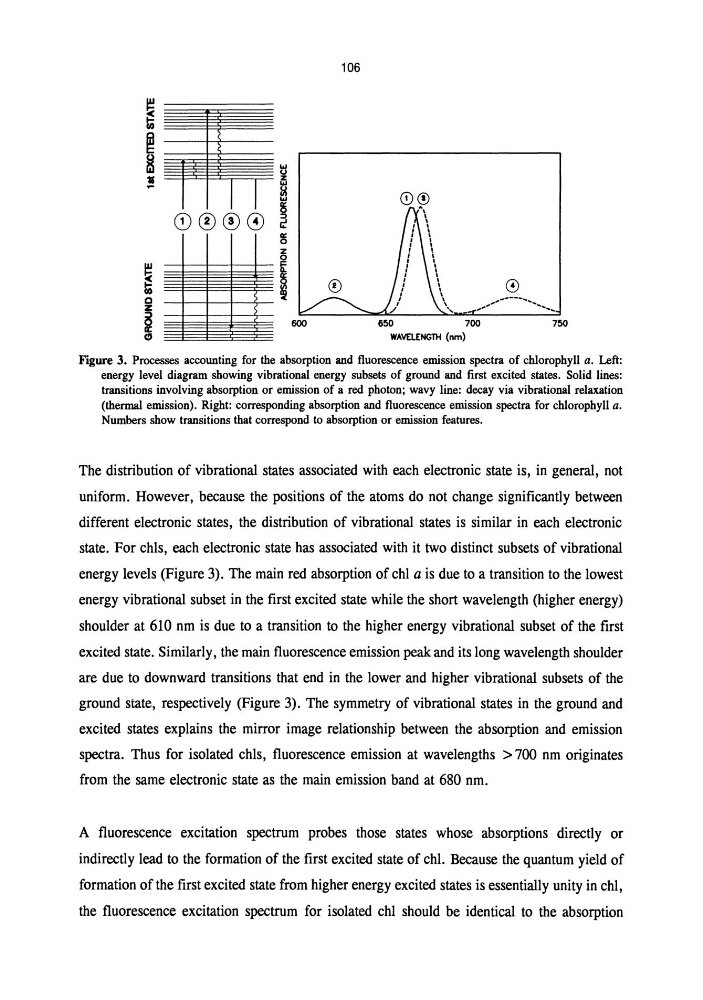
Figure 3. Processes accounting for the absorption and fluorescence emission spectra of chlorophyll a. Left:
energy level diagram showing vibrational energy subsets of ground and first excited states. Solid lines:
transitions involving absorption or emission of a red photon; wavy line: decay via vibrational relaxation
(thermal emission). Right: corresponding absorption and fluorescence emission spectra for chlorophyll a.
Numbers show transitions that correspond to absorption or emission features.
The distribution of vibrational states associated with each electronic state is, in general, not
uniform. However, because the positions of the atoms do not change significantly between
different electronic states, the distribution of vibrational states is similar in each electronic
state. For chIs, each electronic state has associated with it two distinct subsets of vibrational
energy levels (Figure 3). The main red absorption of chI a is due to a transition to the lowest
energy vibrational subset in the first excited state while the short wavelength (higher energy)
shoulder at 610 nm is due to a transition to the higher energy vibrational subset of the first
excited state. Similarly, the main fluorescence emission peak and its long wavelength shoulder
are due to downward transitions that end in the lower and higher vibrational subsets of the
ground state, respectively (Figure 3). The symmetry of vibrational states in the ground and
excited states explains the mirror image relationship between the absorption and emission
spectra. Thus for isolated chIs, fluorescence emission at wavelengths > 700 nm originates
from the same electronic state as the main emission band at 680 nm.
A fluorescence excitation spectrum probes those states whose absorptions directly or
indirectly lead to the formation of the first excited state of chI. Because the quantum yield of
formation of the first excited state from higher energy excited states is essentially unity in chI,
the fluorescence excitation spectrum for isolated chI should be identical to the absorption
... u
I I
~
II! ...
~
CD®®0
::;)
~
'" 0
z
0
i
600
WAVElENGTH (nm)
Figure 3. Processes accounting for the absorption and fluorescence emission spectra of chlorophyll a. Left:
energy level diagram showing vibrational energy subsets of ground and first excited states. Solid lines:
transitions involving absorption or emission of a red photon; wavy line: decay via vibrational relaxation
(thermal emission). Right: corresponding absorption and fluorescence emission spectra for chlorophyll a.
Numbers show transitions that correspond to absorption or emission features.
The distribution of vibrational states associated with each electronic state is, in general, not
uniform. However, because the positions of the atoms do not change significantly between
different electronic states, the distribution of vibrational states is similar in each electronic
state. For chIs, each electronic state has associated with it two distinct subsets of vibrational
energy levels (Figure 3). The main red absorption of chI a is due to a transition to the lowest
energy vibrational subset in the first excited state while the short wavelength (higher energy)
shoulder at 610 nm is due to a transition to the higher energy vibrational subset of the first
excited state. Similarly, the main fluorescence emission peak and its long wavelength shoulder
are due to downward transitions that end in the lower and higher vibrational subsets of the
ground state, respectively (Figure 3). The symmetry of vibrational states in the ground and
excited states explains the mirror image relationship between the absorption and emission
spectra. Thus for isolated chIs, fluorescence emission at wavelengths > 700 nm originates
from the same electronic state as the main emission band at 680 nm.
A fluorescence excitation spectrum probes those states whose absorptions directly or
indirectly lead to the formation of the first excited state of chI. Because the quantum yield of
formation of the first excited state from higher energy excited states is essentially unity in chI,
the fluorescence excitation spectrum for isolated chI should be identical to the absorption