

92
632
700
wavelength, nm
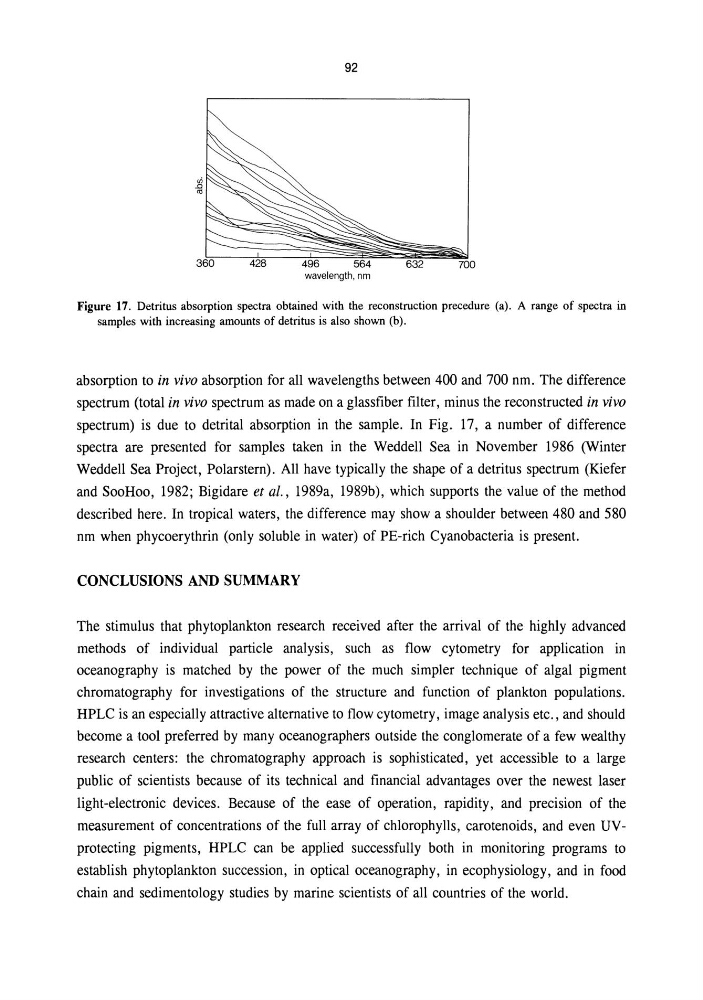
Figure 17. Detritus absorption spectra obtained with the reconstruction precedure (a). A range of spectra in
samples with increasing amounts of detritus is also shown (b).
absorption to in vivo absorption for all wavelengths between 400 and 700 nm. The difference
spectrum (total in vivo spectrum as made on a glassfiber filter, minus the reconstructed in vivo
spectrum) is due to detrital absorption in the sample. In Fig. 17, a number of difference
spectra are presented for samples taken in the Weddell Sea in November 1986 (Winter
Weddell Sea Project, Polarstern). All have typically the shape of a detritus spectrum (Kiefer
and SooHoo, 1982; Bigidare et al., 1989a, 1989b), which supports the value of the method
described here. In tropical waters, the difference may show a shoulder between 480 and 580
nm when phycoerythrin (only soluble in water) of PE-rich Cyanobacteria is present.
CONCLUSIONS AND SUMMARY
The stimulus that phytoplankton research received after the arrival of the highly advanced
methods of individual particle analysis, such as flow cytometry for application in
oceanography is matched by the power of the much simpler technique of algal pigment
chromatography for investigations of the structure and function of plankton populations.
HPLC is an especially attractive alternative to flow cytometry, image analysis etc., and should
become a tool preferred by many oceanographers outside the conglomerate of a few wealthy
research centers: the chromatography approach is sophisticated, yet accessible to a large
public of scientists because of its technical and financial advantages over the newest laser
light-electronic devices. Because of the ease of operation, rapidity, and precision of the
measurement of concentrations of the full array of chlorophylls, carotenoids, and even UVprotecting pigments, HPLC can be applied successfully both in monitoring programs to
establish phytoplankton succession, in optical oceanography, in ecophysiology, and in food
chain and sedimentology studies by marine scientists of all countries of the world.
632
700
wavelength, nm
Figure 17. Detritus absorption spectra obtained with the reconstruction precedure (a). A range of spectra in
samples with increasing amounts of detritus is also shown (b).
absorption to in vivo absorption for all wavelengths between 400 and 700 nm. The difference
spectrum (total in vivo spectrum as made on a glassfiber filter, minus the reconstructed in vivo
spectrum) is due to detrital absorption in the sample. In Fig. 17, a number of difference
spectra are presented for samples taken in the Weddell Sea in November 1986 (Winter
Weddell Sea Project, Polarstern). All have typically the shape of a detritus spectrum (Kiefer
and SooHoo, 1982; Bigidare et al., 1989a, 1989b), which supports the value of the method
described here. In tropical waters, the difference may show a shoulder between 480 and 580
nm when phycoerythrin (only soluble in water) of PE-rich Cyanobacteria is present.
CONCLUSIONS AND SUMMARY
The stimulus that phytoplankton research received after the arrival of the highly advanced
methods of individual particle analysis, such as flow cytometry for application in
oceanography is matched by the power of the much simpler technique of algal pigment
chromatography for investigations of the structure and function of plankton populations.
HPLC is an especially attractive alternative to flow cytometry, image analysis etc., and should
become a tool preferred by many oceanographers outside the conglomerate of a few wealthy
research centers: the chromatography approach is sophisticated, yet accessible to a large
public of scientists because of its technical and financial advantages over the newest laser
light-electronic devices. Because of the ease of operation, rapidity, and precision of the
measurement of concentrations of the full array of chlorophylls, carotenoids, and even UVprotecting pigments, HPLC can be applied successfully both in monitoring programs to
establish phytoplankton succession, in optical oceanography, in ecophysiology, and in food
chain and sedimentology studies by marine scientists of all countries of the world.