

NET AIR-SEA HEAT FLUX AND MERIDIONAL HEAT TRANSPORT
13
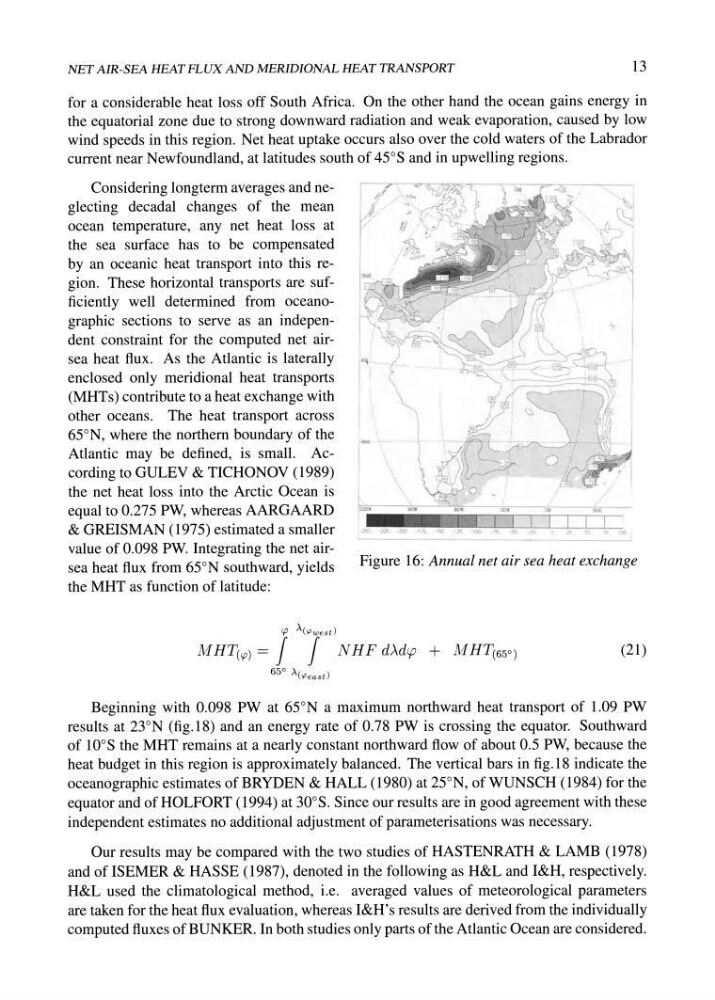
for a considerable heat loss off South Africa. On the other hand the ocean gains energy in
the equatorial zone due to strong downward radiation and weak evaporation, caused by low
wind speeds in this region. Net heat uptake occurs also over the cold waters of the Labrador
current near Newfoundland, at latitudes south of 45°S and in upwelling regions.
Considering longterm averages and neglecting decadal changes of the mean
ocean temperature, any net heat loss at
the sea surface has to be compensated
by an oceanic heat transport into this region. These horizontal transports are sufficiently well determined from oceanographic sections to serve as an independent constraint for the computed net airsea heat flux. As the Atlantic is laterally
I ' :
enclosed only meridional heat transports
(MHTs) contribute to a heat exchange with
other oceans. The heat transport across
65°N, where the northern boundary of the
Atlantic may be defined, is small. Ac''''.
cording to GULEV & TICHONOV (1989)
the net heat loss into the Arctic Ocean is
equal to 0.275 PW, whereas AARGAARD
& GREIS MAN (1975) estimated a smaller
value of 0.098 PW. Integrating the net airsea heat flux from 6SON southward, yields
Figure 16: Annual net air sea heat exchange
the MHT as function of latitude:
cp A('Pwest)
M HT(cp) = J J N H F d)"dcp + M HT(65°)
(21)
65
0 A ('Peas t)
Beginning with 0.098 PW at 6SON a maximum northward heat transport of 1.09 PW
results at 23°N (fig.18) and an energy rate of 0.78 PW is crossing the equator. Southward
of 100S the MHT remains at a nearly constant northward flow of about 0.5 PW, because the
heat budget in this region is approximately balanced. The vertical bars in fig.18 indicate the
oceanographic estimates of BRYDEN & HALL (1980) at 2SON, of WUNSCH (1984) for the
equator and of HOLFORT (1994) at 30° S. Since our results are in good agreement with these
independent estimates no additional adjustment of parameterisations was necessary.
Our results may be compared with the two studies of HASTENRATH & LAMB (1978)
and of ISEMER & HASSE (1987), denoted in the following as H&L and I&H, respectively.
H&L used the climatological method, i.e. averaged values of meteorological parameters
are taken for the heat flux evaluation, whereas I&H's results are derived from the individually
computed fluxes of BUNKER. In both studies only parts of the Atlantic Ocean are considered.
13
for a considerable heat loss off South Africa. On the other hand the ocean gains energy in
the equatorial zone due to strong downward radiation and weak evaporation, caused by low
wind speeds in this region. Net heat uptake occurs also over the cold waters of the Labrador
current near Newfoundland, at latitudes south of 45°S and in upwelling regions.
Considering longterm averages and neglecting decadal changes of the mean
ocean temperature, any net heat loss at
the sea surface has to be compensated
by an oceanic heat transport into this region. These horizontal transports are sufficiently well determined from oceanographic sections to serve as an independent constraint for the computed net airsea heat flux. As the Atlantic is laterally
I ' :
enclosed only meridional heat transports
(MHTs) contribute to a heat exchange with
other oceans. The heat transport across
65°N, where the northern boundary of the
Atlantic may be defined, is small. Ac''''.
cording to GULEV & TICHONOV (1989)
the net heat loss into the Arctic Ocean is
equal to 0.275 PW, whereas AARGAARD
& GREIS MAN (1975) estimated a smaller
value of 0.098 PW. Integrating the net airsea heat flux from 6SON southward, yields
Figure 16: Annual net air sea heat exchange
the MHT as function of latitude:
cp A('Pwest)
M HT(cp) = J J N H F d)"dcp + M HT(65°)
(21)
65
0 A ('Peas t)
Beginning with 0.098 PW at 6SON a maximum northward heat transport of 1.09 PW
results at 23°N (fig.18) and an energy rate of 0.78 PW is crossing the equator. Southward
of 100S the MHT remains at a nearly constant northward flow of about 0.5 PW, because the
heat budget in this region is approximately balanced. The vertical bars in fig.18 indicate the
oceanographic estimates of BRYDEN & HALL (1980) at 2SON, of WUNSCH (1984) for the
equator and of HOLFORT (1994) at 30° S. Since our results are in good agreement with these
independent estimates no additional adjustment of parameterisations was necessary.
Our results may be compared with the two studies of HASTENRATH & LAMB (1978)
and of ISEMER & HASSE (1987), denoted in the following as H&L and I&H, respectively.
H&L used the climatological method, i.e. averaged values of meteorological parameters
are taken for the heat flux evaluation, whereas I&H's results are derived from the individually
computed fluxes of BUNKER. In both studies only parts of the Atlantic Ocean are considered.