

Phytoplankton
9
Pacific
AUantic _
~~~~??:'~~'~CG'
0
'0
20
30
I
'0
:;
50
"- 50
OJ
C
10
0.0&
,
ao
• \
~ I
..,
. '
aOl '
'00
,
,
I
, -
.2
.3
E
...
~
.5
:;
.6
"- .1
OJ
C
."
.9
' .0
,.,
' .2
-50
o
50
100
150
0..,
1
!
200
250
,
,
, ,
300
350
Chla
[2 - O.SlJm]
I I
1 J
400
450
500
550
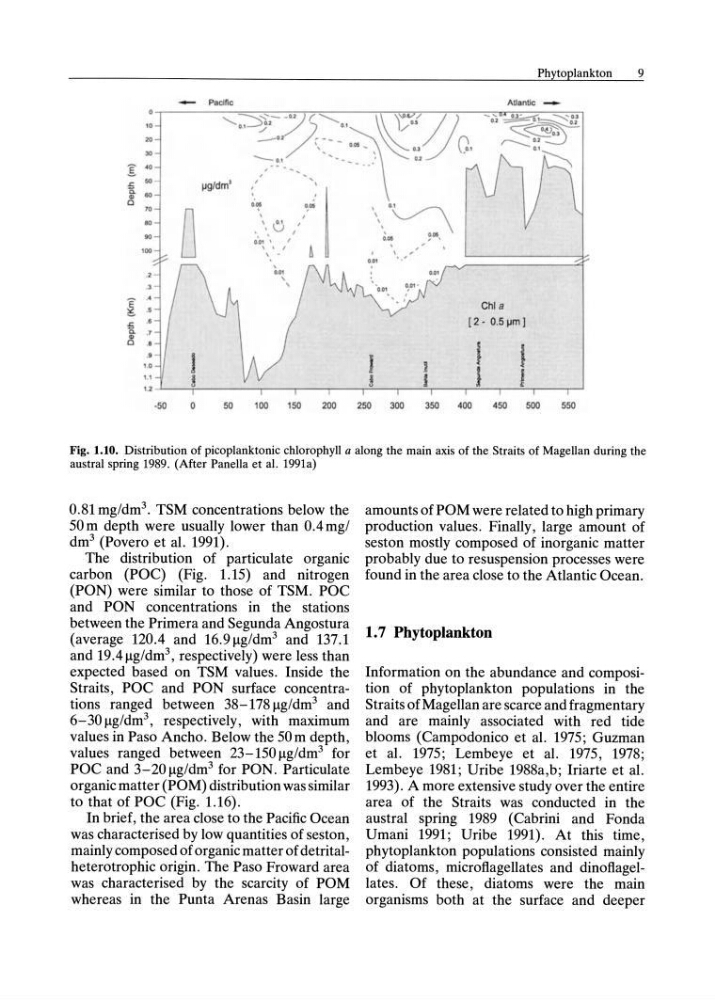
Fig. 1.10. Distribution of picoplanktonic chlorophyll a along the main axis of the Straits of Magellan during the
austral spring 1989. (After Panella et al. 1991a)
0.81 mg/dm 3 . TSM concentrations below the
50 m depth were usually lower than 0.4 mg/
dm 3 (Povero et al. 1991).
The distribution of particulate organic
carbon (POC) (Fig. 1.15) and nitrogen
(PON) were similar to those of TSM. POC
and PON concentrations in the stations
between the Primera and Segunda Angostura
(average 120.4 and 16.9 Jlg/dm3 and 137.1
and 19.4 Jlg/dm3, respectively) were less than
expected based on TSM values. Inside the
Straits, POC and PON surface concentrations ranged between 38-178 Jlg/dm3 and
6-30 Jlg/dm3, respectively, with maximum
values in Paso Ancho. Below the 50 m depth,
values ranged between 23-150 Jlg/dm3 for
POC and 3-20 Jlg/dm3 for PON. Particulate
organic matter (POM) distribution was similar
to that of POC (Fig. 1.16).
In brief, the area close to the Pacific Ocean
was characterised by low quantities of seston,
mainly composed of organic matter of detritalheterotrophic origin. The Paso Froward area
was characterised by the scarcity of POM
whereas in the Punta Arenas Basin large
amounts of POM were related to high primary
production values. Finally, large amount of
seston mostly composed of inorganic matter
probably due to resuspension processes were
found in the area close to the Atlantic Ocean.
1.7 Phytoplankton
Information on the abundance and composition of phytoplankton populations in the
Straits of Magellan are scarce and fragmentary
and are mainly associated with red tide
blooms (Campodonico et al. 1975; Guzman
et al. 1975; Lembeye et al. 1975, 1978;
Lembeye 1981; Uribe 1988a,b; Iriarte et al.
1993). A more extensive study over the entire
area of the Straits was conducted in the
austral spring 1989 (Cabrini and Fonda
Umani 1991; Uribe 1991). At this time,
phytoplankton populations consisted mainly
of diatoms, microflagellates and dinoflagellates. Of these, diatoms were the main
organisms both at the surface and deeper
9
Pacific
AUantic _
~~~~??:'~~'~CG'
0
'0
20
30
I
'0
:;
50
"- 50
OJ
C
10
0.0&
,
ao
• \
~ I
..,
. '
aOl '
'00
,
,
I
, -
.2
.3
E
...
~
.5
:;
.6
"- .1
OJ
C
."
.9
' .0
,.,
' .2
-50
o
50
100
150
0..,
1
!
200
250
,
,
, ,
300
350
Chla
[2 - O.SlJm]
I I
1 J
400
450
500
550
Fig. 1.10. Distribution of picoplanktonic chlorophyll a along the main axis of the Straits of Magellan during the
austral spring 1989. (After Panella et al. 1991a)
0.81 mg/dm 3 . TSM concentrations below the
50 m depth were usually lower than 0.4 mg/
dm 3 (Povero et al. 1991).
The distribution of particulate organic
carbon (POC) (Fig. 1.15) and nitrogen
(PON) were similar to those of TSM. POC
and PON concentrations in the stations
between the Primera and Segunda Angostura
(average 120.4 and 16.9 Jlg/dm3 and 137.1
and 19.4 Jlg/dm3, respectively) were less than
expected based on TSM values. Inside the
Straits, POC and PON surface concentrations ranged between 38-178 Jlg/dm3 and
6-30 Jlg/dm3, respectively, with maximum
values in Paso Ancho. Below the 50 m depth,
values ranged between 23-150 Jlg/dm3 for
POC and 3-20 Jlg/dm3 for PON. Particulate
organic matter (POM) distribution was similar
to that of POC (Fig. 1.16).
In brief, the area close to the Pacific Ocean
was characterised by low quantities of seston,
mainly composed of organic matter of detritalheterotrophic origin. The Paso Froward area
was characterised by the scarcity of POM
whereas in the Punta Arenas Basin large
amounts of POM were related to high primary
production values. Finally, large amount of
seston mostly composed of inorganic matter
probably due to resuspension processes were
found in the area close to the Atlantic Ocean.
1.7 Phytoplankton
Information on the abundance and composition of phytoplankton populations in the
Straits of Magellan are scarce and fragmentary
and are mainly associated with red tide
blooms (Campodonico et al. 1975; Guzman
et al. 1975; Lembeye et al. 1975, 1978;
Lembeye 1981; Uribe 1988a,b; Iriarte et al.
1993). A more extensive study over the entire
area of the Straits was conducted in the
austral spring 1989 (Cabrini and Fonda
Umani 1991; Uribe 1991). At this time,
phytoplankton populations consisted mainly
of diatoms, microflagellates and dinoflagellates. Of these, diatoms were the main
organisms both at the surface and deeper