

84
Chapter 10
Normally, a LAI increase translates in a decrease of red reflectance and
an increase in the NIR, in the absence of atmospheric perturbations. In the
present scenario, however, bright soil makes reflectances in NIR less
sensitive to LAI changes. AVHRR observations are largely affected by the
9.5 days viewing angle period, giving rise to variations much larger than the
variations resulting from the LAI increase. The angular effects are
completely different for geostationary observations. Solar angle changes
generate regular variations in the SEVIRI observations. Direct comparisons
between AVHRR and SEVIRI spectral observations are therefore irrelevant
if angular and atmospheric effects are not properly processed. Because of the
sampling differences, geostationary and polar observation systems require
dedicated retrieval algorithms.
Chapter 10
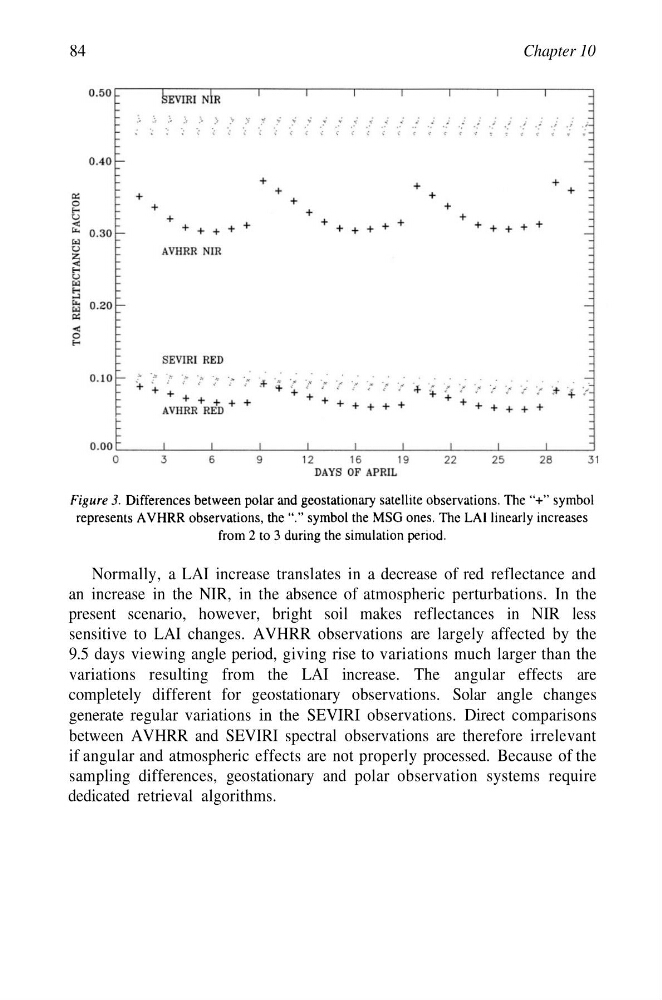
Normally, a LAI increase translates in a decrease of red reflectance and
an increase in the NIR, in the absence of atmospheric perturbations. In the
present scenario, however, bright soil makes reflectances in NIR less
sensitive to LAI changes. AVHRR observations are largely affected by the
9.5 days viewing angle period, giving rise to variations much larger than the
variations resulting from the LAI increase. The angular effects are
completely different for geostationary observations. Solar angle changes
generate regular variations in the SEVIRI observations. Direct comparisons
between AVHRR and SEVIRI spectral observations are therefore irrelevant
if angular and atmospheric effects are not properly processed. Because of the
sampling differences, geostationary and polar observation systems require
dedicated retrieval algorithms.