

320
Chapter 30
In addition to a real-time transmission mode, a data storage system is
often provided, with advance solutions typically based on solid-state
memory devices with capacities now reaching > 50 Gbit
The instrument control electronics which provides the command
interface to the platform, as well as mode and thermal control, plus some
fair amount of processing software
The in-flight calibration unit, for the VNIR and SWIR typically includes
a diffuser against Sun, or an aperture plate with small holes for direct
Sun viewing, and/or calibration lamps, integrating spheres (radiation sensitive), plus possibly active sources such as laser diodes for wavelength
calibration, if atmospheric absorption bands and the solar Fraunhofer
bands are not precise enough
In addition to the instrument space flight hardware, there is a
considerable demand for on-ground pre- and post-launch equipment for
the instrument’s assembly, alignment, performance and functional
testing and, after launch, for calibration and data processing.
The latter is still an area of basic research at least in Europe, as far as
algorithms are concerned
All these sub-units have to be designed, verified by finite element and
performance analyses harmonized on their interfaces, assembled and
verified, where necessary, by breadboarding and space qualification testing
prior to the submission to the platform and its integration. This is a long and
thoroughly planned activity, whose complexity may often exceed that of
designing the satellite itself.
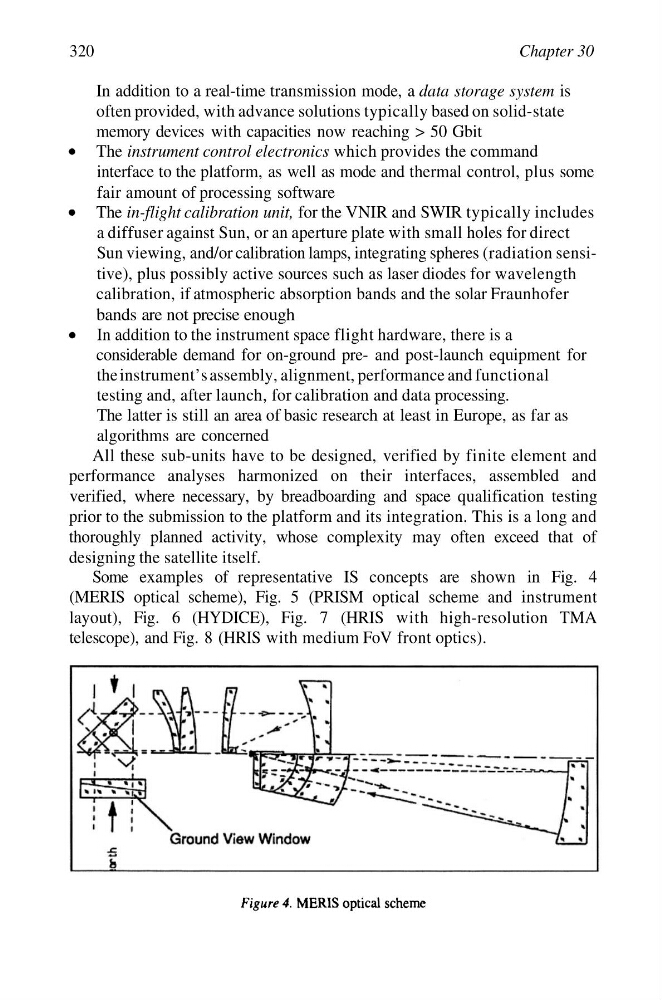
Some examples of representative IS concepts are shown in Fig. 4
(MERIS optical scheme), Fig. 5 (PRISM optical scheme and instrument
layout), Fig. 6 (HYDICE), Fig. 7 (HRIS with high-resolution TMA
telescope), and Fig. 8 (HRIS with medium FoV front optics).
Chapter 30
In addition to a real-time transmission mode, a data storage system is
often provided, with advance solutions typically based on solid-state
memory devices with capacities now reaching > 50 Gbit
The instrument control electronics which provides the command
interface to the platform, as well as mode and thermal control, plus some
fair amount of processing software
The in-flight calibration unit, for the VNIR and SWIR typically includes
a diffuser against Sun, or an aperture plate with small holes for direct
Sun viewing, and/or calibration lamps, integrating spheres (radiation sensitive), plus possibly active sources such as laser diodes for wavelength
calibration, if atmospheric absorption bands and the solar Fraunhofer
bands are not precise enough
In addition to the instrument space flight hardware, there is a
considerable demand for on-ground pre- and post-launch equipment for
the instrument’s assembly, alignment, performance and functional
testing and, after launch, for calibration and data processing.
The latter is still an area of basic research at least in Europe, as far as
algorithms are concerned
All these sub-units have to be designed, verified by finite element and
performance analyses harmonized on their interfaces, assembled and
verified, where necessary, by breadboarding and space qualification testing
prior to the submission to the platform and its integration. This is a long and
thoroughly planned activity, whose complexity may often exceed that of
designing the satellite itself.
Some examples of representative IS concepts are shown in Fig. 4
(MERIS optical scheme), Fig. 5 (PRISM optical scheme and instrument
layout), Fig. 6 (HYDICE), Fig. 7 (HRIS with high-resolution TMA
telescope), and Fig. 8 (HRIS with medium FoV front optics).