

254
Chapter 25
copper casing (5), is placed between two massive copper cylinders (2) with
blackened cavities (1). The upper block is heated by an electric current, the
lower block is either kept at the temperature of the surrounding air, or cooled
by a liquid with the help of a thermostat. The temperature of the radiators is
determined by mercury thermometers located in the walls of the cylinders.
To eliminate molecular heat transfer from the walls of the cavities to the
receiving surfaces, cooling by a faint airflow (arrows in Fig. 9) from a lowpowered ventilator is used. The air, flowing through the passage (4) between
the receiver and the casing, enters into the cavities of black bodies through
annular slots (7), flowing past the receiving surfaces (8), and leaves the
system through the openings (3). For the calibration of the sensor, it is
necessary to determine the dependence of the output signal of the net
radiometer on the difference of radiation fluxes of the radiators and on the
intensity of cooling by the airflow.
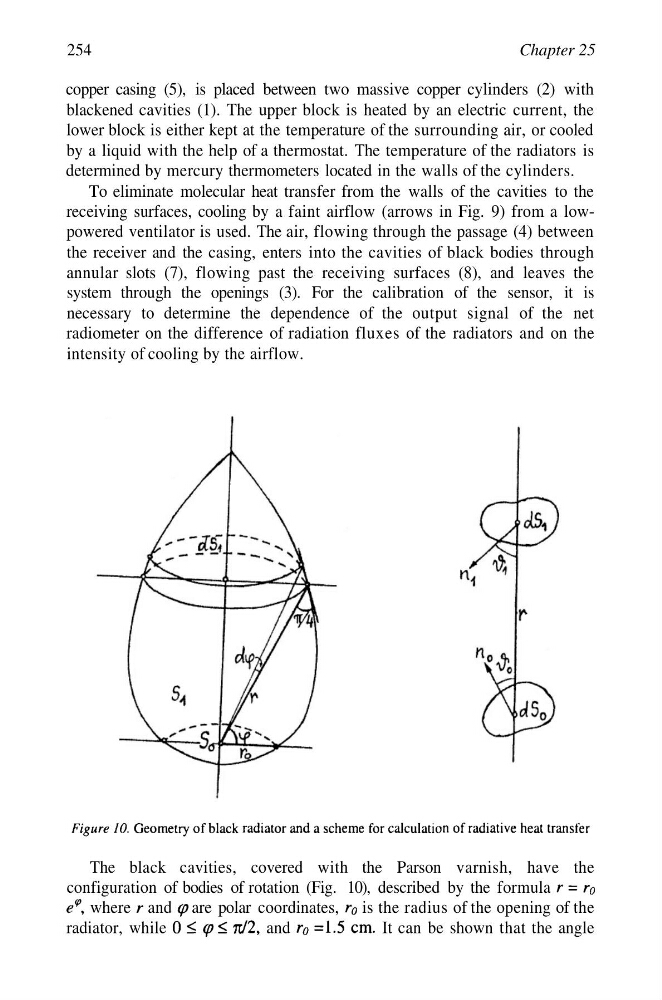
The black cavities, covered with the Parson varnish, have the
configuration of bodies of rotation (Fig. 10), described by the formula
where and are polar coordinates, is the radius of the opening of the
radiator, while
and
It can be shown that the angle
Chapter 25
copper casing (5), is placed between two massive copper cylinders (2) with
blackened cavities (1). The upper block is heated by an electric current, the
lower block is either kept at the temperature of the surrounding air, or cooled
by a liquid with the help of a thermostat. The temperature of the radiators is
determined by mercury thermometers located in the walls of the cylinders.
To eliminate molecular heat transfer from the walls of the cavities to the
receiving surfaces, cooling by a faint airflow (arrows in Fig. 9) from a lowpowered ventilator is used. The air, flowing through the passage (4) between
the receiver and the casing, enters into the cavities of black bodies through
annular slots (7), flowing past the receiving surfaces (8), and leaves the
system through the openings (3). For the calibration of the sensor, it is
necessary to determine the dependence of the output signal of the net
radiometer on the difference of radiation fluxes of the radiators and on the
intensity of cooling by the airflow.
The black cavities, covered with the Parson varnish, have the
configuration of bodies of rotation (Fig. 10), described by the formula
where and are polar coordinates, is the radius of the opening of the
radiator, while
and
It can be shown that the angle