

206
Chapter 21
In order to get most of the benefit from the BRDF the modeling of BRDF
has to be made for three types of snow, namely:
dry new snow
dry old snow, and
wet old snow.
These are the most common types of snow during winter and are closely
connected with the three different phases of snow. In order to be able to
make practical determination of snow reflectance for different incidence
angles a reference reflectance curve, e.g.,
deg., has to be determined
accurately for the whole selected range of the spectrum. The other parts of
the BRDF can then be determined with less measurements because the shape
of the reflectance curve seems not change much Wiscombe and Warren,
(1980). The three cases have to be modeled to get a complete understanding
of the behavior of the snow and to get basic information for the modeling of
the reflectance of the snow covered terrain.
When these BRDF’s are available the incidence angle image can be used
to interpret the reflectance in different parts of the image. This opens the
possibility to increase the accuracy of the interpretation of the snow
following characteristics: dry and wet snow, albedo age. As mentioned
earlier estimated nadir radiances could be useful method to compare
different images in snow characteristics interpretation.
3.3
Modeling of the snow covered terrain
In practice the terrain is very seldom totally snow covered. The area
inside the instantaneous field of view (IFOV) consists of trees, bushes,
bedrock and soil which can be partly or totally snow covered. When the
IFOV increases the possibility to get mixtures of these objects increases. The
next step in modeling is very demanding because we should be able to model
the reflectances of terrain which is partly or totally covered by snow. To
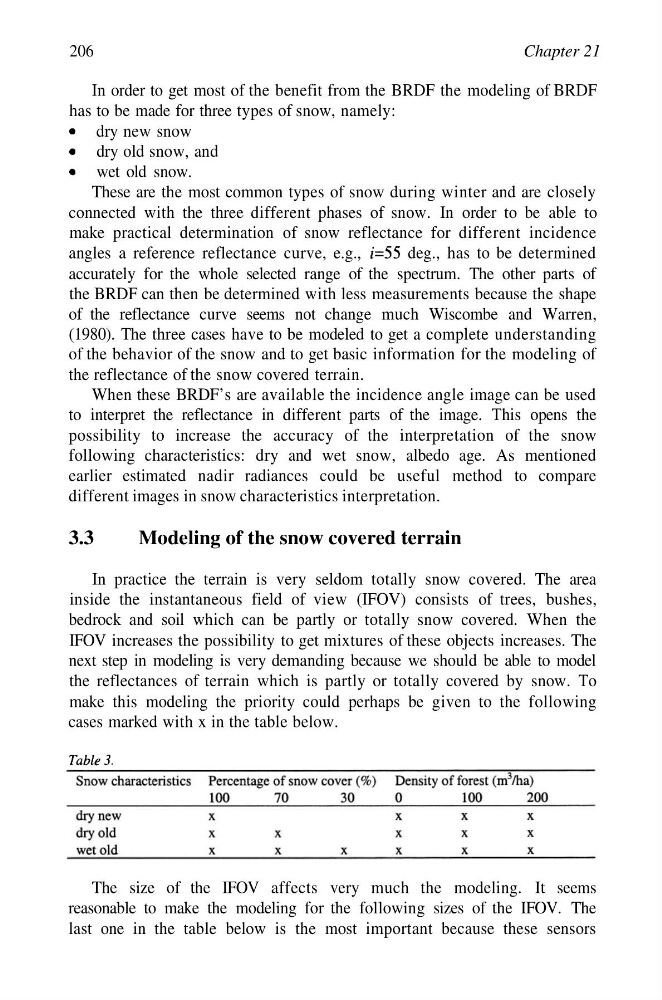
make this modeling the priority could perhaps be given to the following
cases marked with x in the table below.
The size of the IFOV affects very much the modeling. It seems
reasonable to make the modeling for the following sizes of the IFOV. The
last one in the table below is the most important because these sensors
Chapter 21
In order to get most of the benefit from the BRDF the modeling of BRDF
has to be made for three types of snow, namely:
dry new snow
dry old snow, and
wet old snow.
These are the most common types of snow during winter and are closely
connected with the three different phases of snow. In order to be able to
make practical determination of snow reflectance for different incidence
angles a reference reflectance curve, e.g.,
deg., has to be determined
accurately for the whole selected range of the spectrum. The other parts of
the BRDF can then be determined with less measurements because the shape
of the reflectance curve seems not change much Wiscombe and Warren,
(1980). The three cases have to be modeled to get a complete understanding
of the behavior of the snow and to get basic information for the modeling of
the reflectance of the snow covered terrain.
When these BRDF’s are available the incidence angle image can be used
to interpret the reflectance in different parts of the image. This opens the
possibility to increase the accuracy of the interpretation of the snow
following characteristics: dry and wet snow, albedo age. As mentioned
earlier estimated nadir radiances could be useful method to compare
different images in snow characteristics interpretation.
3.3
Modeling of the snow covered terrain
In practice the terrain is very seldom totally snow covered. The area
inside the instantaneous field of view (IFOV) consists of trees, bushes,
bedrock and soil which can be partly or totally snow covered. When the
IFOV increases the possibility to get mixtures of these objects increases. The
next step in modeling is very demanding because we should be able to model
the reflectances of terrain which is partly or totally covered by snow. To
make this modeling the priority could perhaps be given to the following
cases marked with x in the table below.
The size of the IFOV affects very much the modeling. It seems
reasonable to make the modeling for the following sizes of the IFOV. The
last one in the table below is the most important because these sensors