

194
Chapter 20
4.
A NEW STATISTICAL TREATMENT OF THE
GLOBAL PAR INSIDE THE PLANT CANOPY
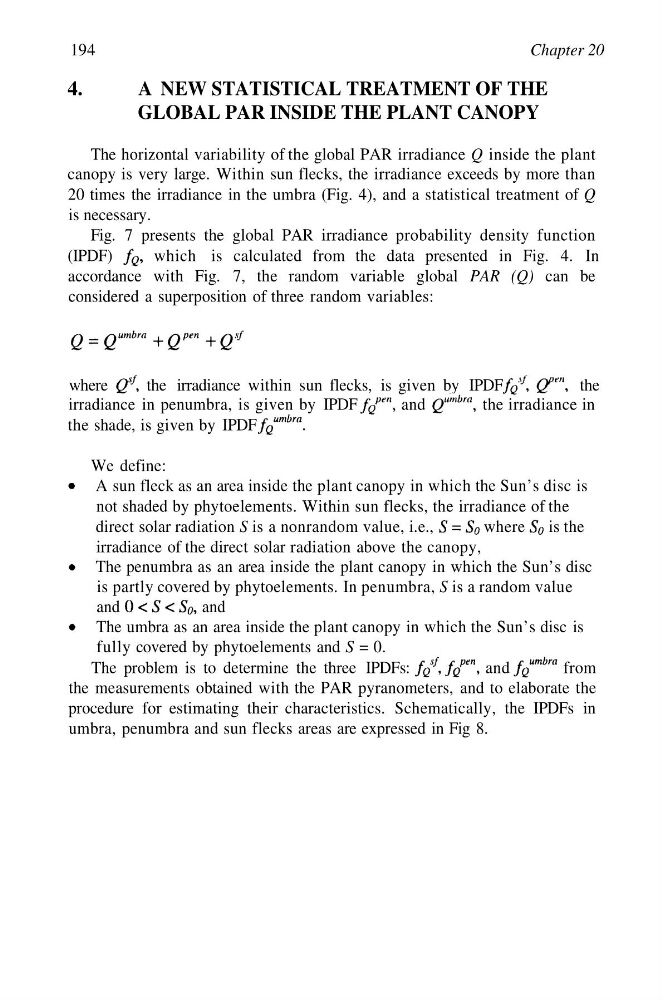
The horizontal variability of the global PAR irradiance Q inside the plant
canopy is very large. Within sun flecks, the irradiance exceeds by more than
20 times the irradiance in the umbra (Fig. 4), and a statistical treatment of Q
is necessary.
Fig. 7 presents the global PAR irradiance probability density function
(IPDF)
which is calculated from the data presented in Fig. 4. In
accordance with Fig. 7, the random variable global PAR (Q) can be
considered a superposition of three random variables:
where
the irradiance within sun flecks, is given by IPDF
the
irradiance in penumbra, is given by IPDF
and
the irradiance in
the shade, is given by IPDF
We define:
A sun fleck as an area inside the plant canopy in which the Sun’s disc is
not shaded by phytoelements. Within sun flecks, the irradiance of the
direct solar radiation S is a nonrandom value, i.e.,
where is the
irradiance of the direct solar radiation above the canopy,
The penumbra as an area inside the plant canopy in which the Sun’s disc
is partly covered by phytoelements. In penumbra, S is a random value
and
and
The umbra as an area inside the plant canopy in which the Sun’s disc is
fully covered by phytoelements and S = 0.
The problem is to determine the three IPDFs:
and
from
the measurements obtained with the PAR pyranometers, and to elaborate the
procedure for estimating their characteristics. Schematically, the IPDFs in
umbra, penumbra and sun flecks areas are expressed in Fig 8.
Chapter 20
4.
A NEW STATISTICAL TREATMENT OF THE
GLOBAL PAR INSIDE THE PLANT CANOPY
The horizontal variability of the global PAR irradiance Q inside the plant
canopy is very large. Within sun flecks, the irradiance exceeds by more than
20 times the irradiance in the umbra (Fig. 4), and a statistical treatment of Q
is necessary.
Fig. 7 presents the global PAR irradiance probability density function
(IPDF)
which is calculated from the data presented in Fig. 4. In
accordance with Fig. 7, the random variable global PAR (Q) can be
considered a superposition of three random variables:
where
the irradiance within sun flecks, is given by IPDF
the
irradiance in penumbra, is given by IPDF
and
the irradiance in
the shade, is given by IPDF
We define:
A sun fleck as an area inside the plant canopy in which the Sun’s disc is
not shaded by phytoelements. Within sun flecks, the irradiance of the
direct solar radiation S is a nonrandom value, i.e.,
where is the
irradiance of the direct solar radiation above the canopy,
The penumbra as an area inside the plant canopy in which the Sun’s disc
is partly covered by phytoelements. In penumbra, S is a random value
and
and
The umbra as an area inside the plant canopy in which the Sun’s disc is
fully covered by phytoelements and S = 0.
The problem is to determine the three IPDFs:
and
from
the measurements obtained with the PAR pyranometers, and to elaborate the
procedure for estimating their characteristics. Schematically, the IPDFs in
umbra, penumbra and sun flecks areas are expressed in Fig 8.