

188
Chapter 20
(see reviews by Ross, 1981 and Campbell and Norman, 1989, Norman and
Campell, 1989): linear sensors (Fassnacht et al., 1994), a set of sensors
located at chosen sites inside the canopy (Pearcy et al., 1990; SassenrathCole, 1995), or distributed along attached rod (e.g., ceptometer, Fassnacht et
al., 1994), moving sensors on rod (Niilisk, 1969; Laisk, 1968, Tooming,
reviewed in Ross, 1981), moving trams (Baldocchi et al., 1984; 1986, Chen,
Black, 1992) or traversing system (Allen, Lemon, 1972).
In this work, linear averaging across the row direction using the moving
sensor on a horizontal rod has been used. The following quantities were also
measured on a 12-meter mast above the canopy: the irradiance, the global
radiation Q, the photosynthetically active global radiation PAR (Q), the
corresponding reflected fluxes and net radiation, as well as the direct solar
radiation S and PAR (S).
2.
MEASUREMENTS AND DATA PROCESSING
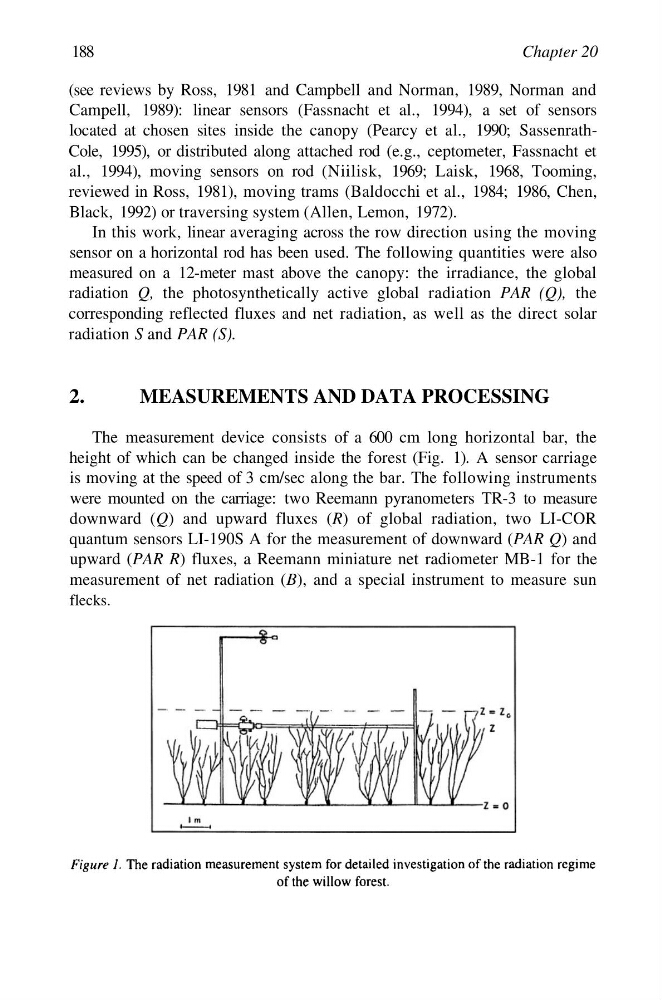
The measurement device consists of a 600 cm long horizontal bar, the
height of which can be changed inside the forest (Fig. 1). A sensor carriage
is moving at the speed of 3 cm/sec along the bar. The following instruments
were mounted on the carriage: two Reemann pyranometers TR-3 to measure
downward (Q) and upward fluxes (R) of global radiation, two LI-COR
quantum sensors LI-190S A for the measurement of downward (PAR Q) and
upward (PAR R) fluxes, a Reemann miniature net radiometer MB-1 for the
measurement of net radiation (B), and a special instrument to measure sun
flecks.
Chapter 20
(see reviews by Ross, 1981 and Campbell and Norman, 1989, Norman and
Campell, 1989): linear sensors (Fassnacht et al., 1994), a set of sensors
located at chosen sites inside the canopy (Pearcy et al., 1990; SassenrathCole, 1995), or distributed along attached rod (e.g., ceptometer, Fassnacht et
al., 1994), moving sensors on rod (Niilisk, 1969; Laisk, 1968, Tooming,
reviewed in Ross, 1981), moving trams (Baldocchi et al., 1984; 1986, Chen,
Black, 1992) or traversing system (Allen, Lemon, 1972).
In this work, linear averaging across the row direction using the moving
sensor on a horizontal rod has been used. The following quantities were also
measured on a 12-meter mast above the canopy: the irradiance, the global
radiation Q, the photosynthetically active global radiation PAR (Q), the
corresponding reflected fluxes and net radiation, as well as the direct solar
radiation S and PAR (S).
2.
MEASUREMENTS AND DATA PROCESSING
The measurement device consists of a 600 cm long horizontal bar, the
height of which can be changed inside the forest (Fig. 1). A sensor carriage
is moving at the speed of 3 cm/sec along the bar. The following instruments
were mounted on the carriage: two Reemann pyranometers TR-3 to measure
downward (Q) and upward fluxes (R) of global radiation, two LI-COR
quantum sensors LI-190S A for the measurement of downward (PAR Q) and
upward (PAR R) fluxes, a Reemann miniature net radiometer MB-1 for the
measurement of net radiation (B), and a special instrument to measure sun
flecks.