

19. REMOTE SENSING OF ALBEDO USING THE BRDF IN
RELATION TO LAND SURFACE PROPERTIES
183
5.
INTERPRETING ALBEDO IN TERMS OF
SURFACE PROPERTIES: AN IDEA
The results shown above demonstrate that the shape of the BRDF, here
expressed as the magnitude of the solar zenith angle-dependence of albedo,
is related to the amount of vegetation present and to the gaps in the canopy
as well as urban protrusions, causing either radiative transfer-type scattering
by the canopy leaves or visibility of shadows in the scene due to its threedimensional structure.
This leads to speculation as to whether the BRDF model parameters for
volume and for geometric scattering may be directly interpretable in terms of
these types of scattering. If this were the case, then one could attempt a
subsequent step of renormalizing each type of scattering empirically to
biophysical qualities of interest to land surface modeling. Particularly, the
mathematical expressions for the kernels and the retrieved parameters reveal
that they are related to LAI and surface structure (Wanner et al., 1995). The
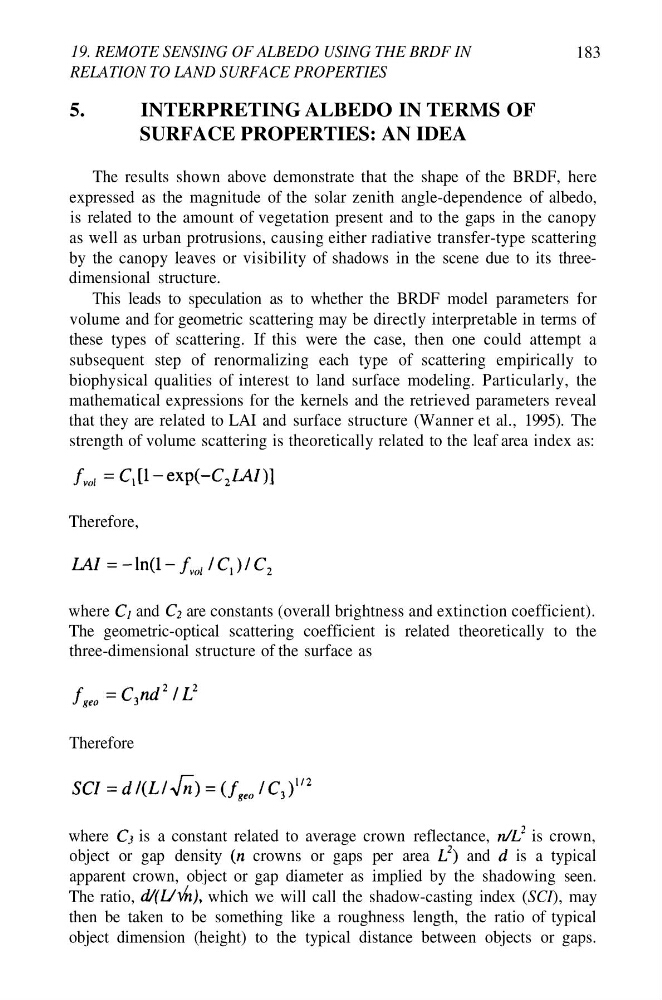
strength of volume scattering is theoretically related to the leaf area index as:
Therefore,
where
and
are constants (overall brightness and extinction coefficient).
The geometric-optical scattering coefficient is related theoretically to the
three-dimensional structure of the surface as
Therefore
where
is a constant related to average crown reflectance,
is crown,
object or gap density
crowns or gaps per area
and is a typical
apparent crown, object or gap diameter as implied by the shadowing seen.
The ratio,
which we will call the shadow-casting index (SCI), may
then be taken to be something like a roughness length, the ratio of typical
object dimension (height) to the typical distance between objects or gaps.
RELATION TO LAND SURFACE PROPERTIES
183
5.
INTERPRETING ALBEDO IN TERMS OF
SURFACE PROPERTIES: AN IDEA
The results shown above demonstrate that the shape of the BRDF, here
expressed as the magnitude of the solar zenith angle-dependence of albedo,
is related to the amount of vegetation present and to the gaps in the canopy
as well as urban protrusions, causing either radiative transfer-type scattering
by the canopy leaves or visibility of shadows in the scene due to its threedimensional structure.
This leads to speculation as to whether the BRDF model parameters for
volume and for geometric scattering may be directly interpretable in terms of
these types of scattering. If this were the case, then one could attempt a
subsequent step of renormalizing each type of scattering empirically to
biophysical qualities of interest to land surface modeling. Particularly, the
mathematical expressions for the kernels and the retrieved parameters reveal
that they are related to LAI and surface structure (Wanner et al., 1995). The
strength of volume scattering is theoretically related to the leaf area index as:
Therefore,
where
and
are constants (overall brightness and extinction coefficient).
The geometric-optical scattering coefficient is related theoretically to the
three-dimensional structure of the surface as
Therefore
where
is a constant related to average crown reflectance,
is crown,
object or gap density
crowns or gaps per area
and is a typical
apparent crown, object or gap diameter as implied by the shadowing seen.
The ratio,
which we will call the shadow-casting index (SCI), may
then be taken to be something like a roughness length, the ratio of typical
object dimension (height) to the typical distance between objects or gaps.