

178
Chapter 19
dense stands, leading to shadow casting and mutual shadowing, is given
by approximations to the geometric-optical theory by Li and Strahler
(1992). It is given by the so-called LiSparse kernel
(Wanner et al.,
1995).
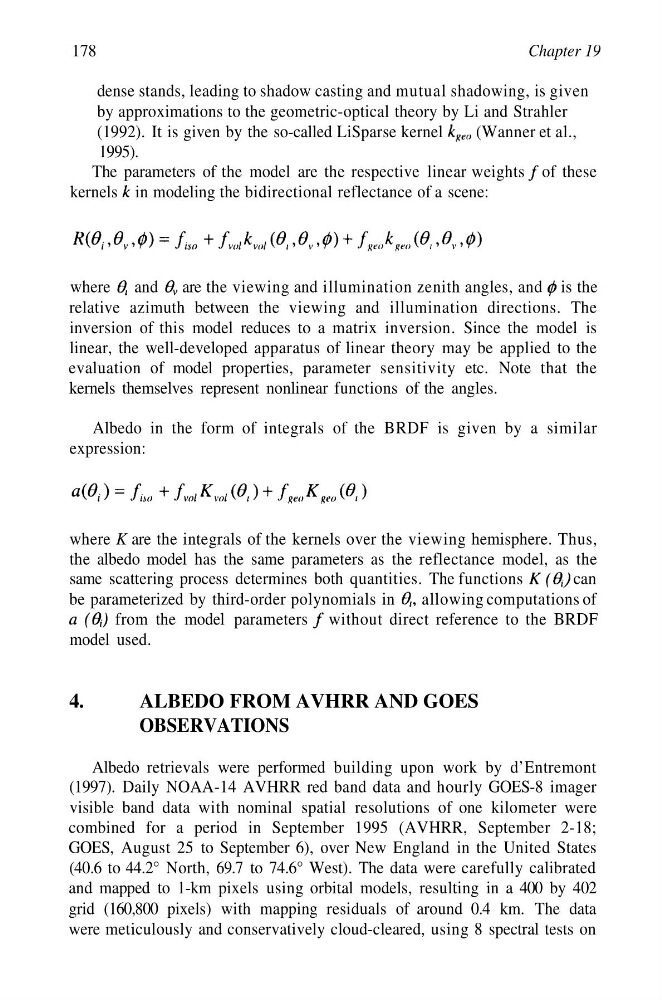
The parameters of the model are the respective linear weights of these
kernels in modeling the bidirectional reflectance of a scene:
where and are the viewing and illumination zenith angles, and is the
relative azimuth between the viewing and illumination directions. The
inversion of this model reduces to a matrix inversion. Since the model is
linear, the well-developed apparatus of linear theory may be applied to the
evaluation of model properties, parameter sensitivity etc. Note that the
kernels themselves represent nonlinear functions of the angles.
Albedo in the form of integrals of the BRDF is given by a similar
expression:
where K are the integrals of the kernels over the viewing hemisphere. Thus,
the albedo model has the same parameters as the reflectance model, as the
same scattering process determines both quantities. The functions
can
be parameterized by third-order polynomials in
allowing computations of
from the model parameters without direct reference to the BRDF
model used.
4.
ALBEDO FROM AVHRR AND GOES
OBSERVATIONS
Albedo retrievals were performed building upon work by d’Entremont
(1997). Daily NOAA-14 AVHRR red band data and hourly GOES-8 imager
visible band data with nominal spatial resolutions of one kilometer were
combined for a period in September 1995 (AVHRR, September 2-18;
GOES, August 25 to September 6), over New England in the United States
(40.6 to 44.2° North, 69.7 to 74.6° West). The data were carefully calibrated
and mapped to 1-km pixels using orbital models, resulting in a 400 by 402
grid (160,800 pixels) with mapping residuals of around 0.4 km. The data
were meticulously and conservatively cloud-cleared, using 8 spectral tests on
Chapter 19
dense stands, leading to shadow casting and mutual shadowing, is given
by approximations to the geometric-optical theory by Li and Strahler
(1992). It is given by the so-called LiSparse kernel
(Wanner et al.,
1995).
The parameters of the model are the respective linear weights of these
kernels in modeling the bidirectional reflectance of a scene:
where and are the viewing and illumination zenith angles, and is the
relative azimuth between the viewing and illumination directions. The
inversion of this model reduces to a matrix inversion. Since the model is
linear, the well-developed apparatus of linear theory may be applied to the
evaluation of model properties, parameter sensitivity etc. Note that the
kernels themselves represent nonlinear functions of the angles.
Albedo in the form of integrals of the BRDF is given by a similar
expression:
where K are the integrals of the kernels over the viewing hemisphere. Thus,
the albedo model has the same parameters as the reflectance model, as the
same scattering process determines both quantities. The functions
can
be parameterized by third-order polynomials in
allowing computations of
from the model parameters without direct reference to the BRDF
model used.
4.
ALBEDO FROM AVHRR AND GOES
OBSERVATIONS
Albedo retrievals were performed building upon work by d’Entremont
(1997). Daily NOAA-14 AVHRR red band data and hourly GOES-8 imager
visible band data with nominal spatial resolutions of one kilometer were
combined for a period in September 1995 (AVHRR, September 2-18;
GOES, August 25 to September 6), over New England in the United States
(40.6 to 44.2° North, 69.7 to 74.6° West). The data were carefully calibrated
and mapped to 1-km pixels using orbital models, resulting in a 400 by 402
grid (160,800 pixels) with mapping residuals of around 0.4 km. The data
were meticulously and conservatively cloud-cleared, using 8 spectral tests on