

18. SOME RESEARCH AND APPLICATIONS IN THE CSIRO
(AUSTRALIA) EARTH OBSERVATION CENTRE ON SCENE
BRIGHTNESS DUE TO BRDF
171
How can we make sense of such a result when the objective is not just to
fit data but to interpret the results in terms of the land cover? To try and
overcome this, we also fitted the models with Li Sparse (which with its
shape parameters at 2.0 matches the structure we know from associated field
data, models and both DATM and photographic data) and the Walthall
model. The reason for this was that the Walthall model could be seen as the
tool to model the (symmetric) multiple scattering leaving the Li Sparse to fit
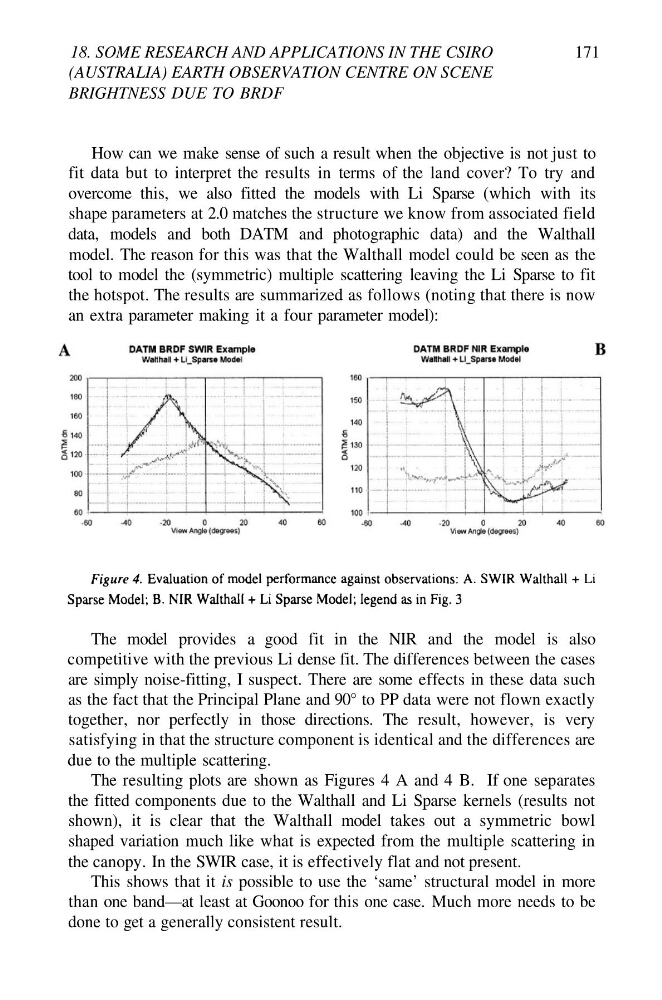
the hotspot. The results are summarized as follows (noting that there is now
an extra parameter making it a four parameter model):
The model provides a good fit in the NIR and the model is also
competitive with the previous Li dense fit. The differences between the cases
are simply noise-fitting, I suspect. There are some effects in these data such
as the fact that the Principal Plane and 90° to PP data were not flown exactly
together, nor perfectly in those directions. The result, however, is very
satisfying in that the structure component is identical and the differences are
due to the multiple scattering.
The resulting plots are shown as Figures 4 A and 4 B. If one separates
the fitted components due to the Walthall and Li Sparse kernels (results not
shown), it is clear that the Walthall model takes out a symmetric bowl
shaped variation much like what is expected from the multiple scattering in
the canopy. In the SWIR case, it is effectively flat and not present.
This shows that it is possible to use the ‘same’ structural model in more
than one band—at least at Goonoo for this one case. Much more needs to be
done to get a generally consistent result.
(AUSTRALIA) EARTH OBSERVATION CENTRE ON SCENE
BRIGHTNESS DUE TO BRDF
171
How can we make sense of such a result when the objective is not just to
fit data but to interpret the results in terms of the land cover? To try and
overcome this, we also fitted the models with Li Sparse (which with its
shape parameters at 2.0 matches the structure we know from associated field
data, models and both DATM and photographic data) and the Walthall
model. The reason for this was that the Walthall model could be seen as the
tool to model the (symmetric) multiple scattering leaving the Li Sparse to fit
the hotspot. The results are summarized as follows (noting that there is now
an extra parameter making it a four parameter model):
The model provides a good fit in the NIR and the model is also
competitive with the previous Li dense fit. The differences between the cases
are simply noise-fitting, I suspect. There are some effects in these data such
as the fact that the Principal Plane and 90° to PP data were not flown exactly
together, nor perfectly in those directions. The result, however, is very
satisfying in that the structure component is identical and the differences are
due to the multiple scattering.
The resulting plots are shown as Figures 4 A and 4 B. If one separates
the fitted components due to the Walthall and Li Sparse kernels (results not
shown), it is clear that the Walthall model takes out a symmetric bowl
shaped variation much like what is expected from the multiple scattering in
the canopy. In the SWIR case, it is effectively flat and not present.
This shows that it is possible to use the ‘same’ structural model in more
than one band—at least at Goonoo for this one case. Much more needs to be
done to get a generally consistent result.