

18. SOME RESEARCH AND APPLICATIONS IN THE CSIRO
(AUSTRALIA) EARTH OBSERVATION CENTRE ON SCENE
BRIGHTNESS DUE TO BRDF
169
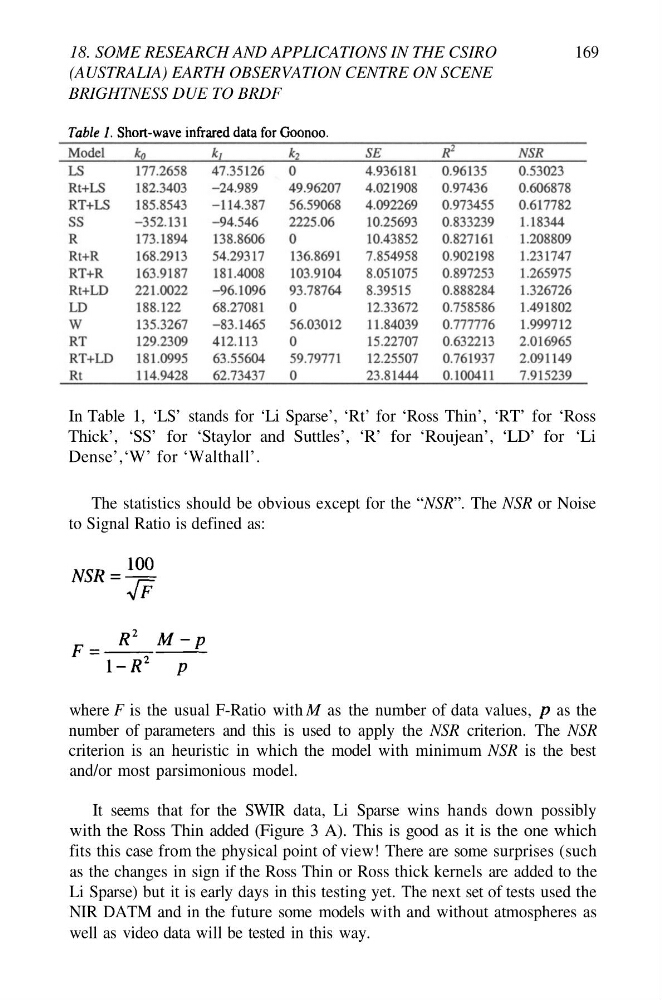
In Table 1, ‘LS’ stands for ‘Li Sparse’, ‘Rt’ for ‘Ross Thin’, ‘RT’ for ‘Ross
Thick’, ‘SS’ for ‘Staylor and Suttles’, ‘R’ for ‘Roujean’, ‘LD’ for ‘Li
Dense’,‘W’ for ‘Walthall’.
The statistics should be obvious except for the “NSR”. The NSR or Noise
to Signal Ratio is defined as:
where F is the usual F-Ratio with M as the number of data values, as the
number of parameters and this is used to apply the NSR criterion. The NSR
criterion is an heuristic in which the model with minimum NSR is the best
and/or most parsimonious model.
It seems that for the SWIR data, Li Sparse wins hands down possibly
with the Ross Thin added (Figure 3 A). This is good as it is the one which
fits this case from the physical point of view! There are some surprises (such
as the changes in sign if the Ross Thin or Ross thick kernels are added to the
Li Sparse) but it is early days in this testing yet. The next set of tests used the
NIR DATM and in the future some models with and without atmospheres as
well as video data will be tested in this way.
(AUSTRALIA) EARTH OBSERVATION CENTRE ON SCENE
BRIGHTNESS DUE TO BRDF
169
In Table 1, ‘LS’ stands for ‘Li Sparse’, ‘Rt’ for ‘Ross Thin’, ‘RT’ for ‘Ross
Thick’, ‘SS’ for ‘Staylor and Suttles’, ‘R’ for ‘Roujean’, ‘LD’ for ‘Li
Dense’,‘W’ for ‘Walthall’.
The statistics should be obvious except for the “NSR”. The NSR or Noise
to Signal Ratio is defined as:
where F is the usual F-Ratio with M as the number of data values, as the
number of parameters and this is used to apply the NSR criterion. The NSR
criterion is an heuristic in which the model with minimum NSR is the best
and/or most parsimonious model.
It seems that for the SWIR data, Li Sparse wins hands down possibly
with the Ross Thin added (Figure 3 A). This is good as it is the one which
fits this case from the physical point of view! There are some surprises (such
as the changes in sign if the Ross Thin or Ross thick kernels are added to the
Li Sparse) but it is early days in this testing yet. The next set of tests used the
NIR DATM and in the future some models with and without atmospheres as
well as video data will be tested in this way.