

18. SOME RESEARCH AND APPLICATIONS IN THE CSIRO
(AUSTRALIA) EARTH OBSERVATION CENTRE ON SCENE
BRIGHTNESS DUE TO BRDF
167
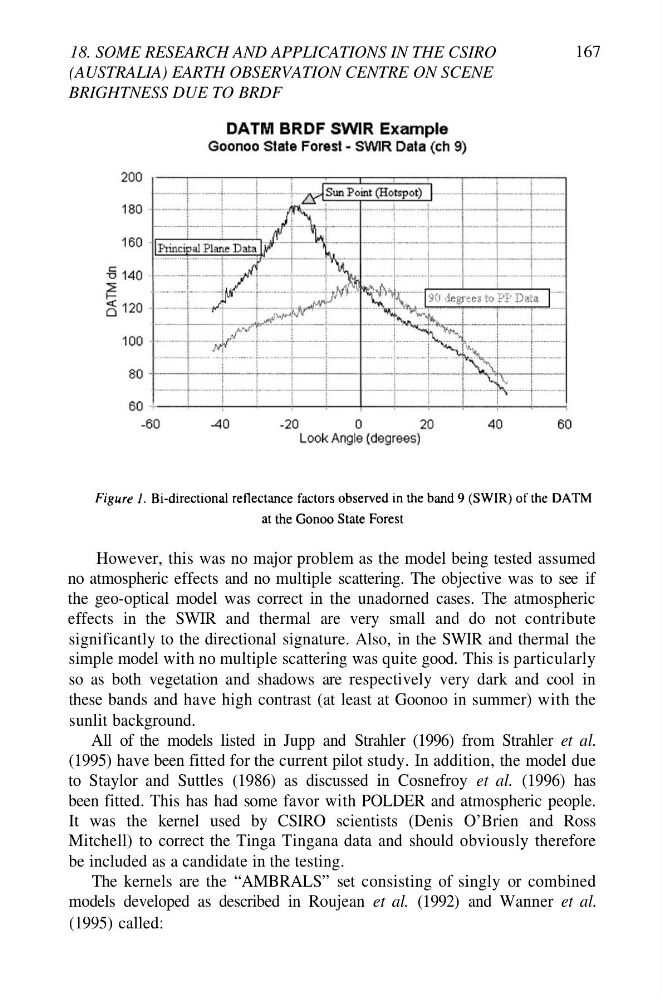
However, this was no major problem as the model being tested assumed
no atmospheric effects and no multiple scattering. The objective was to see if
the geo-optical model was correct in the unadorned cases. The atmospheric
effects in the SWIR and thermal are very small and do not contribute
significantly to the directional signature. Also, in the SWIR and thermal the
simple model with no multiple scattering was quite good. This is particularly
so as both vegetation and shadows are respectively very dark and cool in
these bands and have high contrast (at least at Goonoo in summer) with the
sunlit background.
All of the models listed in Jupp and Strahler (1996) from Strahler et al.
(1995) have been fitted for the current pilot study. In addition, the model due
to Staylor and Suttles (1986) as discussed in Cosnefroy et al. (1996) has
been fitted. This has had some favor with POLDER and atmospheric people.
It was the kernel used by CSIRO scientists (Denis O’Brien and Ross
Mitchell) to correct the Tinga Tingana data and should obviously therefore
be included as a candidate in the testing.
The kernels are the “AMBRALS” set consisting of singly or combined
models developed as described in Roujean et al. (1992) and Wanner et al.
(1995) called:
(AUSTRALIA) EARTH OBSERVATION CENTRE ON SCENE
BRIGHTNESS DUE TO BRDF
167
However, this was no major problem as the model being tested assumed
no atmospheric effects and no multiple scattering. The objective was to see if
the geo-optical model was correct in the unadorned cases. The atmospheric
effects in the SWIR and thermal are very small and do not contribute
significantly to the directional signature. Also, in the SWIR and thermal the
simple model with no multiple scattering was quite good. This is particularly
so as both vegetation and shadows are respectively very dark and cool in
these bands and have high contrast (at least at Goonoo in summer) with the
sunlit background.
All of the models listed in Jupp and Strahler (1996) from Strahler et al.
(1995) have been fitted for the current pilot study. In addition, the model due
to Staylor and Suttles (1986) as discussed in Cosnefroy et al. (1996) has
been fitted. This has had some favor with POLDER and atmospheric people.
It was the kernel used by CSIRO scientists (Denis O’Brien and Ross
Mitchell) to correct the Tinga Tingana data and should obviously therefore
be included as a candidate in the testing.
The kernels are the “AMBRALS” set consisting of singly or combined
models developed as described in Roujean et al. (1992) and Wanner et al.
(1995) called: