

16. A NEW APPROACH TO CHARACTERIZE GLOBAL LAND
SURFACES
145
model implements a statistical description of the discrete nature of the
canopy to relax the usual continuous (turbid) medium assumption, and
includes an explicit representation of architectural effects for homogeneous
canopies. The first two orders of scattering (by the soil and by plant leaves)
are calculated in three-dimensional space using an adaptation of the original
discrete model developed by Verstraete (1987) for the extinction of the
direct incoming solar radiation in vegetation canopies. This statistical
representation of the canopy architecture permits an explicit representation
of the hot spot phenomenon in these first two orders of scattering, adapted
from Verstraete et al. (1990).
The multiple scattering contribution is calculated with a Discrete
Ordinates Method using an azimuthally averaged expression of the
anisotropic scattering phase function proposed by Shultis and Myneni
(1988). Extensive comparisons against a Ray-tracing model (Govaerts and
Verstraete, 1995) simulating homogeneous canopies have shown the high
performance of this semi-discrete model (see also Gobron et al. 1997).
The choice of a one-dimensional model reflects 1) the fact that no reliable
ancillary information is available globally to run three-dimensional models,
2) the need to limit computational costs to permit the processing of global
data and 3) the requirement to consider a large enough selection of radiative
transfer variables values.
2.2
Design of the inversion algorithm
The inversion algorithm then consists in identifying the most probable
solutions amongst the set of possible solutions predefined in the LUT. It
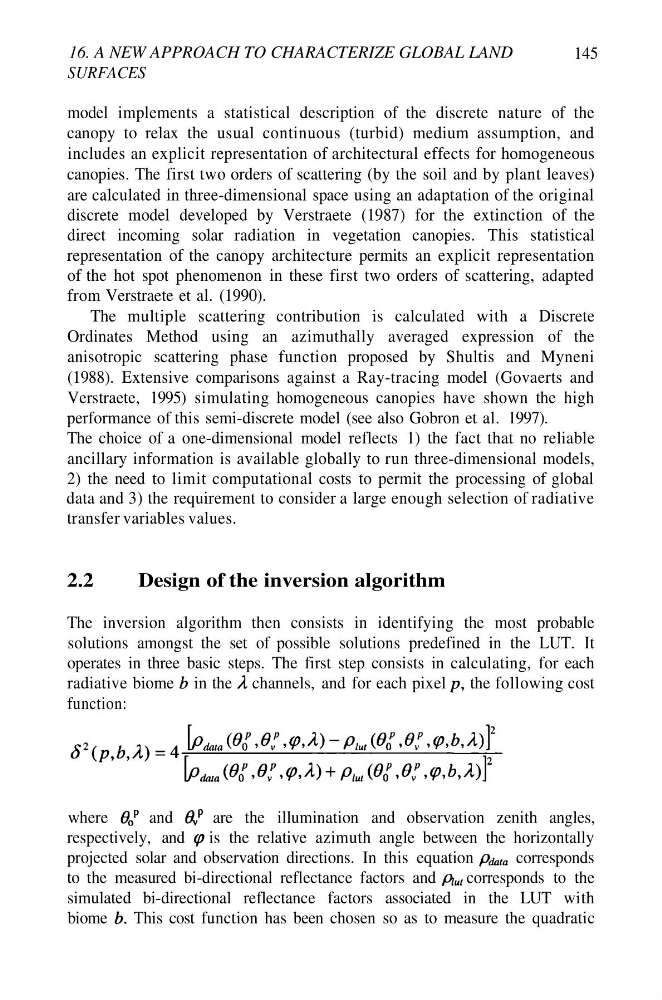
operates in three basic steps. The first step consists in calculating, for each
radiative biome in the channels, and for each pixel the following cost
function:
where
and
are the illumination and observation zenith angles,
respectively, and is the relative azimuth angle between the horizontally
projected solar and observation directions. In this equation
corresponds
to the measured bi-directional reflectance factors and
corresponds to the
simulated bi-directional reflectance factors associated in the LUT with
biome This cost function has been chosen so as to measure the quadratic
SURFACES
145
model implements a statistical description of the discrete nature of the
canopy to relax the usual continuous (turbid) medium assumption, and
includes an explicit representation of architectural effects for homogeneous
canopies. The first two orders of scattering (by the soil and by plant leaves)
are calculated in three-dimensional space using an adaptation of the original
discrete model developed by Verstraete (1987) for the extinction of the
direct incoming solar radiation in vegetation canopies. This statistical
representation of the canopy architecture permits an explicit representation
of the hot spot phenomenon in these first two orders of scattering, adapted
from Verstraete et al. (1990).
The multiple scattering contribution is calculated with a Discrete
Ordinates Method using an azimuthally averaged expression of the
anisotropic scattering phase function proposed by Shultis and Myneni
(1988). Extensive comparisons against a Ray-tracing model (Govaerts and
Verstraete, 1995) simulating homogeneous canopies have shown the high
performance of this semi-discrete model (see also Gobron et al. 1997).
The choice of a one-dimensional model reflects 1) the fact that no reliable
ancillary information is available globally to run three-dimensional models,
2) the need to limit computational costs to permit the processing of global
data and 3) the requirement to consider a large enough selection of radiative
transfer variables values.
2.2
Design of the inversion algorithm
The inversion algorithm then consists in identifying the most probable
solutions amongst the set of possible solutions predefined in the LUT. It
operates in three basic steps. The first step consists in calculating, for each
radiative biome in the channels, and for each pixel the following cost
function:
where
and
are the illumination and observation zenith angles,
respectively, and is the relative azimuth angle between the horizontally
projected solar and observation directions. In this equation
corresponds
to the measured bi-directional reflectance factors and
corresponds to the
simulated bi-directional reflectance factors associated in the LUT with
biome This cost function has been chosen so as to measure the quadratic