

fluorescence between 685 and 710 nm and the red chlorophyll absorption band between
about 670 and 675 nm.
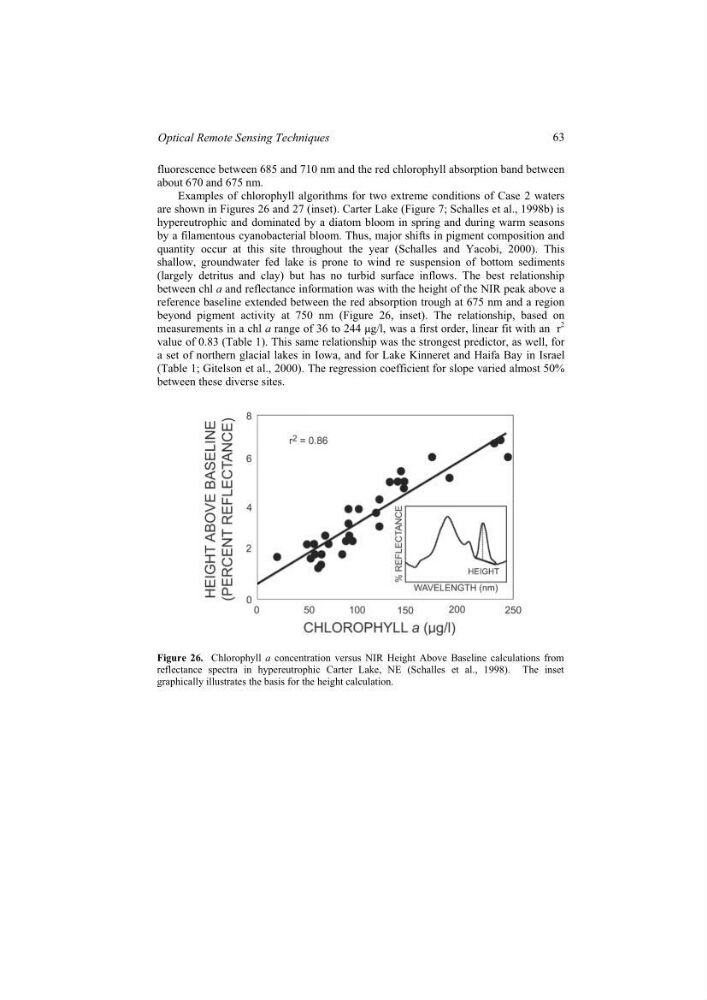
Examples of chlorophyll algorithms for two extreme conditions of Case 2 waters
are shown in Figures 26 and 27 (inset). Carter Lake (Figure 7; Schalles et al., 1998b) is
hypereutrophic and dominated by a diatom bloom in spring and during warm seasons
by a filamentous cyanobacterial bloom. Thus, major shifts in pigment composition and
quantity occur at this site throughout the year (Schalles and Yacobi, 2000). This
shallow, groundwater fed lake is prone to wind re suspension of bottom sediments
(largely detritus and clay) but has no turbid surface inflows. The best relationship
between chl a and reflectance information was with the height of the NIR peak above a
reference baseline extended between the red absorption trough at 675 nm and a region
beyond pigment activity at 750 nm (Figure 26, inset). The relationship, based on
measurements in a chl a range of 36 to 244 µg/l, was a first order, linear fit with an r
2
value of 0.83 (Table 1). This same relationship was the strongest predictor, as well, for
a set of northern glacial lakes in Iowa, and for Lake Kinneret and Haifa Bay in Israel
(Table 1; Gitelson et al., 2000). The regression coefficient for slope varied almost 50%
between these diverse sites.
Figure 26. Chlorophyll a concentration versus NIR Height Above Baseline calculations from
reflectance spectra in hypereutrophic Carter Lake, NE (Schalles et al., 1998). The inset
graphically illustrates the basis for the height calculation.
63
Optical Remote Sensing Techniques
about 670 and 675 nm.
Examples of chlorophyll algorithms for two extreme conditions of Case 2 waters
are shown in Figures 26 and 27 (inset). Carter Lake (Figure 7; Schalles et al., 1998b) is
hypereutrophic and dominated by a diatom bloom in spring and during warm seasons
by a filamentous cyanobacterial bloom. Thus, major shifts in pigment composition and
quantity occur at this site throughout the year (Schalles and Yacobi, 2000). This
shallow, groundwater fed lake is prone to wind re suspension of bottom sediments
(largely detritus and clay) but has no turbid surface inflows. The best relationship
between chl a and reflectance information was with the height of the NIR peak above a
reference baseline extended between the red absorption trough at 675 nm and a region
beyond pigment activity at 750 nm (Figure 26, inset). The relationship, based on
measurements in a chl a range of 36 to 244 µg/l, was a first order, linear fit with an r
2
value of 0.83 (Table 1). This same relationship was the strongest predictor, as well, for
a set of northern glacial lakes in Iowa, and for Lake Kinneret and Haifa Bay in Israel
(Table 1; Gitelson et al., 2000). The regression coefficient for slope varied almost 50%
between these diverse sites.
Figure 26. Chlorophyll a concentration versus NIR Height Above Baseline calculations from
reflectance spectra in hypereutrophic Carter Lake, NE (Schalles et al., 1998). The inset
graphically illustrates the basis for the height calculation.
63
Optical Remote Sensing Techniques