

peak reflectance between 530 and 570 nm was present. Blue reflectance was sharply
reduced compared to the offshore station. Reflectance was detectable to about 725 nm.
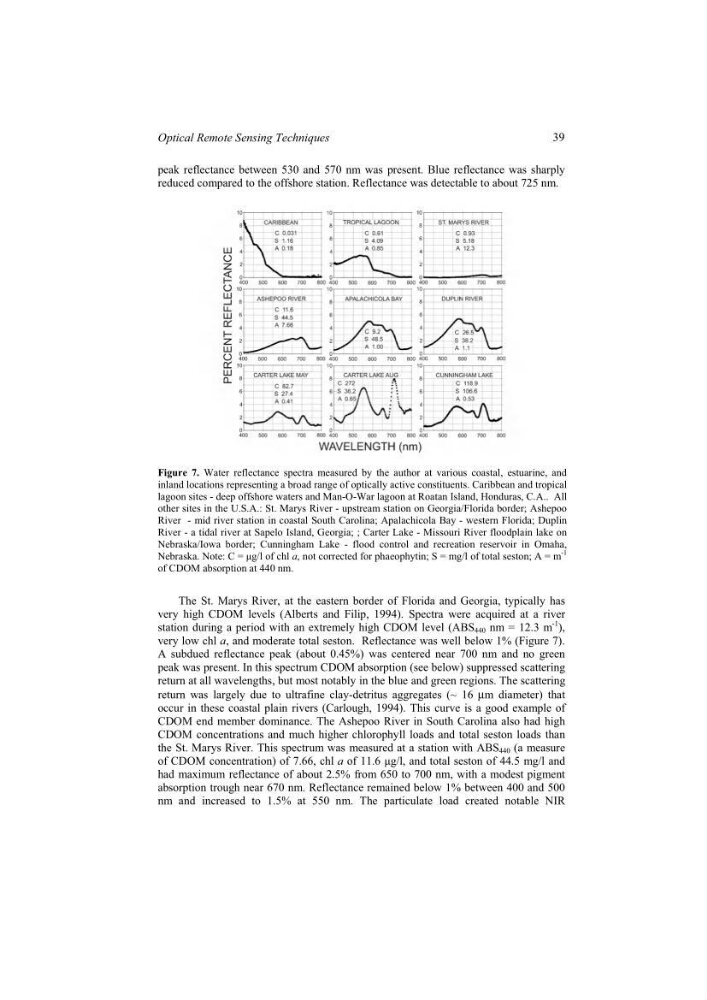
Figure 7. Water reflectance spectra measured by the author at various coastal, estuarine, and
inland locations representing a broad range of optically active constituents. Caribbean and tropical
lagoon sites - deep offshore waters and Man-O-War lagoon at Roatan Island, Honduras, C.A.. All
other sites in the U.S.A.: St. Marys River - upstream station on Georgia/Florida border; Ashepoo
River - mid river station in coastal South Carolina; Apalachicola Bay - western Florida; Duplin
River - a tidal river at Sapelo Island, Georgia; ; Carter Lake - Missouri River floodplain lake on
Nebraska/Iowa border; Cunningham Lake - flood control and recreation reservoir in Omaha,
Nebraska. Note: C = µg/l of chl a, not corrected for phaeophytin; S = mg/l of total seston; A = m
-1
of CDOM absorption at 440 nm.
The St. Marys River, at the eastern border of Florida and Georgia, typically has
very high CDOM levels (Alberts and Filip, 1994). Spectra were acquired at a river
station during a period with an extremely high CDOM level (ABS 440 nm = 12.3 m
-1 ),
very low chl a, and moderate total seston. Reflectance was well below 1% (Figure 7).
A subdued reflectance peak (about 0.45%) was centered near 700 nm and no green
peak was present. In this spectrum CDOM absorption (see below) suppressed scattering
return at all wavelengths, but most notably in the blue and green regions. The scattering
return was largely due to ultrafine clay-detritus aggregates (~ 16 µm diameter) that
occur in these coastal plain rivers (Carlough, 1994). This curve is a good example of
CDOM end member dominance. The Ashepoo River in South Carolina also had high
CDOM concentrations and much higher chlorophyll loads and total seston loads than
the St. Marys River. This spectrum was measured at a station with ABS 440 (a measure
of CDOM concentration) of 7.66, chl a of 11.6 µg/l, and total seston of 44.5 mg/l and
had maximum reflectance of about 2.5% from 650 to 700 nm, with a modest pigment
absorption trough near 670 nm. Reflectance remained below 1% between 400 and 500
nm and increased to 1.5% at 550 nm. The particulate load created notable NIR
39
Optical Remote Sensing Techniques
reduced compared to the offshore station. Reflectance was detectable to about 725 nm.
Figure 7. Water reflectance spectra measured by the author at various coastal, estuarine, and
inland locations representing a broad range of optically active constituents. Caribbean and tropical
lagoon sites - deep offshore waters and Man-O-War lagoon at Roatan Island, Honduras, C.A.. All
other sites in the U.S.A.: St. Marys River - upstream station on Georgia/Florida border; Ashepoo
River - mid river station in coastal South Carolina; Apalachicola Bay - western Florida; Duplin
River - a tidal river at Sapelo Island, Georgia; ; Carter Lake - Missouri River floodplain lake on
Nebraska/Iowa border; Cunningham Lake - flood control and recreation reservoir in Omaha,
Nebraska. Note: C = µg/l of chl a, not corrected for phaeophytin; S = mg/l of total seston; A = m
-1
of CDOM absorption at 440 nm.
The St. Marys River, at the eastern border of Florida and Georgia, typically has
very high CDOM levels (Alberts and Filip, 1994). Spectra were acquired at a river
station during a period with an extremely high CDOM level (ABS 440 nm = 12.3 m
-1 ),
very low chl a, and moderate total seston. Reflectance was well below 1% (Figure 7).
A subdued reflectance peak (about 0.45%) was centered near 700 nm and no green
peak was present. In this spectrum CDOM absorption (see below) suppressed scattering
return at all wavelengths, but most notably in the blue and green regions. The scattering
return was largely due to ultrafine clay-detritus aggregates (~ 16 µm diameter) that
occur in these coastal plain rivers (Carlough, 1994). This curve is a good example of
CDOM end member dominance. The Ashepoo River in South Carolina also had high
CDOM concentrations and much higher chlorophyll loads and total seston loads than
the St. Marys River. This spectrum was measured at a station with ABS 440 (a measure
of CDOM concentration) of 7.66, chl a of 11.6 µg/l, and total seston of 44.5 mg/l and
had maximum reflectance of about 2.5% from 650 to 700 nm, with a modest pigment
absorption trough near 670 nm. Reflectance remained below 1% between 400 and 500
nm and increased to 1.5% at 550 nm. The particulate load created notable NIR
39
Optical Remote Sensing Techniques