

pigment fractions. These techniques provide both direct estimation of pigment in
samples and calibration information for in situ measures.
In situ chl a is currently assessed using fluorometry (submersible or shipboard
probes or airborne LIDAR systems; see Yoder et al., 1992), wavelength specific path
attenuation in transmissometers (Morrow et al., 2000), and measurement of water
column reflectance from close range, airborne (Kallio et al., 2003), or satellite sensors
(Brando and Dekker, 2003). When data are collected from high altitude aircraft and
satellite sensors, the signal from water column reflectance is usually far lower in
magnitude than the atmospheric scatter. Removal of this “atmospheric effect” through
correction techniques is very important for standardizing data and normalization to
reflectance (Bukata et al., 1995; Gordon, 1997; Brando and Dekker, 2003).
Antoine et al. (1996) used CZCS satellite data to estimate an average chl a value of
0.19 µg/l for the world’s oceans. These workers further calculated that 55.8% of the
world’s oceans (between 50
o S to 50
o N) averaged less than 0.1 µg/l chl a, 41.8% were
between 0.1 and 1 µg/l, and only 2.4% exceeded 1 µg/l, levels which they classified as
oligotrophic, mesotrophic, and eutrophic, respectively. In the low phytoplankton
densities of the open oceans, productivity is comparably low. On average, the quantum
yield in the oceans is about one third that of terrestrial ecosystems, with only one CO 2
molecule fixed per 1500 incident photons (Falkowski and Raven, 1997).
Most coastal waters exceed the 0.19 µg/l chl a average, with more productive
upwelling and offshore river plume areas commonly reaching the 1-10 range and an
additional order of magnitude greater in highly eutrophic and higher latitude sites.
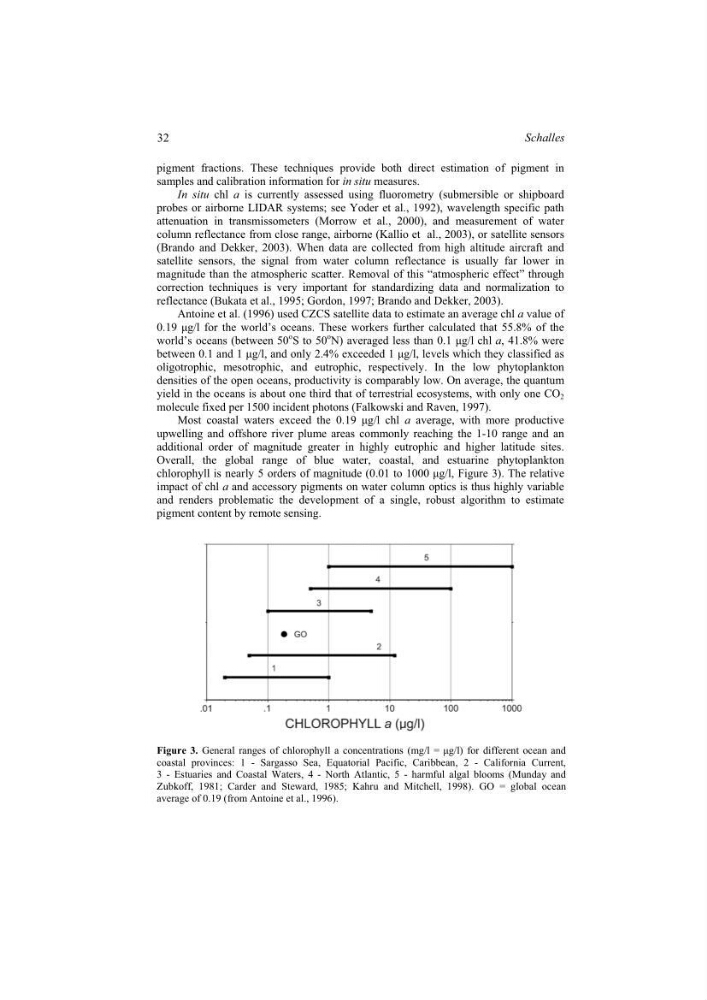
Overall, the global range of blue water, coastal, and estuarine phytoplankton
chlorophyll is nearly 5 orders of magnitude (0.01 to 1000 µg/l, Figure 3). The relative
impact of chl a and accessory pigments on water column optics is thus highly variable
and renders problematic the development of a single, robust algorithm to estimate
pigment content by remote sensing.
Figure 3. General ranges of chlorophyll a concentrations (mg/l = µg/l) for different ocean and
coastal provinces: 1 - Sargasso Sea, Equatorial Pacific, Caribbean, 2 - California Current,
3 - Estuaries and Coastal Waters, 4 - North Atlantic, 5 - harmful algal blooms (Munday and
Zubkoff, 1981; Carder and Steward, 1985; Kahru and Mitchell, 1998). GO = global ocean
average of 0.19 (from Antoine et al., 1996).
32
Schalles
samples and calibration information for in situ measures.
In situ chl a is currently assessed using fluorometry (submersible or shipboard
probes or airborne LIDAR systems; see Yoder et al., 1992), wavelength specific path
attenuation in transmissometers (Morrow et al., 2000), and measurement of water
column reflectance from close range, airborne (Kallio et al., 2003), or satellite sensors
(Brando and Dekker, 2003). When data are collected from high altitude aircraft and
satellite sensors, the signal from water column reflectance is usually far lower in
magnitude than the atmospheric scatter. Removal of this “atmospheric effect” through
correction techniques is very important for standardizing data and normalization to
reflectance (Bukata et al., 1995; Gordon, 1997; Brando and Dekker, 2003).
Antoine et al. (1996) used CZCS satellite data to estimate an average chl a value of
0.19 µg/l for the world’s oceans. These workers further calculated that 55.8% of the
world’s oceans (between 50
o S to 50
o N) averaged less than 0.1 µg/l chl a, 41.8% were
between 0.1 and 1 µg/l, and only 2.4% exceeded 1 µg/l, levels which they classified as
oligotrophic, mesotrophic, and eutrophic, respectively. In the low phytoplankton
densities of the open oceans, productivity is comparably low. On average, the quantum
yield in the oceans is about one third that of terrestrial ecosystems, with only one CO 2
molecule fixed per 1500 incident photons (Falkowski and Raven, 1997).
Most coastal waters exceed the 0.19 µg/l chl a average, with more productive
upwelling and offshore river plume areas commonly reaching the 1-10 range and an
additional order of magnitude greater in highly eutrophic and higher latitude sites.
Overall, the global range of blue water, coastal, and estuarine phytoplankton
chlorophyll is nearly 5 orders of magnitude (0.01 to 1000 µg/l, Figure 3). The relative
impact of chl a and accessory pigments on water column optics is thus highly variable
and renders problematic the development of a single, robust algorithm to estimate
pigment content by remote sensing.
Figure 3. General ranges of chlorophyll a concentrations (mg/l = µg/l) for different ocean and
coastal provinces: 1 - Sargasso Sea, Equatorial Pacific, Caribbean, 2 - California Current,
3 - Estuaries and Coastal Waters, 4 - North Atlantic, 5 - harmful algal blooms (Munday and
Zubkoff, 1981; Carder and Steward, 1985; Kahru and Mitchell, 1998). GO = global ocean
average of 0.19 (from Antoine et al., 1996).
32
Schalles