

1998). Color has also been used as a comparison measure between three coral
species, five algal species, and three benthic (on sand) communities (Hochberg
and Atkinson, 2000) and as a means of differentiating between dead coral in various
stages of algae colonization (Clark et al., 2000). Fluorescence, a color that results
when light is absorbed in one wavelength and emitted at a longer wavelength, has
also been found to contribute to the reflectance received at a sensor. Five pigments
have been found to fluoresce in Caribbean reef corals (Mazel, 1997). Remote detection
of these pigments, using activation of florescence, has been used for inter-species
differentiation and detection of bleached colonies (Hardy et al., 1992). Second,
signatures are examined as a function of morphological characteristics. Reflectance
values measured over varying angles and azimuths were examined to determine the bidirectional reflectance distribution function of coral species and their inter-species
variation between rounded and branching types (Joyce and Phinn, 2002).
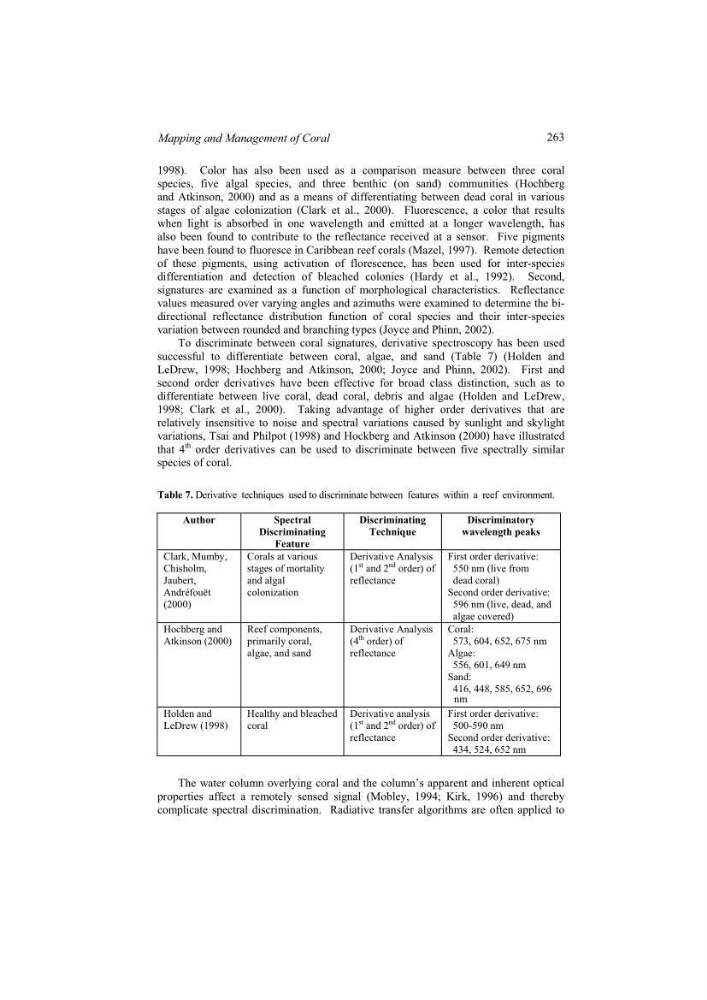
To discriminate between coral signatures, derivative spectroscopy has been used
successful to differentiate between coral, algae, and sand (Table 7) (Holden and
LeDrew, 1998; Hochberg and Atkinson, 2000; Joyce and Phinn, 2002). First and
second order derivatives have been effective for broad class distinction, such as to
differentiate between live coral, dead coral, debris and algae (Holden and LeDrew,
1998; Clark et al., 2000). Taking advantage of higher order derivatives that are
relatively insensitive to noise and spectral variations caused by sunlight and skylight
variations, Tsai and Philpot (1998) and Hockberg and Atkinson (2000) have illustrated
that 4
th order derivatives can be used to discriminate between five spectrally similar
species of coral.
Table 7. Derivative techniques used to discriminate between features within a reef environment.
Author
Spectral
Discriminating
Feature
Discriminating
Technique
Discriminatory
wavelength peaks
Clark, Mumby,
Chisholm,
Jaubert,
Andréfouët
(2000)
Corals at various
stages of mortality
and algal
colonization
Derivative Analysis
(1
st and 2
nd order) of
reflectance
First order derivative:
550 nm (live from
dead coral)
Second order derivative:
596 nm (live, dead, and
algae covered)
Hochberg and
Atkinson (2000)
Reef components,
primarily coral,
algae, and sand
Derivative Analysis
(4
th order) of
reflectance
Coral:
573, 604, 652, 675 nm
Algae:
556, 601, 649 nm
Sand:
416, 448, 585, 652, 696
nm
Holden and
LeDrew (1998)
Healthy and bleached
coral
Derivative analysis
(1
st and 2
nd order) of
reflectance
First order derivative:
500-590 nm
Second order derivative:
434, 524, 652 nm
The water column overlying coral and the column’s apparent and inherent optical
properties affect a remotely sensed signal (Mobley, 1994; Kirk, 1996) and thereby
complicate spectral discrimination. Radiative transfer algorithms are often applied to
263
Mapping and Management of Coral
species, five algal species, and three benthic (on sand) communities (Hochberg
and Atkinson, 2000) and as a means of differentiating between dead coral in various
stages of algae colonization (Clark et al., 2000). Fluorescence, a color that results
when light is absorbed in one wavelength and emitted at a longer wavelength, has
also been found to contribute to the reflectance received at a sensor. Five pigments
have been found to fluoresce in Caribbean reef corals (Mazel, 1997). Remote detection
of these pigments, using activation of florescence, has been used for inter-species
differentiation and detection of bleached colonies (Hardy et al., 1992). Second,
signatures are examined as a function of morphological characteristics. Reflectance
values measured over varying angles and azimuths were examined to determine the bidirectional reflectance distribution function of coral species and their inter-species
variation between rounded and branching types (Joyce and Phinn, 2002).
To discriminate between coral signatures, derivative spectroscopy has been used
successful to differentiate between coral, algae, and sand (Table 7) (Holden and
LeDrew, 1998; Hochberg and Atkinson, 2000; Joyce and Phinn, 2002). First and
second order derivatives have been effective for broad class distinction, such as to
differentiate between live coral, dead coral, debris and algae (Holden and LeDrew,
1998; Clark et al., 2000). Taking advantage of higher order derivatives that are
relatively insensitive to noise and spectral variations caused by sunlight and skylight
variations, Tsai and Philpot (1998) and Hockberg and Atkinson (2000) have illustrated
that 4
th order derivatives can be used to discriminate between five spectrally similar
species of coral.
Table 7. Derivative techniques used to discriminate between features within a reef environment.
Author
Spectral
Discriminating
Feature
Discriminating
Technique
Discriminatory
wavelength peaks
Clark, Mumby,
Chisholm,
Jaubert,
Andréfouët
(2000)
Corals at various
stages of mortality
and algal
colonization
Derivative Analysis
(1
st and 2
nd order) of
reflectance
First order derivative:
550 nm (live from
dead coral)
Second order derivative:
596 nm (live, dead, and
algae covered)
Hochberg and
Atkinson (2000)
Reef components,
primarily coral,
algae, and sand
Derivative Analysis
(4
th order) of
reflectance
Coral:
573, 604, 652, 675 nm
Algae:
556, 601, 649 nm
Sand:
416, 448, 585, 652, 696
nm
Holden and
LeDrew (1998)
Healthy and bleached
coral
Derivative analysis
(1
st and 2
nd order) of
reflectance
First order derivative:
500-590 nm
Second order derivative:
434, 524, 652 nm
The water column overlying coral and the column’s apparent and inherent optical
properties affect a remotely sensed signal (Mobley, 1994; Kirk, 1996) and thereby
complicate spectral discrimination. Radiative transfer algorithms are often applied to
263
Mapping and Management of Coral