

Areas as a management model. Next, we explore the technology of remote sensing,
where we highlight the differences between aerial and digital imagery, the past and
present coastal sensors, and the advancements in mapping coral reef environments. We
wish to equip the reader with an understanding of the complexity of mapping coral
reefs and to acquaint the reader with the limitations that hinder high levels of mapping
accuracy and precision. Following these explanations, we examine the place for
‘communication’ when remote sensing is applied to coral reef management. From our
experiences in Fiji, we identify ‘lessons learned’ and examine the importance of
incorporating local knowledge, when the goal is to utilize remote sensing effectively
and appropriately in local management strategies. We advocate ‘designing with culture’
to enhance the utilization of remote sensing in many developing countries that are
inexperienced with the remote sensing process, unfamiliar with interpreting remotely
sensed information from imagery, and uncertain about how remote sensing can
contribute to local management strategies.
2. Effective Management as a Response to the Coral Reef ‘Crisis’
There is general agreement amongst scientists that the majority of reefs around the
world are, with increasing frequency and magnitude, being negatively impacted by
human and natural events (Kleypas et al. 2001). As a result, reefs are degrading at a
rate faster than their rebounding and recruitment potential (Souter and Linden, 2000;
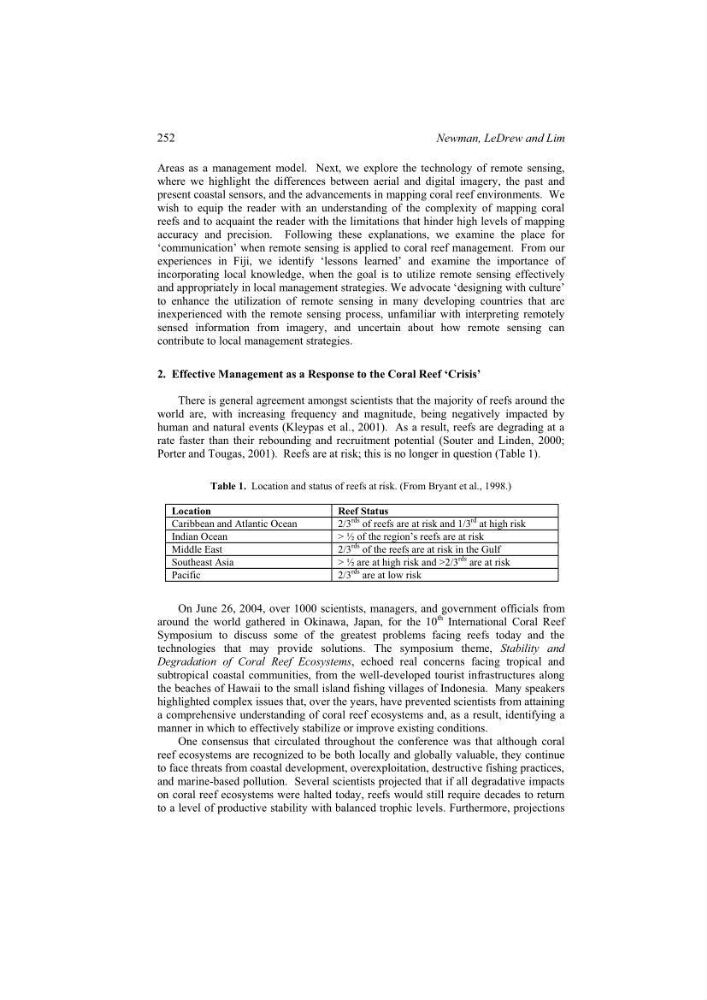
Porter and Tougas, 2001). Reefs are at risk; this is no longer in question (Table 1).
Table 1. Location and status of reefs at risk. (From Bryant et al., 1998.)
Location
Reef Status
Caribbean and Atlantic Ocean
2/3
rds of reefs are at risk and 1/3
rd at high risk
Indian Ocean
> ½ of the region’s reefs are at risk
Middle East
2/3
rds of the reefs are at risk in the Gulf
Southeast Asia
> ½ are at high risk and >2/3
rds are at risk
Pacific
2/3
rds are at low risk
On June 26, 2004, over 1000 scientists, managers, and government officials from
around the world gathered in Okinawa, Japan, for the 10
th International Coral Reef
Symposium to discuss some of the greatest problems facing reefs today and the
technologies that may provide solutions. The symposium theme, Stability and
Degradation of Coral Reef Ecosystems, echoed real concerns facing tropical and
subtropical coastal communities, from the well-developed tourist infrastructures along
the beaches of Hawaii to the small island fishing villages of Indonesia. Many speakers
highlighted complex issues that, over the years, have prevented scientists from attaining
a comprehensive understanding of coral reef ecosystems and, as a result, identifying a
manner in which to effectively stabilize or improve existing conditions.
One consensus that circulated throughout the conference was that although coral
reef ecosystems are recognized to be both locally and globally valuable, they continue
to face threats from coastal development, overexploitation, destructive fishing practices,
and marine-based pollution. Several scientists projected that if all degradative impacts
on coral reef ecosystems were halted today, reefs would still require decades to return
to a level of productive stability with balanced trophic levels. Furthermore, projections
,
252
Newman, LeDrew and Lim
where we highlight the differences between aerial and digital imagery, the past and
present coastal sensors, and the advancements in mapping coral reef environments. We
wish to equip the reader with an understanding of the complexity of mapping coral
reefs and to acquaint the reader with the limitations that hinder high levels of mapping
accuracy and precision. Following these explanations, we examine the place for
‘communication’ when remote sensing is applied to coral reef management. From our
experiences in Fiji, we identify ‘lessons learned’ and examine the importance of
incorporating local knowledge, when the goal is to utilize remote sensing effectively
and appropriately in local management strategies. We advocate ‘designing with culture’
to enhance the utilization of remote sensing in many developing countries that are
inexperienced with the remote sensing process, unfamiliar with interpreting remotely
sensed information from imagery, and uncertain about how remote sensing can
contribute to local management strategies.
2. Effective Management as a Response to the Coral Reef ‘Crisis’
There is general agreement amongst scientists that the majority of reefs around the
world are, with increasing frequency and magnitude, being negatively impacted by
human and natural events (Kleypas et al. 2001). As a result, reefs are degrading at a
rate faster than their rebounding and recruitment potential (Souter and Linden, 2000;
Porter and Tougas, 2001). Reefs are at risk; this is no longer in question (Table 1).
Table 1. Location and status of reefs at risk. (From Bryant et al., 1998.)
Location
Reef Status
Caribbean and Atlantic Ocean
2/3
rds of reefs are at risk and 1/3
rd at high risk
Indian Ocean
> ½ of the region’s reefs are at risk
Middle East
2/3
rds of the reefs are at risk in the Gulf
Southeast Asia
> ½ are at high risk and >2/3
rds are at risk
Pacific
2/3
rds are at low risk
On June 26, 2004, over 1000 scientists, managers, and government officials from
around the world gathered in Okinawa, Japan, for the 10
th International Coral Reef
Symposium to discuss some of the greatest problems facing reefs today and the
technologies that may provide solutions. The symposium theme, Stability and
Degradation of Coral Reef Ecosystems, echoed real concerns facing tropical and
subtropical coastal communities, from the well-developed tourist infrastructures along
the beaches of Hawaii to the small island fishing villages of Indonesia. Many speakers
highlighted complex issues that, over the years, have prevented scientists from attaining
a comprehensive understanding of coral reef ecosystems and, as a result, identifying a
manner in which to effectively stabilize or improve existing conditions.
One consensus that circulated throughout the conference was that although coral
reef ecosystems are recognized to be both locally and globally valuable, they continue
to face threats from coastal development, overexploitation, destructive fishing practices,
and marine-based pollution. Several scientists projected that if all degradative impacts
on coral reef ecosystems were halted today, reefs would still require decades to return
to a level of productive stability with balanced trophic levels. Furthermore, projections
,
252
Newman, LeDrew and Lim