

Subjective Data Ranges:
Subjective Periods of the Day:
Abbreviation
ul
dl
vl
lo
sl
aw
Descriptor
unbelievable low
drastically low
very low
low
somewhat low
average
Abbreviation
sh
hi
vh
dh
uh
Descriptor
somewhat high
high
very high
drastically high
unbelievably high
Abbreviation
(Basic Periods)
midn
pdaw
dawn
morn
midd
psun
suns
even
(Larger Groupings)
all
dayl
nite
dayb
aftn
Period
midnight
pre-dawn
dawn
morning
mid-day
pre-sunset
sunset
evening
all-day
daylight-hours
night-hours
dawn-morning
afternoon
2200 - 2200
0400 - 1900
1900 - 0400
0400 - 1000
1300 - 1900
Local Time
2200 - 0100
0100 - 0400
0400 - 0700
0700 - 1000
1300 - 1600
1600 - 1900
1900 - 2200
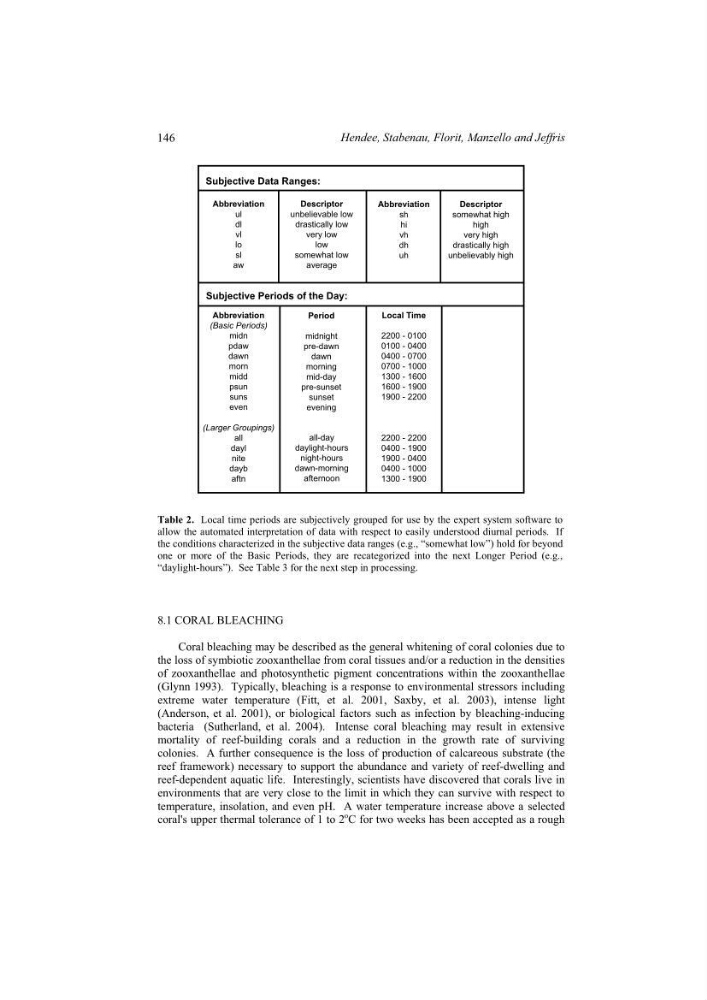
Table 2. Local time periods are subjectively grouped for use by the expert system software to
allow the automated interpretation of data with respect to easily understood diurnal periods. If
the conditions characterized in the subjective data ranges (e.g., “somewhat low”) hold for beyond
one or more of the Basic Periods, they are recategorized into the next Longer Period (e.g.,
“daylight-hours”). See Table 3 for the next step in processing.
8.1 CORAL BLEACHING
Coral bleaching may be described as the general whitening of coral colonies due to
the loss of symbiotic zooxanthellae from coral tissues and/or a reduction in the densities
of zooxanthellae and photosynthetic pigment concentrations within the zooxanthellae
(Glynn 1993). Typically, bleaching is a response to environmental stressors including
extreme water temperature (Fitt, et al. 2001, Saxby, et al. 2003), intense light
(Anderson, et al. 2001), or biological factors such as infection by bleaching-inducing
bacteria (Sutherland, et al. 2004). Intense coral bleaching may result in extensive
mortality of reef-building corals and a reduction in the growth rate of surviving
colonies. A further consequence is the loss of production of calcareous substrate (the
reef framework) necessary to support the abundance and variety of reef-dwelling and
reef-dependent aquatic life. Interestingly, scientists have discovered that corals live in
environments that are very close to the limit in which they can survive with respect to
temperature, insolation, and even pH. A water temperature increase above a selected
coral's upper thermal tolerance of 1 to 2
o C for two weeks has been accepted as a rough
146
Hendee, Stabenau, Florit, Manzello and Jeffris
Subjective Periods of the Day:
Abbreviation
ul
dl
vl
lo
sl
aw
Descriptor
unbelievable low
drastically low
very low
low
somewhat low
average
Abbreviation
sh
hi
vh
dh
uh
Descriptor
somewhat high
high
very high
drastically high
unbelievably high
Abbreviation
(Basic Periods)
midn
pdaw
dawn
morn
midd
psun
suns
even
(Larger Groupings)
all
dayl
nite
dayb
aftn
Period
midnight
pre-dawn
dawn
morning
mid-day
pre-sunset
sunset
evening
all-day
daylight-hours
night-hours
dawn-morning
afternoon
2200 - 2200
0400 - 1900
1900 - 0400
0400 - 1000
1300 - 1900
Local Time
2200 - 0100
0100 - 0400
0400 - 0700
0700 - 1000
1300 - 1600
1600 - 1900
1900 - 2200
Table 2. Local time periods are subjectively grouped for use by the expert system software to
allow the automated interpretation of data with respect to easily understood diurnal periods. If
the conditions characterized in the subjective data ranges (e.g., “somewhat low”) hold for beyond
one or more of the Basic Periods, they are recategorized into the next Longer Period (e.g.,
“daylight-hours”). See Table 3 for the next step in processing.
8.1 CORAL BLEACHING
Coral bleaching may be described as the general whitening of coral colonies due to
the loss of symbiotic zooxanthellae from coral tissues and/or a reduction in the densities
of zooxanthellae and photosynthetic pigment concentrations within the zooxanthellae
(Glynn 1993). Typically, bleaching is a response to environmental stressors including
extreme water temperature (Fitt, et al. 2001, Saxby, et al. 2003), intense light
(Anderson, et al. 2001), or biological factors such as infection by bleaching-inducing
bacteria (Sutherland, et al. 2004). Intense coral bleaching may result in extensive
mortality of reef-building corals and a reduction in the growth rate of surviving
colonies. A further consequence is the loss of production of calcareous substrate (the
reef framework) necessary to support the abundance and variety of reef-dwelling and
reef-dependent aquatic life. Interestingly, scientists have discovered that corals live in
environments that are very close to the limit in which they can survive with respect to
temperature, insolation, and even pH. A water temperature increase above a selected
coral's upper thermal tolerance of 1 to 2
o C for two weeks has been accepted as a rough
146
Hendee, Stabenau, Florit, Manzello and Jeffris