

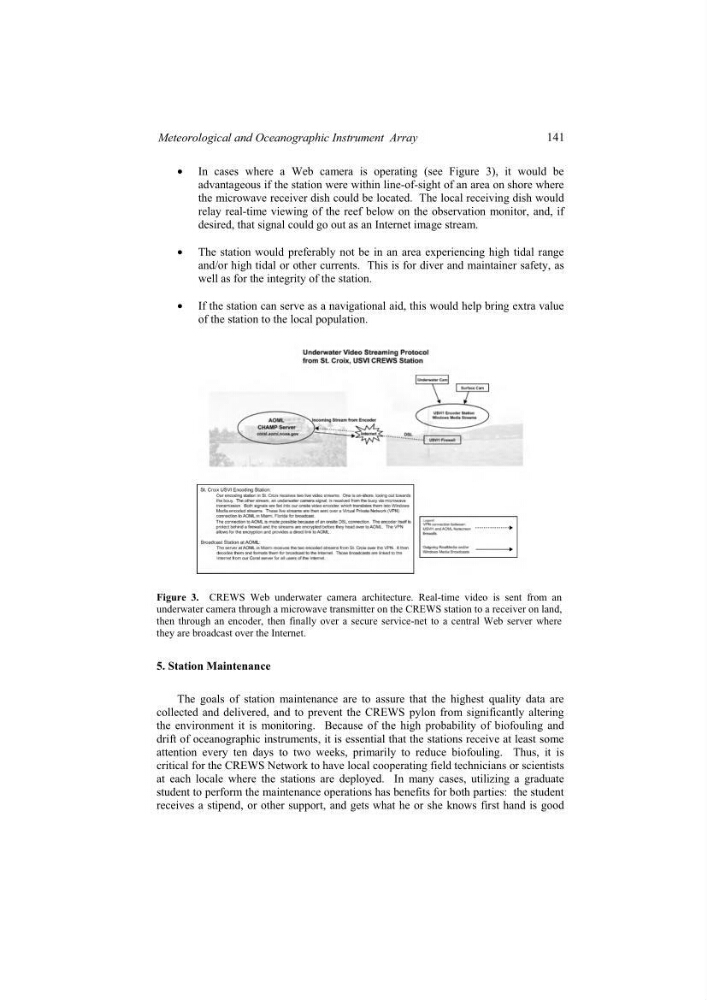
• In cases where a Web camera is operating (see Figure 3), it would be
advantageous if the station were within line-of-sight of an area on shore where
the microwave receiver dish could be located. The local receiving dish would
relay real-time viewing of the reef below on the observation monitor, and, if
desired, that signal could go out as an Internet image stream.
• The station would preferably not be in an area experiencing high tidal range
and/or high tidal or other currents. This is for diver and maintainer safety, as
well as for the integrity of the station.
• If the station can serve as a navigational aid, this would help bring extra value
of the station to the local population.
Figure 3. CREWS Web underwater camera architecture. Real-time video is sent from an
underwater camera through a microwave transmitter on the CREWS station to a receiver on land,
then through an encoder, then finally over a secure service-net to a central Web server where
they are broadcast over the Internet.
5. Station Maintenance
The goals of station maintenance are to assure that the highest quality data are
collected and delivered, and to prevent the CREWS pylon from significantly altering
the environment it is monitoring. Because of the high probability of biofouling and
drift of oceanographic instruments, it is essential that the stations receive at least some
attention every ten days to two weeks, primarily to reduce biofouling. Thus, it is
critical for the CREWS Network to have local cooperating field technicians or scientists
at each locale where the stations are deployed. In many cases, utilizing a graduate
student to perform the maintenance operations has benefits for both parties: the student
receives a stipend, or other support, and gets what he or she knows first hand is good
141
Meteorological and Oceanographic Instrument Array
advantageous if the station were within line-of-sight of an area on shore where
the microwave receiver dish could be located. The local receiving dish would
relay real-time viewing of the reef below on the observation monitor, and, if
desired, that signal could go out as an Internet image stream.
• The station would preferably not be in an area experiencing high tidal range
and/or high tidal or other currents. This is for diver and maintainer safety, as
well as for the integrity of the station.
• If the station can serve as a navigational aid, this would help bring extra value
of the station to the local population.
Figure 3. CREWS Web underwater camera architecture. Real-time video is sent from an
underwater camera through a microwave transmitter on the CREWS station to a receiver on land,
then through an encoder, then finally over a secure service-net to a central Web server where
they are broadcast over the Internet.
5. Station Maintenance
The goals of station maintenance are to assure that the highest quality data are
collected and delivered, and to prevent the CREWS pylon from significantly altering
the environment it is monitoring. Because of the high probability of biofouling and
drift of oceanographic instruments, it is essential that the stations receive at least some
attention every ten days to two weeks, primarily to reduce biofouling. Thus, it is
critical for the CREWS Network to have local cooperating field technicians or scientists
at each locale where the stations are deployed. In many cases, utilizing a graduate
student to perform the maintenance operations has benefits for both parties: the student
receives a stipend, or other support, and gets what he or she knows first hand is good
141
Meteorological and Oceanographic Instrument Array