

not reviewed in a timely fashion; hence, features of interest may be missed by scientists
or MPA managers. We describe below the way in which we have addressed such
problems for one particular network. Included is a summary of our current effort to
make use of the data collection capabilities of our system to provide a new capability
for understanding coral health from afar.
3. The CREWS Network
The Coral Reef Early Warning System (CREWS) network is being developed
through the Coral Reef Conservation Program (CRCP) of the National Oceanic and
Atmospheric Administration (NOAA) in response to a U.S. Coral Reef Task Force
(established through Executive Order 13089) recommendation to install a network of
meteorological and oceanographic monitoring stations at all major U.S. coral reef areas
(e.g., the Florida Keys, the Bahamas, Hawaii, U.S. Virgin Islands, Puerto Rico,
American Samoa, etc.) by 2010. The stations are being constructed and deployed by
the Atlantic Oceanographic and Meteorological Laboratory (AOML) in Miami, Florida,
and the Coral Reef Ecosystem Division (CRED) in Honolulu, Hawaii. AOML
constructs and installs fixed pylon-type stations, and CRED deploys buoys. Other
stations providing data to the network are the SEAKEYS Network of seven stations in
the Florida Keys (Ogden et al 1994) and the Australian Institute of Marine Science
(AIMS) Weather Station Network (http://www.aims.gov.au).
The basic purpose of the CREWS network is to compile long-term data sets upon
which MPA managers can be aided in their management decisions, and upon which
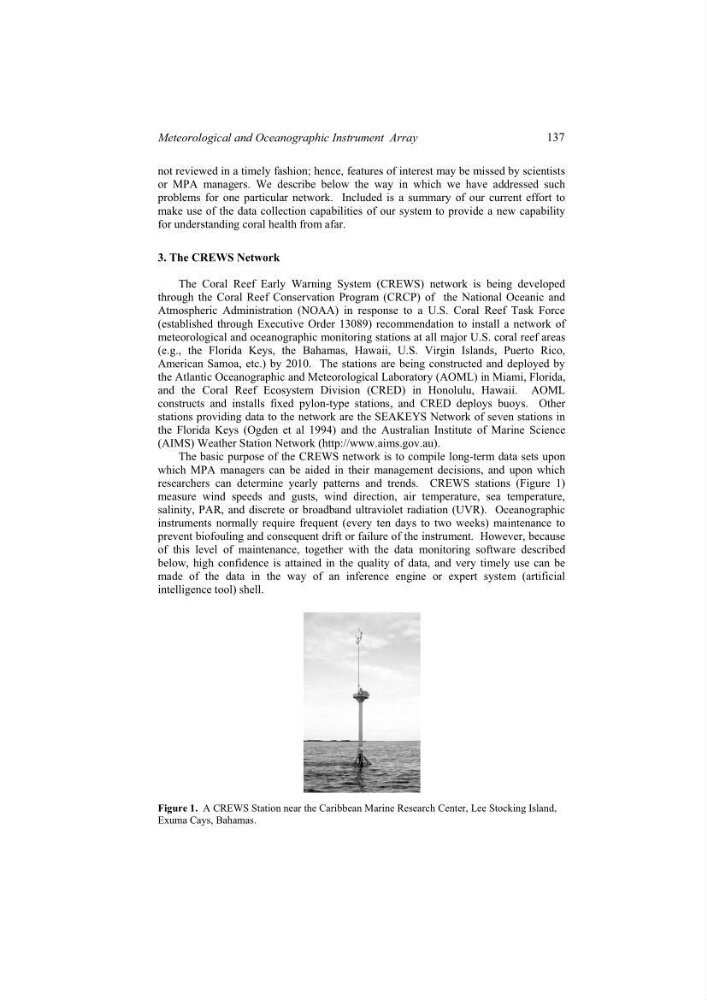
researchers can determine yearly patterns and trends. CREWS stations (Figure 1)
measure wind speeds and gusts, wind direction, air temperature, sea temperature,
salinity, PAR, and discrete or broadband ultraviolet radiation (UVR). Oceanographic
instruments normally require frequent (every ten days to two weeks) maintenance to
prevent biofouling and consequent drift or failure of the instrument. However, because
of this level of maintenance, together with the data monitoring software described
below, high confidence is attained in the quality of data, and very timely use can be
made of the data in the way of an inference engine or expert system (artificial
intelligence tool) shell.
Figure 1. A CREWS Station near the Caribbean Marine Research Center, Lee Stocking Island,
Exuma Cays, Bahamas.
137
Meteorological and Oceanographic Instrument Array
or MPA managers. We describe below the way in which we have addressed such
problems for one particular network. Included is a summary of our current effort to
make use of the data collection capabilities of our system to provide a new capability
for understanding coral health from afar.
3. The CREWS Network
The Coral Reef Early Warning System (CREWS) network is being developed
through the Coral Reef Conservation Program (CRCP) of the National Oceanic and
Atmospheric Administration (NOAA) in response to a U.S. Coral Reef Task Force
(established through Executive Order 13089) recommendation to install a network of
meteorological and oceanographic monitoring stations at all major U.S. coral reef areas
(e.g., the Florida Keys, the Bahamas, Hawaii, U.S. Virgin Islands, Puerto Rico,
American Samoa, etc.) by 2010. The stations are being constructed and deployed by
the Atlantic Oceanographic and Meteorological Laboratory (AOML) in Miami, Florida,
and the Coral Reef Ecosystem Division (CRED) in Honolulu, Hawaii. AOML
constructs and installs fixed pylon-type stations, and CRED deploys buoys. Other
stations providing data to the network are the SEAKEYS Network of seven stations in
the Florida Keys (Ogden et al 1994) and the Australian Institute of Marine Science
(AIMS) Weather Station Network (http://www.aims.gov.au).
The basic purpose of the CREWS network is to compile long-term data sets upon
which MPA managers can be aided in their management decisions, and upon which
researchers can determine yearly patterns and trends. CREWS stations (Figure 1)
measure wind speeds and gusts, wind direction, air temperature, sea temperature,
salinity, PAR, and discrete or broadband ultraviolet radiation (UVR). Oceanographic
instruments normally require frequent (every ten days to two weeks) maintenance to
prevent biofouling and consequent drift or failure of the instrument. However, because
of this level of maintenance, together with the data monitoring software described
below, high confidence is attained in the quality of data, and very timely use can be
made of the data in the way of an inference engine or expert system (artificial
intelligence tool) shell.
Figure 1. A CREWS Station near the Caribbean Marine Research Center, Lee Stocking Island,
Exuma Cays, Bahamas.
137
Meteorological and Oceanographic Instrument Array